

Artificial Intelligence is beginning to deliver what B2B marketing has long promised – efficiency, speed and measurable impact at scale. Campaigns are moving faster with insights arriving sooner. Personalisation operates continuously rather than periodically. Marketing organisations today can execute with a level of productivity that was unimaginable only a few years ago.
Yet beneath this progress lies a quiet paradox. While AI is improving marketing performance, many marketers are experiencing rising expectations rather than rising professional value. Output has increased, but influence has not expanded at the same pace.
This is not a failure of technology. It is a redistribution of value.
The AI Moment in B2B Marketing
AI adoption in B2B marketing has moved decisively beyond experimentation. Automation now supports campaign planning, analytics interpretation, customer segmentation and content workflows across enterprise environments.
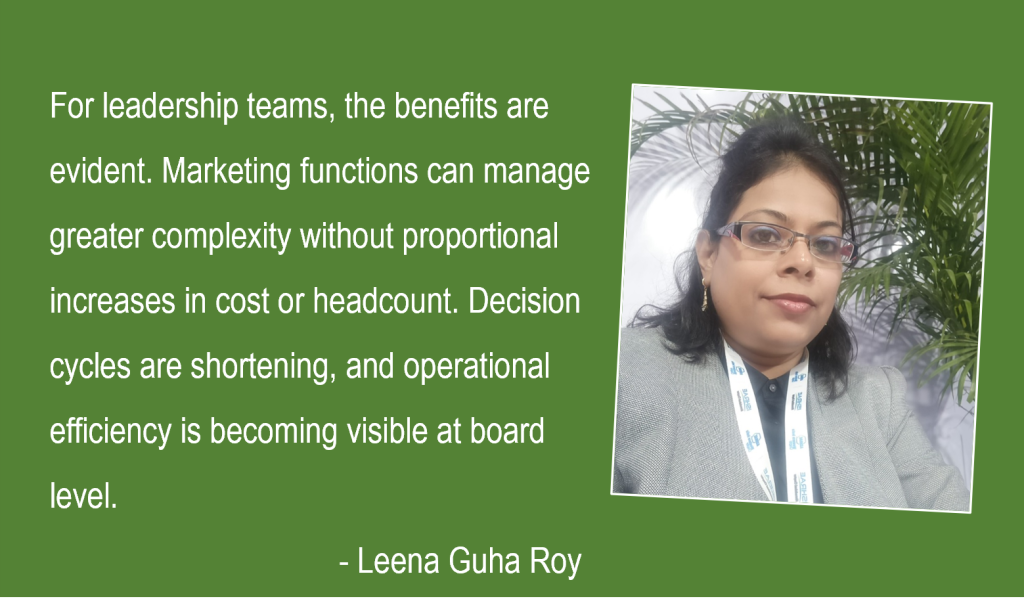
For leadership teams, the benefits are evident. Marketing functions can manage greater complexity without proportional increases in cost or headcount. Decision cycles are shortening, and operational efficiency is becoming visible at board level. AI has effectively become an operational multiplier.
However, operational transformation often advances faster than organisational adaptation. And this imbalance is beginning to reshape how marketing work and how marketers themselves are perceived.
Where the Value Is Actually Flowing
The economic gains from AI adoption are flowing primarily towards organisations and technology ecosystems. Businesses benefit from productivity improvements and reduced execution costs. Platforms gain deeper integration into enterprise decision-making. Performance expectations, meanwhile, continue to rise.
For many professionals, AI does not remove work; it compresses it. Tasks are completed faster, which quietly resets performance benchmarks. What was once considered exceptional delivery quickly becomes standard expectation.
Efficiency becomes absorbed into the system rather than individually rewarded. This pattern is familiar in periods of technological transition, where institutional advantage precedes individual benefit.
The Reputation Risk Nobody Is Discussing
A less visible risk now emerges. When marketing success becomes closely associated with automation and output velocity, the function risks being viewed primarily as an execution engine rather than a strategic partner. Over time, this perception influences organisational reputation as much as individual careers.
Companies that optimise excessively for automation may unintentionally weaken strategic thinking within teams. Innovation rarely emerges from accelerated execution alone. It depends on interpretation, judgment and market understanding.
The danger is subtle but real; organisations may gain efficiency while gradually losing strategic depth.
The Structural Shift: Execution vs Judgment
AI excels at execution like drafting, analysing, optimising and predicting patterns at scale. Human value, therefore, is moving elsewhere.
Marketing’s future relevance increasingly depends on judgment – defining market positioning, shaping narratives, aligning commercial priorities and interpreting complex customer behaviour. AI can inform decisions, but accountability remains human.
As execution becomes automated, judgment becomes the primary differentiator. This is not a temporary adjustment. It is a structural shift in how marketing value is created.
The Emerging Divide: AI Operators vs AI Leaders
A divide is beginning to form within organisations. Some professionals focus on operating AI tools and improving workflows. These capabilities remain important but are rapidly becoming standardised.
Others are learning to translate AI capabilities into business advantage, by connecting insights to revenue growth, customer experience and competitive positioning. The distinction lies not in technical skill, but in strategic ownership.
AI operators improve efficiency while AI leaders influence direction. Over time, this divide will shape influence, career mobility and leadership relevance.
What CXOs Must Recognise
For enterprise leaders, AI adoption cannot remain solely an efficiency initiative. Sustainable advantage depends on evolving talent alongside technology. Marketing leaders must be enabled to move upstream, from campaign delivery towards enterprise decision-making.
Organisations that fail to make this transition risk building highly efficient systems without equally strong strategic leadership. Technology scales execution. Leadership sustains differentiation.
The New Mandate for Marketers
For marketers, the implication is equally clear. Competitive advantage will no longer come from access to AI tools. Those capabilities are rapidly becoming universal. Value will instead come from framing better business problems and translating AI-driven insights into commercial outcomes.
The role of the marketer is evolving from executor to growth architect, operating at the intersection of data, customer understanding and strategy. Those who adapt will see their influence expand.
Closing Thought
Every technological shift changes how value is distributed before it creates new opportunity. AI is already transforming B2B marketing performance. The next phase will determine whether it elevates marketing leadership or confines it to operational efficiency.
The future will belong not to organisations that simply deploy AI, but to those that combine machine intelligence with human judgment. Because ultimately, AI will not redefine marketing leadership. Leadership choices will.
____________________________________________________________________________________________________________
The views and opinions published here belong to the author and do not necessarily reflect the views and opinions of the publisher.

