

Companies rarely explore a Fractional CMO when marketing is absent. They do so when marketing is active, yet outcomes remain inconsistent. Campaigns are running while budgets are allocated. Teams are engaged, yet revenue lacks predictability, and leadership cannot clearly connect effort to impact. The issue is not a lack of activity. It is a lack of coherence.
At this stage, the instinct is to bring in senior expertise without committing to a full-time executive. Sometimes this works. Often, it leads to muted outcomes. The difference lies in organisational readiness.
The Misunderstanding: Fractional Is Not Part-Time Execution
The term ‘fractional’ is often misread as reduced capacity. In reality, it represents concentrated leadership. Many organisations expect a fractional CMO to operate as both strategist and executor—defining direction while also managing campaigns. This expectation limits the role from the outset. A fractional leader is not designed to compensate for execution gaps.
The value lies in decision clarity. The role establishes how priorities are set, how investments are evaluated, and how marketing connects to revenue. Execution remains distributed across teams or partners. Direction becomes centralised.
Without this distinction, the role defaults into advisory without authority.
The Real Problem Companies Are Trying to Solve
Most organisations engaging fractional leadership are not solving for marketing capability. They are solving for fragmentation. Sales operates with immediate targets. Product evolves within its own constraints. Customer experience responds to service demands. Data exists, but often in silos. Marketing sits at the intersection, expected to unify these moving parts without formal ownership.
The result is predictable – activity increases, alignment decreases.
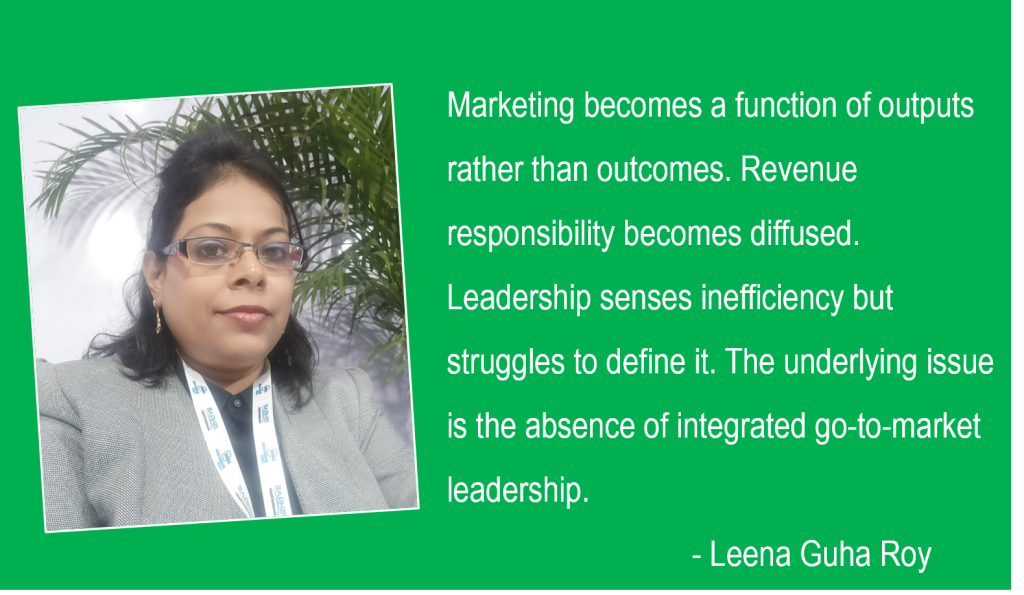
Marketing becomes a function of outputs rather than outcomes. Revenue responsibility becomes diffused. Leadership senses inefficiency but struggles to define it. The underlying issue is the absence of integrated go-to-market leadership.
What a Fractional CMO Actually Does
A fractional CMO introduces a unifying commercial lens.
The role begins by clarifying positioning and aligning it with measurable demand. It establishes how marketing, sales, and customer experience contribute to revenue as a coordinated system. This includes defining success metrics, rationalising channel investments, and creating structured decision-making processes.
The impact extends beyond marketing. It influences pricing logic, pipeline quality, customer segmentation, and long-term brand direction. In data-driven environments, the role also bridges analytics capability with commercial application. The objective is not more activity. It is better orchestration.
The Right Time to Hire One (Organisational Signals)
Timing is driven by complexity, not scale. The need emerges when product-market fit exists, but growth becomes inconsistent. Marketing investments increase without clear visibility into returns. Sales demands better pipelines, while marketing lacks clarity on positioning or priorities.
At this point, marketing decisions begin to influence enterprise outcomes. Founder-led oversight becomes insufficient, and informal alignment breaks down. A fractional CMO becomes valuable when the organisation needs integration more than execution.
When Hiring a Fractional CMO Will Fail
The model fails when expectations remain operational.
Companies without a clearly defined offering often seek strategic leadership too early. Others expect a single individual to act as strategist, operator, and growth driver simultaneously. Failure also occurs when authority is not transferred. If decision-making remains centralised or fragmented, the role operates without the mandate required to drive change.
In such environments, the outcome is predictable. Advice increases. Impact does not.
The Leadership Readiness Test
The effectiveness of a fractional CMO depends on leadership readiness. This includes clarity on revenue ownership, willingness to revisit positioning, and commitment to disciplined decision-making. Marketing must move beyond intuition and operate through systems and shared accountability.
This shift can feel restrictive. It replaces flexibility with structure and experimentation with prioritisation. Not every organisation is prepared for that transition.
What CXOs Must Recognise
The rise of fractional leadership reflects a broader shift in enterprise operating models.
As AI, data, and market complexity increase, organisations no longer scale purely through headcount. They scale through targeted expertise applied at critical inflection points. The fractional CMO operates as an integrator across marketing, sales, customer experience, and data functions. The role ensures that insight translates into coordinated action and that decisions are made within a coherent framework.
It is less about marketing transformation and more about organisational alignment.
Final Thought
Companies do not outgrow execution first. They outgrow informal decision-making. The right time to hire a fractional CMO is when growth requires structure, accountability, and strategic continuity. When effort alone no longer delivers outcomes.
A fractional CMO is not a cost-saving alternative. It is a signal of organisational maturity. And increasingly, that signal determines whether growth remains episodic or becomes scalable.

