

London Heathrow Airport’s LinkedIn page declares: “There’s no place like Heathrow. We are Europe’s largest airport and the world’s most connected airport.”
And for two days in mid-March, there really was no airport like Heathrow – not because of its global reach, but because it was shut down. A fire at an offsite electricity substation left around 1,400 flights grounded and over a quarter of a million passengers facing widespread disruption. The root cause was clear enough. But for many watching the chaos unfold – from stranded families to national media – the pressing question quickly became: how can a vitally important part of UK infrastructure be brought to its knees by a single point of failure?
While Heathrow’s early messaging was clear about why it had taken the decision to temporarily suspend operations – to safely reroute power from the airport’s other substations – what it didn’t do was confront the more uncomfortable question: how was it that no contingency plan existed to keep the lights on and the runways rolling?
The head of the UK’s National Grid later confirmed there had been enough power available to maintain some level of operations. Heathrow’s decision to pause services wasn’t necessarily an overreaction, but it indicated possible gaps in its business continuity and contingency plans. Heathrow’s management said certain affected (IT) systems could not safely be rebooted without intervention and time. Such vulnerability can harbour concomitant negative impacts for airline passengers.
This wasn’t the first time the issue had been flagged. A report from more than a decade ago suggests the airport’s reliance on external power delivery made it fragile in ways other major hubs had addressed or were addressing. In the US, Hartsfield-Jackson Atlanta International Airport – which suffered a similar outage in 2017 – responded by investing heavily in back-up generation infrastructure. Heathrow appears not to have followed suit. That’s not just an operational decision; it’s a risk management call that can demand public justification.
The fallout hasn’t only affected Heathrow’s brand. Airlines, too, have been swift to manage passenger expectations – often by subtly, or not so subtly, pointing the finger squarely at the airport’s lack of planning.
British Airways, whose identity is inextricably linked to Heathrow, was among those affected most severely. And while distancing themselves may protect short-term reputation and help limit compensation claims, it also lays bare the tensions in the risk and threat ecosystem.
Longer-term, consumers are unlikely to remember who was technically responsible, but they’ll still recall missed milestones, ruined holidays, and long hours spent waiting.
Still, Heathrow deserves some credit. Once systems were restored, the operational recovery was rapid; a sure sign that scenario/continuity planning for a shutdown-and-restart event had been well drilled.
But reputation recovery is a different matter entirely.
In the days that followed, the tone of Heathrow’s communications has risked sounding just a little too proud of that impressive recovery, given the trauma still being processed by tens of thousands of passengers. One woman, tearful on a Sky News segment, shared that she had missed her child’s graduation. You only get one of those. Her story echoed many others. For every aeroplane grounded, there is a human story of disruption that deserves empathy, not corporate hubris.
So, what should Heathrow – and other businesses facing similarly high-stakes crisis scenarios – take away from this? Firstly, even unlikely risks deserve serious attention. If this was the continuity plan in action, the question continues to be: was it good enough? And should affected parties expect better? Continuity plans aren’t just technical documents; they’re promises to stakeholders that you’ve imagined what could go wrong and made the necessary provisions.
Secondly, crisis communication may be about timely, factual updates; but it’s also about tone, timing and trust.
Stakeholders want transparency, but they also want to feel seen and heard.
That means not just saying “we’ve restored operations” – but also saying “we understand how this affected you and continues to.” That nuance is easily lost as operational pressures give way to the instinct to move on. But for those affected, the experience can linger.
Thirdly, reputation is not just about recovery speed – it’s about relationships. If Heathrow focuses as much on contrition and compensation as it did on restoring systems, it can emerge stronger. If not, it risks long-term trust erosion. Passengers aren’t going to stop using Heathrow, but once frayed, trust is slow to reweave.
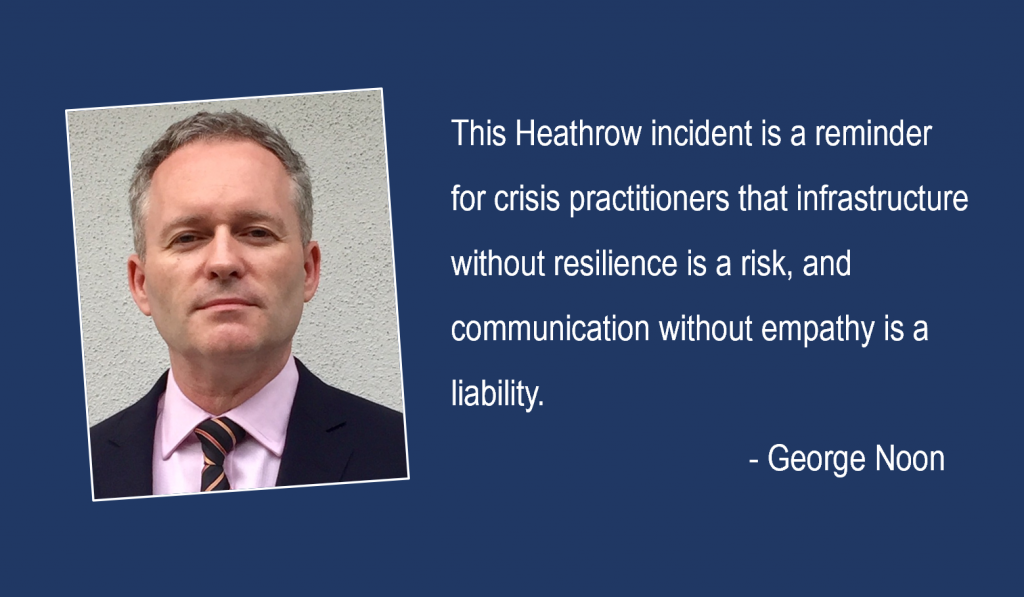
This Heathrow incident is a reminder for crisis practitioners that infrastructure without resilience is a risk, and communication without empathy is a liability. For now, flights are back in the air. But the deeper questions remain buried. Heathrow may again be the most connected airport in the world – but it must now reconnect with its most important asset of all: its passengers.
The views and opinions published here belong to the author and do not necessarily reflect the views and opinions of the publisher.