

Artificial intelligence is shaping a new world. From transforming how we work and communicate to redefining how decisions are made, AI is no longer a distant concept—it is here, evolving rapidly. But as this technological revolution unfolds, one group is again being left behind: women.
History offers a cautionary tale. During the industrial age, women were largely excluded from shaping the systems that defined our economic and social futures. Today, we risk repeating that exclusion in the AI era—this time with even greater consequences. If women aren’t fully included in shaping the future of AI, we risk building systems that reinforce inequality, overlook diverse perspectives, and fail to meet the needs of half the world’s population.
A recent Harvard Business School study reveals that women account for less than 40% of users on leading generative AI platforms. Even when access is equal, women are significantly less likely to adopt these tools—citing low confidence, concerns about misuse, and a sense that these platforms weren’t built with them in mind.
Leaving women out of AI’s development and deployment doesn’t just perpetuate gender bias. it leads to economic loss and missed innovation. Economists like Erik Brynjolfsson estimate that generative AI could boost productivity by 20% globally over the next decade. But if women lag behind by 25% in AI adoption, we risk losing hundreds of billions in untapped potential.
And the gap doesn’t stop at usage. Women are underrepresented at every level of AI leadership. A recent study by Fullstack Academy on the Forbes AI 50 list shows that only 24% of executive roles in AI companies are held by women, and just 10% of these firms are led by female CEOs. The message is clear: we need more than surface-level inclusion—we need structural change that places women at the forefront of AI development and governance.
Why does this matter? Because AI isn’t just about code or data. It’s about values. It’s about who decides how algorithms are trained, what fairness looks like, and which problems get solved. These choices are deeply human—and they require a wide range of perspectives, especially those grounded in empathy, ethics, and emotional intelligence.
This is where women offer a distinct and vital advantage.
A global report by Six Seconds found that emotional intelligence (EQ) is declining globally. Yet women’s EQ scores have not only stabilised—they are increasing. In contrast, men’s scores continue to fall. As AI becomes more advanced in IQ—reasoning, logic, speed—it remains underdeveloped in EQ. AI can generate content, but it cannot understand context. It can predict outcomes, but it cannot sense human nuance.
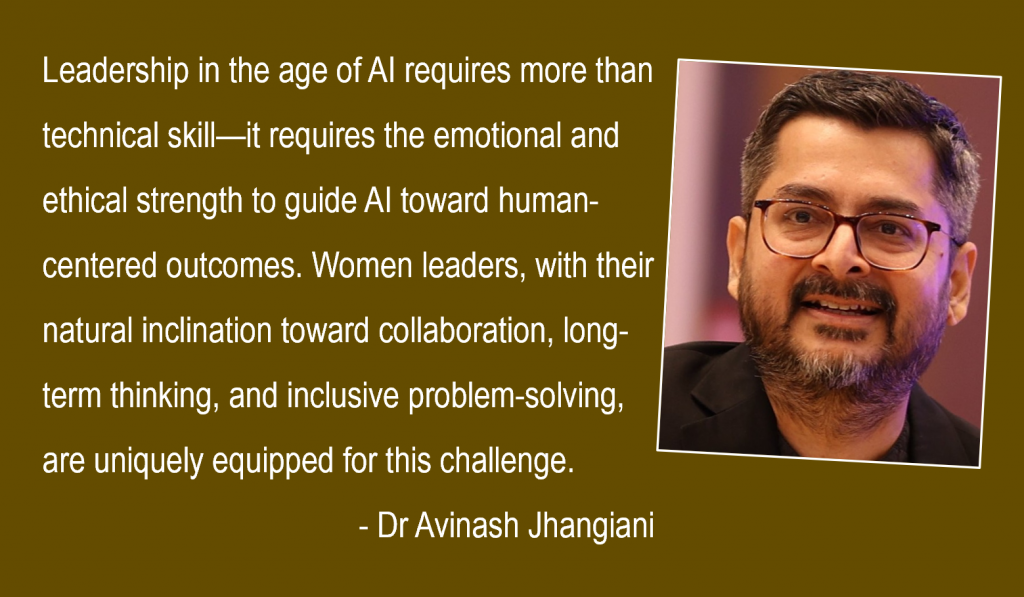
Leadership in the age of AI requires more than technical skill—it requires the emotional and ethical strength to guide AI toward human-centered outcomes. Women leaders, with their natural inclination toward collaboration, long-term thinking, and inclusive problem-solving, are uniquely equipped for this challenge.
But to bring more women into the fold, we must be intentional. That means simplifying AI for non-tech leaders, offering mentorship and safe spaces for women to explore and experiment elevating emotional intelligence and ethical reflection alongside AI literacy and showcasing visible role models to shift perceptions of who belongs in tech leadership.
Women are already reshaping AI with vision, empathy, and purpose. In India, Kirthiga Reddy, CEO of Verix, launched AI Kiran to elevate women in AI, while Geetha Manjunath, CEO of Niramai, uses AI to transform breast cancer screening, and Debjani Ghosh, President of NASSCOM, champions inclusive AI policies. Globally, leaders like Anima Anandkumar, Mira Murati, Daniela Amodei, Fei-Fei Li, Daniela Braga, and Nell Watson are driving responsible, human-centered AI across research, policy, and innovation. Their leadership shows that when women lead in AI, we build not just smarter systems—but a more inclusive future.
As we stand at the frontier of this next revolution, the question is not whether AI will change the world—it already is. The question is: who will lead it?
The ROI of women-led AI isn’t just moral. It’s strategic. Let’s close the gender gap in AI adoption, leadership and influence, so the future of tech is inclusive, ethical and deeply human. The industrial revolution left women behind. AI must not. We cannot afford for AI to become yet another domain defined by narrow perspectives and short-term priorities. This is our opportunity to get it right. To build systems that are not just intelligent, but wise. And that requires women at the helm—not only to balance the equation, but to elevate the direction AI takes next.
The views and opinions published here belong to the author and do not necessarily reflect the views and opinions of the publisher.

