

If you’re still relying on instinct and experience to drive your public relations campaigns, you’re already a step behind. Not because instinct is obsolete, but because the rules of the game are changing, and the scoreboard is now lit up by neuroscience.
Neuroscience, the study of how the brain processes information, forms memories, and makes decisions, is quietly transforming public relations from the inside out. And it’s not optional anymore. In a world where AI can churn out content faster than you can make your morning cup of chai, PR professionals have one unique edge: their ability to understand and influence human behaviour and psychology at its core. That edge begins inside the brain.
What the brain actually notices
Here is a fundamental truth worth remembering: humans make decisions based on subjective value. So when a journalist, editor, or reader decides to pay attention to your message, they are not thinking about what you want to say. They are thinking about what they stand to gain.
This is where many PR campaigns fall flat. Messages are created from the brand’s perspective instead of the perspective of those they aim to influence. Neuroscience tells us that messages register only when they align with existing neural pathways and stir an emotional response. Without that emotional connection, attention fades fast.
Why expertise still works
We are exposed to persuasive messages all day, every day. Our brains have developed filters. But one thing still cuts through: perceived expertise.
When the brain identifies a speaker or source as an expert, it processes that information more deeply. The content is stored differently. Trust forms faster. Attitudes shift more easily. This is why building expert positioning for your client isn’t just smart PR strategy. It is a direct appeal to how memory and influence function inside the brain.
Legacy news websites like The Indian Express, The Hindu, Hindustan Times, Mid-Day, and veteran websites like Rediff, The Print, Latestly and Scroll, in particular, hold this standard high. Their readers expect substance. They reward authority. Even veteran and new-age Bollywood news websites like SpotboyE, Koimoi, Super Showbiz and Bollywood Roundup show preference for trusted names in celebs, as well as in their preference for the public relations firms, and their editors and journalists they interact with. The same goes for the popular veteran and new-age lifestyle websites like Pinkvilla, Miss Malini and Celeb Taxi. Consistency, credibility, and subject relevance go further than buzz or PR hype.
Emotion gets the story covered
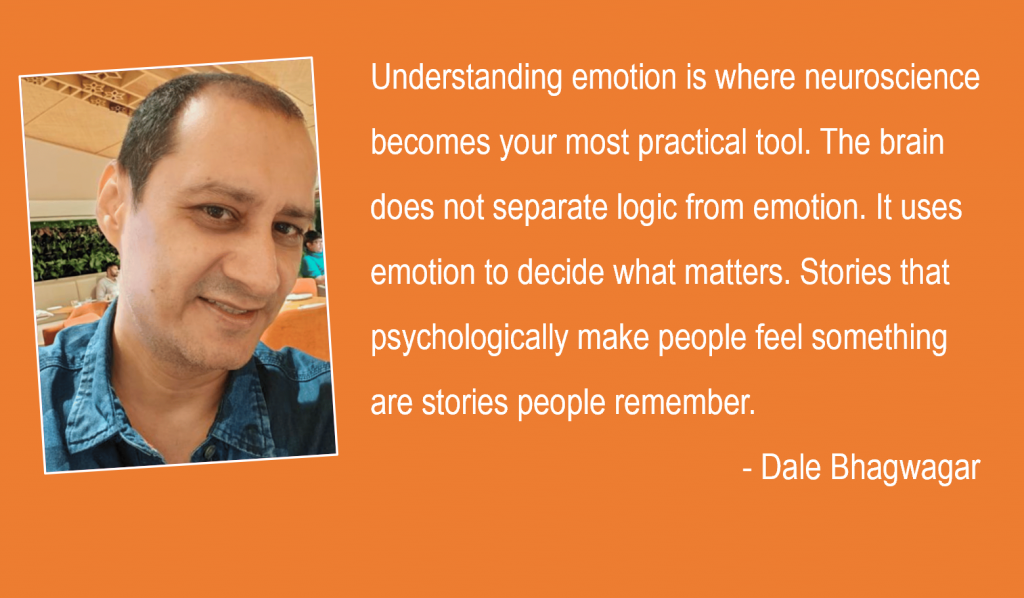
Understanding emotion is where neuroscience becomes your most practical tool. The brain does not separate logic from emotion. It uses emotion to decide what matters. Stories that psychologically make people feel something are stories people remember.
Each media genre responds to different emotional cues. Business platforms react to stories about innovation, uncertainty, or control. Tech publications respond to excitement and the fear of missing out. Lifestyle and entertainment outlets are drawn to aspiration, identity and intrigue.
Emotion is not manipulation. It is the natural language of the brain. When your message (even if it is PR-generated) evokes a genuine feeling that aligns with the outlet’s tone and the audience’s expectations, coverage follows.
Make your message stick
To be remembered, your message must do more than inform. It must connect. The brain forms memories by linking new data to existing frameworks. So, when your story builds on familiar narratives or known associations, it becomes easier to recall and reuse.
New-age journalism websites that balance classic storytelling with fresh angles are especially open to this approach. These platforms want content that contributes to the broader conversation while offering something novel. When your story is structured to make those neural connections easy, you’re not just offering news. You’re offering recall. And recall is influence. After all, it is the recall value that contributes the most to creating a brand. Right?
Timing is everything
Your pitch might be clever, clear, and credible. But if it arrives at the wrong time, it disappears into the noise. That is not about luck. It is about timing and brain function.
Research confirms that the brain’s ability to process new information fluctuates throughout the day. When cognitive load is high, people are more likely to skim or ignore messages entirely. This affects when to send emails, WhatsApp messages, how quickly to follow up, and how much detail to include upfront.
It matters even more in crisis communications. Always remember that psychology plays a huge part in PR. When people are stressed, their brains process information differently. Rational thought takes a back seat to survival instincts. If you understand this, you adapt your language to be simpler, more reassuring, and easier to process in moments of pressure.
This is what AI cannot do
AI can write faster, sort data more efficiently, and even mimic style. But it cannot understand how someone feels when they read a story. It cannot anticipate emotional responses or build trust with a headline the way a human can with empathy and emotion. And it certainly cannot establish real, lasting credibility the way a human can.
That is your job. And that is your edge.
So the question is not whether neuroscience has a place in PR. The question is whether you are ready to use it. Those who do will craft messages that cut through noise, spark memory, and move people to act. Those who do not will be replaced by machines that are cheaper and faster.
You get to choose. The future belongs to the communicator who understands not just what to say, but how the brain hears it. And that, unlike automation, is a skill no algorithm can touch.
The views and opinions published here belong to the author and do not necessarily reflect the views and opinions of the publisher.

