

We are living in the most connected time in history, and yet, perhaps also the most judgmental.
In an age ruled by likes, filters, and shares, we have swapped curiosity for conclusions and empathy for evaluation. We don’t just observe anymore; we assume, we label, and we decide — often without context and almost always without invitation.
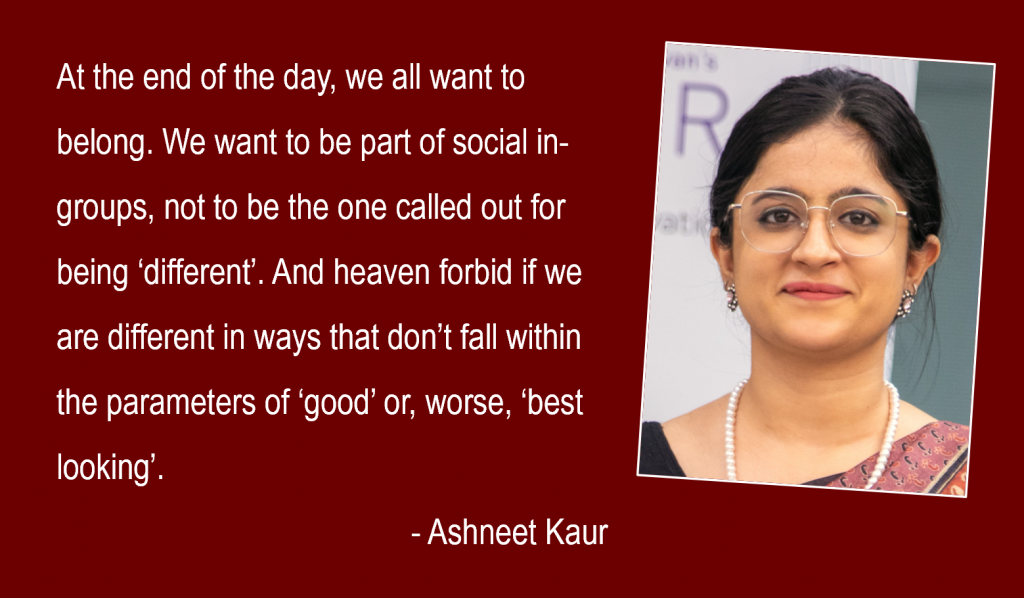
At the end of the day, we all want to belong. We want to be part of social in-groups, not to be the one called out for being ‘different’. And heaven forbid if we are different in ways that don’t fall within the parameters of ‘good’ or, worse, ‘best looking’.
We tell ourselves we are working toward the best version of ourselves. But who defines that ‘best’? Apparently, our social circles do not include us. And with that begins the slow cycle of becoming a social slave, not a social being.
You post a story, walk into a room, or laugh a little too freely, and suddenly you’re the subject of speculation:
- Did she wear that for attention?
- Why is he talking so much to that person?
- Why does she look so confident — or not confident enough?
Some judgements are dressed up as concern:
- “Did you do this? You won’t be taken seriously if you do this!”
- “You’ve lost weight — are you okay?”
- “You’re dressing up too much — what’s the occasion?”
- “You’re unmarried — why?”
As if mere visibility gives others the right to assess your choices. This affects everyone, but some more than others. Some judgements are disguised as concern. But let’s be clear: concern is not judgement. Concern requires empathy. Concern respects boundaries. Concern begins with permission.
If you genuinely care about someone’s well-being, you don’t say, “You seem to be struggling with your new role — you look weak and unsure.” You ask, “Hey, dear, how are you? Is something bothering you?”
If a woman attends her cousin’s engagement wearing a well-fitted dress, smiling and meeting relatives. She gets pulled aside: “You’re glowing… someone special, is it?” No, she’s not. She just used a good serum and finally slept eight hours. But that doesn’t matter — the narrative is written.
Or take a man who comes home tired after a long day and heads straight to the kitchen, because both partners are working, and this is shared responsibility. Yet someone watching may say: “You’re whipped,” or “She’s made you soft.” But caregiving and contribution don’t make a man any less masculine — they make him human.
A new mother returns to work after six months. She chooses to dress sharply, hoping to feel like herself again. But a colleague remarks, “You look too fresh for someone with a baby — are you even doing the night feeds?” As though exhaustion is the only proof of motherhood.
A man tears up during a farewell speech. He’s told, “Be a man. Don’t be so emotional.” As if expressing tenderness is a threat to masculinity. Or he chooses to wear a pastel kurta instead of a rugged suit to a family function, and a cousin jokes, “Are you trying to be cute or what?” Not because he’s doing anything wrong, but because he isn’t fitting a rigid frame of how a ‘man’ should behave.
That’s the difference.
Judgement assumes. Concerned enquiries.
Judgement concludes. Concern connects.
And to even offer concern, you must be allowed in. You can’t just show up with conclusions dressed as care and expect them to be welcome. That’s not kindness; it’s intrusion.
If you’re younger, newer, or simply different, you’re seen as someone who must ‘earn’ their place. If you’re assertive, you’re arrogant. If you’re warm, you’re seeking attention. If you’re quiet, you’re suspicious. If you’re vocal, you’re ‘too much’. These silent judgements creep into professional spaces too — spaces that claim to value merit and inclusion.
The McKinsey Women in the Workplace 2024 report notes that while women’s representation in the C-suite has grown from 17% in 2015 to 29% in 2024, their authority is still undermined. Microaggressions—subtle slights, dismissals, and eye-rolls—remain persistent.
A young instructor walks into a classroom. Some learners, especially older ones, tune out, not
because of the content, but because of the assumption, “What will she/he teach me?” “He/she doesn’t seem to be an expert in this field — look how tiny, sleek, and too young this person is. I want someone with grey hair.”
Even in places meant for learning, we carry pre-formed conclusions. We say we champion inclusion, but often, our subconscious hasn’t caught up. We carry unverified stories in our heads about others, and worse, we speak them aloud, confidently, even carelessly.
But thankfully, not everyone is watching to critique. There are people who will stand up, who will support you without question. People who empathise, who listen without diagnosing, who lighten your burden by simply being there.
People who…
Ask before assuming, offering space instead of solutions: “Would you like to talk about it?” instead of “You should do this.”
- Mirror without magnifying, holding up calm instead of chaos: They don’t rush to fix; they sit with you in discomfort until it feels lighter.
- Normalise your humanness, not your performance: They remind you that it’s okay not to be okay — that vulnerability is not weakness.
- Respect silence, knowing that sometimes presence matters more than words.
- Celebrate in private, not just perform in public: They cheer your wins without making it about themselves or needing a spotlight.
- Check in without checking up: A simple ‘Thinking of you’ message, a shared coffee, a soft laugh — these are the antidotes to judgement.
These people may be few, but they exist. And often, they’re the reason someone keeps going. Let them in. Be one of them. Because in a noisy world full of opinions, grace is a quiet revolution. Because in a world that rushes to judge, choosing to understand is an act of rebellion. And in a world where people shrink to fit, staying fully yourself is power.
So the next time you find yourself forming a story about someone, based on how they dress, who they talk to, how they’ve changed, or how they express themselves, take a pause. Ask yourself: Is this concern, or is it judgement in disguise? Because concern is rooted in care, and it asks permission to enter. Judgement barges in, uninvited, and often, uninformed. And unless you have been invited in, unless you’re an expert on that person’s life or field, or specifically asked for your opinion, you don’t have the right to conclude their story. So before you judge next time, pause. Differentiate. And choose to understand. That pause could be the most powerful, most respectful thing you do.
In sum, “You don’t have to echo what’s around you. You are allowed to be softer, kinder, and fuller. In a world wired for judgement, understanding is a quiet rebellion. And in a world where fitting in often means fading out, staying wholly yourself is your superpower.”
The views and opinions published here belong to the author and do not necessarily reflect the views and opinions of the publisher.

