

PRAXIS 2026
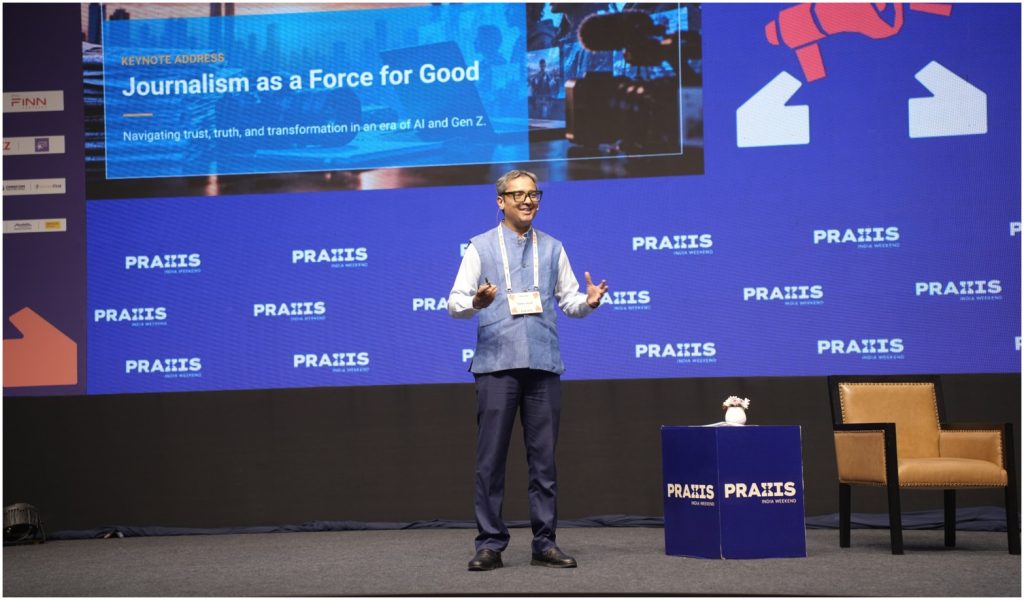
Keynote Address 7: Zakka Jacob, Managing Editor, Times Now
Journalism as a Force of Good
We were reminded at #PRAXIS2026 that AI can sort the stories, but only journalists can bring context and empathy.
Today, we can actually dwell on the good, the bad and the ugly of journalism. In the face of a massive onslaught of opposition, action from the government, for instance – journalistic institutions at every level must fight to ensure that the truth is reported.
But is that happening?
Taking the audience on a deep dive into the ever-evolving world of media, Zakka Jacobs, Managing Editor, Times Now, held centrestage at #PRAXIS2026. He kicked off with the remark that the topic, “Journalism as a Force for Good,” sounded like an oxymoron.
Calm, collected and armed with a nose for news, Jacobs has the ability to get to the heart of the matter, as we have seen. On Times Now, he brings viewers face to face with the day’s most important developments and then offers as wide a picture as possible. As he once said, “The role of a journalist is to ask tough questions and bring clarity to complex issues.”
The Fourth Estate, but also a business. In the intricate architecture of democracy, journalism stands as the indispensable Fourth Estate – a beacon of truth and accountability. “We are the fourth pillar, and media represents the force of the people,” Jacobs said. But the paradox, he pointed out, is that it is not charity; it is a business that has to be profitable.
Giving voice to the voiceless. For Jacobs, the real purpose of journalism lies here. Citing a recent instance of a 90-year-old who had no Aadhaar card and whose name was missing from the electoral rolls, he exclaimed that “media gave voice to their stories!”
Gen Z, AI and accountability. On the Gen Z and AI era, Jacobs candidly admitted that the media has been at both ends – including spreading misinformation. As for the individual journalist, he said, “I am liable for legal action and I can be sued as a journalist!”
He referred to the recent protest at Jantar Mantar, which blew up and drew critical-mass attention. The Parliament of India, he said, needs to do a lot, and it was the first time in twelve years that a Minister had to step down. What AI helps us do, he explained, is segregate stories and tell us which are important – but what it cannot provide is context and empathy.
News is everywhere – but much of it may be noise. Big stories are simplified, bite by bite. Today news is 24×7, Jacobs added, with constant news monitoring, instant translation and rapid ‘breaking news’ all along. And for news to be consumed, you have to reach out to the viewers.
So what meets Gen Z’s interest? Short-form videos, podcasts and social media – all of which, he noted, have wide democratic reach.
Finally, Jacobs struck an upbeat note: “We are living in great times, as far as we journalists are concerned.” And, perking up our interest, he revealed that “Indian journalism is in good hands!” Taking the case of the ‘internal dissent’ among the country’s three Election Commissioners, he noted that “it took media to expose this.”
His final take was a call to the citizen: “We have all become critical thinkers. For you as a citizen there is the call to separate the need from fact!”
In the age of AI and information overload, Jacobs left the audience with one clear message: technology may speed up the news, but truth, context and empathy still need a human journalist.
______________________________________________________________________________________________________________________________
The views and opinions published here belong to the author and do not necessarily reflect the views and opinions of the publisher.