

In a world increasingly driven by automation and artificial intelligence (AI), being human is your greatest competitive edge. When people discuss landing a job, the conversation often turns towards tools, certifications, and hard-earned credentials. Yet, in rooms where decisions are made, something else often tips the scale—and it isn’t listed under technical skills.
The most underrated job skill that cannot be automated
It is listening.
Not the passive kind where words merely enter your ears, but the kind that makes people feel heard, respected, and understood—the kind that builds trust before a sentence is even complete. It is a skill so subtle that it rarely appears on CVs, yet it is increasingly becoming the reason why people are hired—or passed over.
Irmgard Naudin ten Cate, EY’s Global Talent Attraction and Acquisition Leader, recently identified three essential qualities that today’s talent must possess: curiosity, adaptability, and influence. At the root of each lies empathy. And there is no empathy without listening.
In a hyperconnected, AI-driven world, listening has become our most human—and most strategic—edge.
The ‘Ladder of Listening’
Communication experts often refer to the ‘Ladder of Listening’, a simple yet powerful concept that breaks down how people listen. At the bottom is ignoring—a complete lack of attention. Slightly better is pretending to listen, followed by selective listening, where one filters what they want to hear. Then comes attentive listening, where focus is active and visible. At the top sits empathetic listening—the kind that seeks to understand not just words, but intentions, emotions, and unspoken concerns.
Most individuals hover somewhere in the middle. However, it is the climb to the top that makes all the difference in professional interactions.
{The ‘Ladder of Listening’ draws on ideas from several thought leaders, including Carl Rogers (active listening), Otto Scharmer (Theory U), Marshall Rosenberg (Nonviolent Communication), and Stephen Covey (five levels of listening).}
The human skill that changes outcomes
Listening affects everything: the tone of an interview, the outcome of a meeting, and the perception of your leadership. People who listen well are perceived as more competent, trustworthy, and emotionally intelligent—not because they say the right things, but because they respond in ways that show understanding.
Take Vicky, for example (name changed), a mid-career professional with a solid CV from a top institute. On paper, he met every requirement. In interviews, however, something did not resonate. Feedback often circled around a single observation: “He does not seem to listen.”
It wasn’t that Vicky was dismissive. However, he interrupted too often, spoke over people, and missed subtle cues in tone and expression. He was technically proficient but emotionally misaligned. It cost him opportunity after opportunity.
To course-correct, Vicky began summarising long podcasts—not just for content, but for tone shifts, emotion, and speaker intent. He practised staying silent in conversations—just long enough to notice the pause after a difficult question, the hesitation before a “yes.” Slowly, his communication changed. Not just the words he used, but the timing, the pace, and the tone. Eventually, he secured the most fulfilling role of his career—not through louder persuasion, but through quieter attention.
His story is not exceptional. It reflects a growing reality: listening has become a differentiator.
Why listening is not a solo act
Listening today goes beyond decoding words. It is tightly woven with body language and emotional intelligence.
Non-verbal signals—eye contact, posture, tone—are the cues through which people decide whether they feel respected. Emotional listening, in particular, is the ability to sense what is not being said. The unspoken concern in a team meeting. The resistance masked by a smile. The hesitation behind a “sure.”
This is where many stumble. One can be well-spoken and still fail to listen. Because effective communication is not merely about self-expression; it is about giving others the space to be understood.
Influence begins with understanding
In many roles today, especially leadership, influence is not about authority. It is about alignment. That alignment occurs when people feel heard—not merely managed. This is why emotional intelligence, often overlooked, is now regarded as essential.
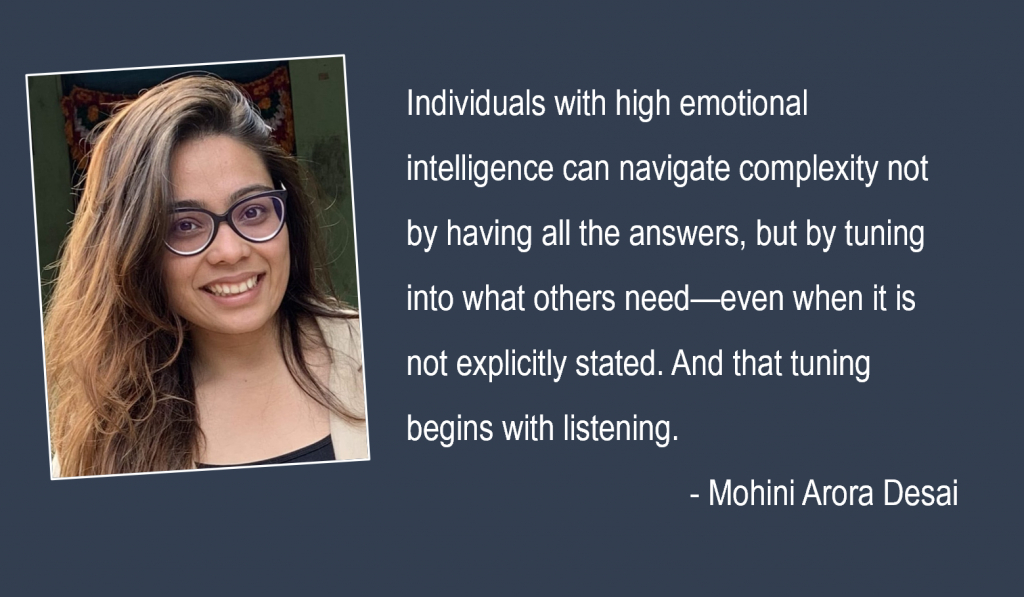
Individuals with high emotional intelligence can navigate complexity not by having all the answers, but by tuning into what others need—even when it is not explicitly stated. And that tuning begins with listening.
The best collaborators, the most sought-after managers, and the people who lead without a title—they have mastered the pause. They listen not to reply, but to understand.
Quiet skills, loud impact
As AI takes over more of what can be measured, the value of what cannot be measured is skyrocketing. Skills such as curiosity and adaptability are critical. However, their strength lies in the foundation of human connection—and that begins with how well we listen.
Therefore, if you are preparing for your next significant interview, team project, or career pivot, do not merely brush up on tools and trends. Ask yourself: When was the last time someone said, “I felt heard” after speaking with me?
Because sometimes, the strongest impression you leave has less to do with what you say, and more to do with how deeply you listened.
The views and opinions published here belong to the author and do not necessarily reflect the views and opinions of the publisher.

