

When a journalist at the White House berated Ukrainian President Volodymyr Zelenskyy’s choice of attire amid discussions of war and geopolitics, it was a jarring non sequitur. Even if intended as an insult—made worse by the laughs of those present in the Oval Office—the remark raised eyebrows around the world. Why should dressing up in formal suits be de rigueur in formal settings?
Centuries ago, Shakespeare wrote about Shylock being disparaged publicly in Venice for his ‘Jewish gaberdine’ by the elitist Antonio—an insult that could lead him to seek revenge in seeking a ‘pound of flesh’. Gandhi was berated for his loincloth attire during his 1931 visit to England—there too, a journalist asked him if he was “appropriately dressed to meet the King?” He famously retorted, “The King was wearing enough clothes for both of us.”
Fast forward to 2025, Zelenskyy wore his signature olive-green military sweatshirt instead of a tailored corporate suit. And a trite comment on his clothes wasn’t just an offhand remark; it revealed an ingrained expectation—serious leaders wear suits. But why is that? Who decided that authority comes in the form of a tailored jacket?
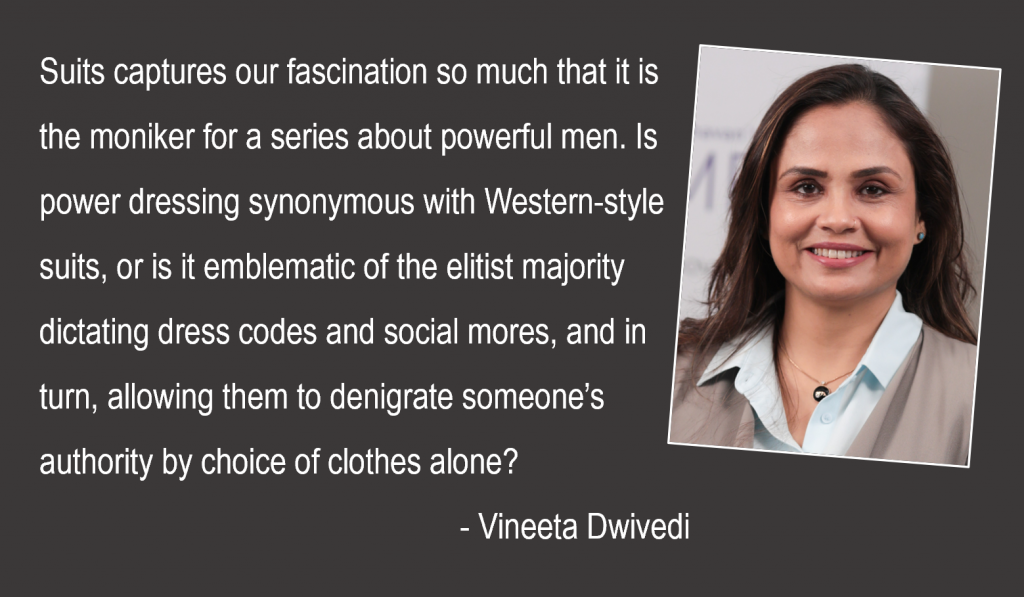
Suits captures our fascination so much that it is the moniker for a series about powerful men. Is power dressing synonymous with Western-style suits, or is it emblematic of the elitist majority dictating dress codes and social mores, and in turn, allowing them to denigrate someone’s authority by choice of clothes alone?
Historian Christopher Breward, in the book ‘The Suit: Form, Function, and Style’, notes that the suit’s real power lies in its adaptability. Unlike elaborate aristocratic clothing, it was simple yet authoritative, allowing it to become the universal uniform for businessmen, politicians, and anyone looking to project power.
Not every culture embraced the suit in the same way. Many world leaders have deliberately rejected Western suits to make a political point.
Gandhi favoured simple handmade loincloth, using his attire as a symbol of anti-colonial resistance. Mao Zedong popularised the Mao suit as an assertion of Communist ideology and rejection of Western influence. Sheikh Mohammed bin Rashid Al Maktoum—Dubai’s ruler—wears a traditional Emirati kanduras, reinforcing national identity. Japan took a more hybrid approach—during the Meiji era, Western suits became a symbol of modernisation, but traditional clothing like the kimono is still worn for formal occasions.
Even among world leaders who wear suits, personal style varies widely. Barack Obama’s choice of neutral, no-drama navy suits projected professionalism—except for the one time he wore a tan suit, which caused a minor political meltdown. Donald Trump favours oversised suits with very long ties, making him instantly recognisable.
Angela Merkel made her simple, bold-coloured blazers a uniform of stability. Russian President Vladimir Putin sticks to dark, perfectly tailored suits that reinforce his image of control. Indian Prime Minister Narendra Modi often wears closed-neck Indian-style jackets and suits in a not-so-subtle power statement. Despite all this variation, the expectation remains that world leaders—particularly those from the West—should wear suits.
This is where the hypocrisy becomes clear. While Zelenskyy was publicly questioned about not wearing one, tech moguls like Elon Musk and Mark Zuckerberg have built their images around casual wear. Musk can walk into a boardroom in jeans and still be treated as a visionary. Zuckerberg’s hoodie became a symbol of the start-up revolution. The late Steve Jobs made the black turtleneck a personal brand. The fact that some men can rewrite the rules while others are held to rigid standards shows that the suit is less about authority itself and more about who is granted the privilege to defy tradition.
Zelenskyy’s choice of military-style clothing is not accidental—it is a deliberate statement of solidarity with Ukrainian soldiers. His appearance sends a message that he is not just a distant politician but a leader in the trenches. The expectation that he should wear a suit, even in a war zone, suggests an outdated belief that formality is a prerequisite for leadership. Clothing, after all, is more than just fabric—it is a form of nonverbal communication. Sociologist Erving Goffman, in ‘The Presentation of Self in Everyday Life’, describes clothing as part of a social performance—we “dress the part” to meet expectations.
A judge’s robe, a doctor’s coat, or a military uniform immediately conveys authority. The business suit could serve the same purpose. However, clothing it can also challenge expectations. The Black Panthers’ leather jackets and berets in the 1960s symbolised militancy and resistance. Even casual attire, like Zuckerberg’s hoodie, can be a statement that traditional rules no longer apply.
What we wear also affects our own behaviour. A 2012 study by Hajo Adam and Adam Galinsky found that participants who wore lab coats performed better on attention-related tasks—a phenomenon called ‘enclothed cognition’. The implication is that clothing does not just project authority—it can create it. This might explain why people feel more powerful in a well-tailored suit or why athletes feel more confident in their team’s uniform. And who’s to say that Zelenskyy doesn’t feel powerful in his fatigues?
So, what does all of this mean for the corporate world? Well, context matters! Whether Zelenskyy’s outfit was appropriate for his situation is still an open question. Shouldn’t professionals consider their environment? Many Asian countries follow the Western ideal of wearing formal suits to project corporate seriousness. However, neither the climate nor the physique behooves a suit dress-up, and with the addition of tight collared ties in ninety-nine percent humidity, a suit is sometimes short of punishment dressing.
Authority doesn’t come from a suit; otherwise, many tech leaders won’t be such poster boys. Maybe the time has come to raise the bugle against the ‘suityranny’. Clothing in public settings is always a statement, whether intentional or not. From Gandhi’s loincloth to Musk’s hoodie, every outfit carries meaning—sometimes defiance, sometimes tradition, sometimes just personal comfort.
The views and opinions published here belong to the author and do not necessarily reflect the views and opinions of the publisher.

