

If you have spent even a few hours in a PR brainstorming session you know that words can move markets, shape perceptions and even tilt alliances. Right now, India is being told (and sometimes with bullying tones) by the United States to back off from buying cheap Russian oil and to realign with Washington, opening up its dairy and agricultural sectors to the US markets. Yet New Delhi’s stance can be summed up in the famous line from the megahit ‘Pushpa’: “Jhukega nahin.”
And this is why communications pros must study the ‘Pushpa’ moment playing out in geopolitics. Here is something PR pros can learn from India’s refusal to bend. This matters to communications and marketing leaders because it is no longer just about diplomacy or trade.
It is about positioning, narrative control and the power of standing firm when pressured to bend. The way India is framing its response to the US will be studied not only by governments but also by brands, boards and media strategists who know that credibility rests on consistency.
Why this matters now
US Commerce Secretary Howard Lutnick recently predicted that India will say “sorry” to President Donald Trump within two months. “In a month or two months, I think India is going to be at the table, and they’re going to say they’re sorry, and they’re going to try to make a deal with Donald Trump,” he told Bloomberg. He went further, calling India’s surge in Russian oil imports “ridiculous” and added that New Delhi had simply decided, “Ah, the heck with it. Let’s buy it cheap and make a ton of money.”
He also warned that India must choose whether to back the US and the dollar or continue aligning with Russia and China through groupings like BRICS. “They’re the vowel between Russia and China (in BRICS). If that’s who you want to be, go be it. But either support the dollar, support the United States of America, support your biggest client, who is the American consumer, or I guess you’re going to pay a 50% tariff. And let’s see how long this lasts.”
India has defended its choice, arguing that energy security comes first and that cheap crude keeps inflation in check. This is not an emotional argument. It is a data-driven one, and it shows that long-term positioning can matter more than short-term criticism.
The chorus of critics
Lutnick is not alone! Peter Navarro, Trump’s White House trade adviser, spent years painting India as one of the worst offenders in global trade. He accused New Delhi of having some of the highest trade barriers in the world and said India had been taking advantage of the US for years. Navarro repeatedly slammed tariffs on American dairy, agriculture and medical devices, calling them unacceptable protectionism. He also backed Trump’s decision to strip India of its preferential trade status under the Generalized System of Preferences (GSP) program for beneficiary developing countries, framing it as overdue punishment.
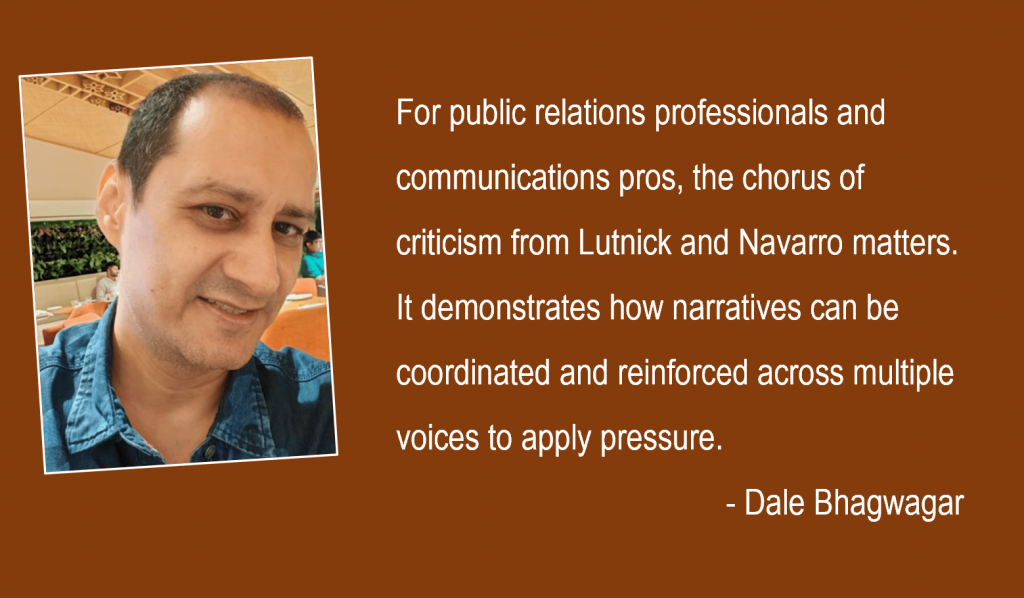
For public relations professionals and communications pros, this chorus of criticism from Lutnick and Navarro matters. It demonstrates how narratives can be coordinated and reinforced across multiple voices to apply pressure. When opponents echo each other’s bitterness, the perception of isolation grows stronger for the target, whether that target is a government, a corporation or a brand.
Trump woke up on the right side of his bed!
After many insults and exaggerations which have offended Indians, Trump who recently called India’s economy a “dead economy” offered a softer line last weekend, stressing that he and Prime Minister Narendra Modi will “always be friends” even if he dislikes current decisions.
When ANI asked Trump, “Are you ready to reset relations with India at this point?”, the US President responded, “I always will. I’ll always be friends with (PM) Modi. He’s a great Prime Minister. I’ll always be friends, but I just don’t like what he is doing at this particular moment. But India and the United States have a very special relationship. There is nothing to worry about. We just have moments on occasion”.
Prime Minister Modi quickly responded with his own message on X: “Deeply appreciate and fully reciprocate President Trump’s sentiments and positive assessment of our ties. India and the US have a very positive and forward-looking Comprehensive and Global Strategic Partnership.”
And though not many in India may really believe the flip-flopping Trump to stand by whatever he says anymore, this is an important reminder for comms leaders. Your critics might push hard, but you can still maintain goodwill if you communicate strength with respect.
A new lever taking hold
The emerging lever is reframing criticism as proof of leverage. Howard Lutnick himself underlined that “we are the consumer of the world” with America’s $30 trillion economy, warning that India and China “are not going to be able to sell to each other” forever. The message is clear: the US sees itself as the indispensable market. Yet the flipside for comms leaders is that when critics stress your dependency on them, it is usually an admission of your own negotiating power.
India’s oil decision shows that size, scale and market gravity can force others back to the table no matter how loud the threats. For comms leaders, this is a shift from reactive defense to proactive framing. Instead of apologising for tough calls, explain the rationale, amplify the benefits and let the critics signal your importance.
Which side of the bed next?
One never knows which side Trump will wake up from tomorrow. India’s diplomatic circles may therefore keep taking a cautious line with America for years. Trust has been thrown out of the window during this administration, erasing years of patient relationship-building. It almost echoes the shadows of the 1971 Indo-Pakistan War, when the US Seventh Fleet sailed into the Bay of Bengal to intimidate India and the Soviet Union countered with its own nuclear-armed flotilla. That standoff scarred bilateral ties for decades. Today, with Trump’s daily trapeze acts and headline-chasing theatrics, India is reminded that diplomacy, like public relations, must go on regardless of the noise.
The views and opinions published here belong to the author and do not necessarily reflect the views and opinions of the publisher.

