

Picture this: you’re speaking, sharing something that matters, and the person across from you glances down at their phone. They nod, half-smile, maybe even mumble a reply. But you know you’ve lost them. That sting you feel: phubbing is the act of snubbing someone in favour of your phone.
At first glance, it may seem like a trivial social annoyance. But mounting evidence shows phubbing is more than bad manners; it is disrespectful, hurtful, and corrosive to our personal and professional relationships. In fact, it is quietly rewiring how we communicate and how much we trust one another.
Governments are beginning to take notice. Denmark, Australia, the USA and, most recently, South Korea have banned phones in schools, at least. Higher education experts are pushing for ‘no phones in the classroom’ wherever they can. But what about workplaces and home life? Are we even aware of the damage that constant distraction does to attention, behaviour, and social connections? What was once considered a private etiquette problem has now become a matter of public policy.
The consequences are everywhere, from couples drifting apart to teams in workplaces struggling with engagement. Listening, once considered a basic human courtesy, has become a scarce skill. Yet it is also the single most important foundation of effective communication.
The workplace isn’t immune either. Boss phubbing is getting more and more prevalent. Boss phubbing has serious repercussions for the company and the welfare of its employees. The most frequently mentioned adverse effect is the decline in employee trust in their supervisors. Employee engagement, job satisfaction, and performance are all negatively impacted by boss phubbing.
Research on problematic smartphone use as an addictive habit in connection to psychopathology is growing and is now classified clinically as a behavioural addiction, and problematic use has even been linked to higher levels of PTSD. The fact remains that we can understand and access the minds of other people only through deep listening. That is why listening remains not just a key communication skill but a life skill.
Neuroscience explains why! Listening is not passive—it is an active process in which our brains fire mirror neurons to empathise and connect (Iacoboni, 2009). When our attention flickers between a glowing screen and another human being, this process breaks down. Over time, constant distraction conditions our brains to seek novelty over depth, leaving our conversations shallow and our relationships strained.
Why we don’t change
Here lies the paradox: most of us know it’s rude to check our phones mid-conversation, but we keep doing it. Why?
Part of the answer is normalisation. When ‘everyone’ is guilty of it, the behaviour no longer feels as disrespectful. Another driver is neurological: the dopamine hit of notifications makes phones exceptionally hard to resist, even in serious conversations.
And then there is self-deception. We like to believe we can multitask effectively. But research from Stanford (Ophir, Nass, & Wagner, 2009) shows that heavy multitaskers are actually worse at filtering distractions, worse at switching tasks, and worse at recalling information. In short, by phubbing, we not only undermine the relationship, we undermine our own effectiveness as communicators.
This isn’t just theory. A recent Ohio State study found that average screen focus has plummeted from 2.5 minutes in 2004 to just 47 seconds today. Experts now recommend the ‘Take Five’ method – stepping away from screens for five to ten minutes every hour to restore attention and avoid fragmented thinking.
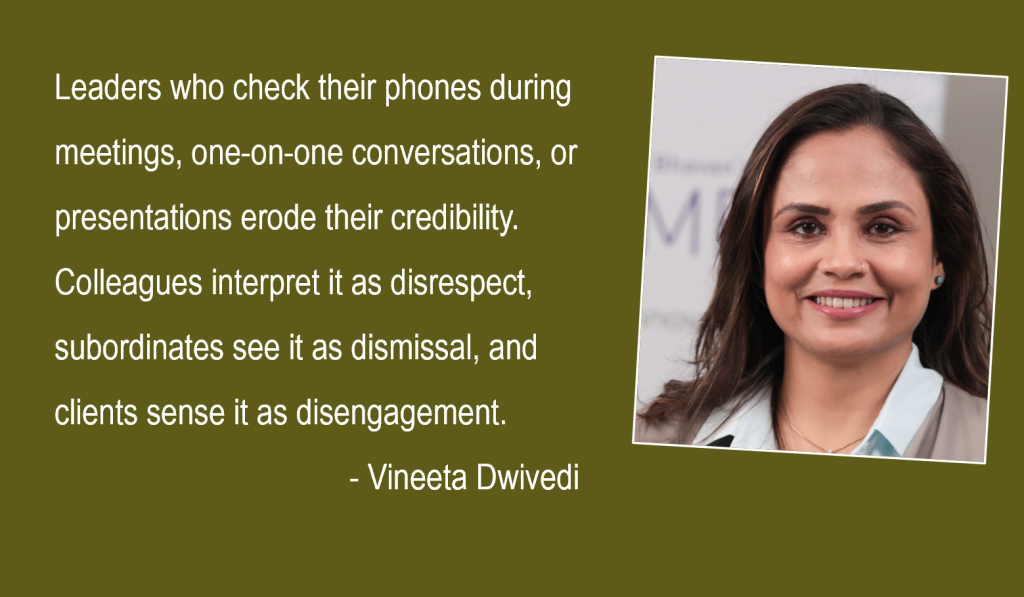
The professional costs of phubbing are also damaging. Leaders who check their phones during meetings, one-on-one conversations, or presentations erode their credibility. Colleagues interpret it as disrespect, subordinates see it as dismissal, and clients sense it as disengagement. Nothing undermines executive presence faster than a leader who appears absent.
Even tech leaders recognise this. Eric Schmidt, former CEO of Google, recently advised people to simply “turn off your phone” if they want to focus or relax. When the architects of the digital world acknowledge its downsides, it is a reminder that the attention we give to our phones has consequences.
How to correct ourselves
The good news is that listening, like any discipline, can be practised and strengthened. Some practical strategies include:
- Create phone-free rituals: Protect mealtimes, family discussions, and meetings by declaring them device-free. Small rituals can shift entire cultures.
- Signal presence through body language: Eye contact, nodding, and leaning in communicate attentiveness even before words do.
- Practice active listening: Repeat or paraphrase what the other person has said. This not only proves attention but deepens understanding.
- Audit your triggers: Notice when you reflexively reach for your phone. Is it boredom, anxiety, or habit? Awareness is the first step toward change.
- Lead by example: For leaders, modelling undivided attention sets a standard others are likely to follow. Similarly at home, parents can only expect children to leave their phones, if they put down their own.
Kate Murphy, in her book You’re Not Listening (2020), argues that listening is not merely a courtesy but a form of power. The person who listens shapes the depth and direction of the conversation. By truly listening, we diffuse conflict, uncover hidden meaning, and strengthen bonds of trust.
Phones are not the enemy here; our habits are. The test of respect is not how quickly we reply to an email or message, but how deeply we listen when someone is speaking to us. In a distracted world, undivided attention has become the most valuable and rare gift we can give.
Phubbing may be normalised, but it is not harmless. It is a small act with big consequences: dismissing the person in front of you for the device in your hand. The damage is cumulative – relationships falter, teams disengage, trust collapses.
So the next time you feel the itch to glance at your phone mid-conversation, pause. Remember that what you’re looking at is not just a screen, it’s also a signal. And the message it sends may be louder than you intend: You don’t matter enough to hold my attention. In the end, your full attention may be the most powerful thing you have to offer. Just keep your phone down – consciously, willingly.
The views and opinions published here belong to the author and do not necessarily reflect the views and opinions of the publisher.

