PRAXIS 2026
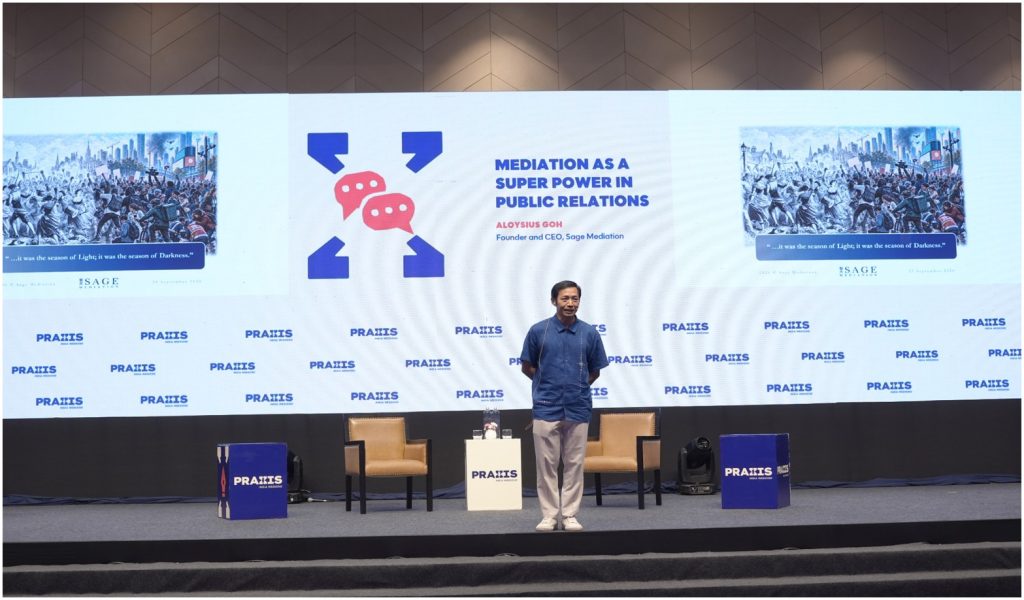
Keynote address 2: Mediation as a Super Power in Public Relations by Aloysius Goh, Founder & CEO, Sage Mediation
Q/A with Kritika Saxena, Head – Marketing (India), Tata Consultancy Service
Aloysius Goh, Founder & CEO of Sage Mediation, made the case that mediation deserves a fuller place in the evolution of PR – because both begin with listening beyond what is being said.
Perhaps it is time for mediation to be addressed more fully in the body of literature for public relations, specifically in the evolution of PR. That was the thought that lingered as Goh took the stage to speak on “Mediation as a Super Power in PR”.
Goh is the Founder & CEO of Sage Mediation, a company he established in 2019 after a fairly unconventional post-graduation journey. A graduate of the National University of Singapore (NUS) Law School in the early 2000s, he has served in the diplomatic corps, run a multi-national tofu business, acted as General Counsel for state institutions including a university and public hospitals, and even spent a year in a French Catholic monastery.
His commitment to resolution, he revealed, goes back to his first year in law school and a classmate called ‘Poetry’ – seemingly super intelligent, always with the right answers, even when she missed lectures. When she passed away, it emerged that she had been suffering from depression. “I graduated with the scepticism of the law system,” he said. “The episode left a deep commitment that we need to find a way to fix problems”.
As he shared his thoughts, the connection between mediation and communication became very clear. Both require us to listen beyond what is being said.
“The dispute may be about money, but it may not be about money,” Goh pointed out. Drawing on stories from more than 1,000 mediations, he showed how conflict is often about much more than the issue on the surface – pain, dignity, trust, fear and relationships.
And that holds a direct lesson for PR. Our job isn’t just to create a narrative. The way we frame a situation can become the starting point of a solution – or the starting point of a bigger crisis.
Mediators and PR experts share a mission of transforming crises for their clients, he emphasized. Goh distilled it into five principles that spell out PEACE:
- Proactively design how we listen, and deeply contemplate what clients are truly saying.
- Empathy powers communication – and empathy starts from admitting what we don’t understand.
- Astutely tap the unseen stakeholder when we sense we are missing something; that can give us the light we need.
- Collaboration builds trust – seize and celebrate every small act of it, because reliability depends on trustworthiness.
- Ethics must never be compromised if we want crises to stay resolved.
“There is co-existence of good and evil,” he explained, “but good mediation shows that we can choose peace,” he said with confidence.
To the attentive audience, he left three easy actions:
- Take a walk along the Kochi beaches and send a message of peace to the universe.
- Inculcate a culture of peace.
- Consider learning mediation skills – “it won’t make you rich, but spiritually it will enrich you!”
In an industry built on shaping narratives, Goh’s message was a quiet reminder: the strongest stories begin with listening – and the most lasting resolutions begin with peace.
In a Q/A with Kritika Saxena, Head – Marketing (India), Tata Consultancy Services, she questioned – why is mediation seen as a final step, and when things collapse why is mediation seen as a skillset important for PR? His response was that “the first reality is that the job of the mediator is so similar to a PR expert. The skill set is to listen and frame a way so that society listens and we are trying to find solutions”.
And how to turn conversation in the right direction? He admitted he looks at body language and listens to the words and tries to decipher “the role people are not admitting to themselves and what is the positive vision they have kept for themselves”.
For the moderator, it’s always about finding a solution!
In crisis how could communication leaders take the most ideal proactive approach that would lead to a holistic solution? “Design holistic solution,” was his quick take.
In a rapid fire round he gave quick answers to certain situations like –
* One thing we should stop doing – Judging!
* Use of AI is good or bad? Good.
______________________________________________________________________________________________________________________
The views and opinions published here belong to the author and do not necessarily reflect the views and opinions of the publisher.