

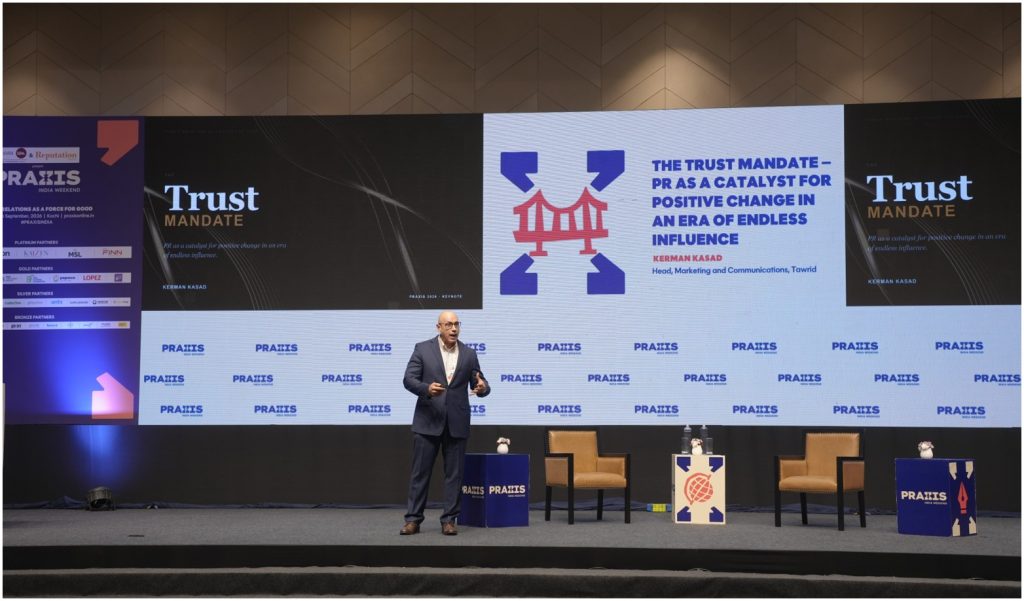
PRAXIS2026 Keynote 10
Kerman Kasad, Head, marketing & Communications, Tawrid
The Trust Mandate: PR as a Catalyst for Positive Change in an Era of Endless Influence
Trust is indispensable in today’s business landscape. So, what is the power of trust in business? As communicators, we explored the vital role of trust in the competitive business landscape.
Opening his talk, Kerman Kasad, Head, Marketing & Communications, Tawrid, said he would speak about the trust detector and the trust amplifier. His topic – “The Trust Mandate: PR as a Catalyst for Positive Change in an Era of Endless Influence” – came with a direct argument: “PR for good” means little unless it moves revenue, reputation and regulation & in an era of endless influence, trust is the scarce resource.
Trust, is an important currency. Like respect, it is earned: do what you say and say what you do. Build a track record of this, with results, and you earn that currency. Trust is the foundational currency and the most valuable intangible asset in business – directly driving financial performance, brand reputation, employee productivity and long-term resilience. It is the firm belief in a company’s reliability, ability, integrity and goodwill, and a critical component of any economy, allowing companies to grow and build strong relationships with customers and other stakeholders. The trust framework helps businesses grow – by focusing on teaching, engaging, building an owned audience, understanding, and clear communication.
And what happens when it is missing? Without trust, human relationships, economic systems and society as a whole would fail to function.
So what does “PR for good” really mean? Kasad answered with cases where trust broke down. Sharing one incident, he recalled how a customer received a broken laptop and the story went viral. The impact was profound – it shook Dell’s entire structure, and it began with a single blog post. The “Dell sucks” story, he noted, went on to dominate search results.
He also pointed to Flipkart’s One Day sale in 2014, which cost the company market share. When India’s Flipkart turned into ‘Flopkart’, as a BBC headline put it, the company was in a battle to win customers in a highly competitive market, with rivals such as Snapdeal and Amazon rapidly increasing their share. It did not go to plan. Angry customers posted links to show that supposedly discounted items were being sold at prices higher than on other websites, and media reports suggested the frustrating experience pushed many customers to rivals. The entire supply chain and merchant relationships were affected, the government stepped in, and the CEO had to publish an apology.
“Everything is not about doom and gloom,” he said, but one lesson stood out: influence does not ensure trust. Citing his own experience at Symantec, he recalled how a product launch drew negative comments, and one publication ran the news. People stalled their buying, sales fell, and the company lost its No. 1 slot – it took three months to restore it.
Three technology waves, he said, have tested communicators. The internet became infrastructure, and weak claims were exposed faster. Social media turned audiences into participants, and we lost our grip on the narrative & AI now sits between people and information, and reputation can be damaged at machine speed.
So how would he assess himself as a communicator? Kasad said he looks at three things – Truth, Standards and Judgement:
- Trust is a business metric, not a moral aspiration. It protects demand, buys the benefit of the doubt when things go wrong, and builds the evidence regulators expect.
- Every claim must be traceable to conduct, experience and evidence. If you can’t verify it, don’t make it.
- Influence is no longer scarce. Trust is.
“A moral claim persuades a room. An operating discipline survives a boardroom.”
He left his fellow communicators with a question: are we becoming better users of technology, or better stewards of meaning? Before drafting the next statement, he suggested, we should ask where our words and our conduct could diverge – because that gap is where our work should begin. What boards fund, they measure, and trust behaviour gives leading signals.
And what were the takeaways? Kasad offered a Reputation Before Decision Test – to be used before a launch, a policy change, a campaign, an executive statement or a market expansion – built on five questions:
- Stakeholder consequence: Who feels the impact first – customers, employees, communities, investors, regulators?
- Trust gap: Where could words and actions diverge?
- Cultural interpretation: What could be misread across language, region or community?
- Proof standard: What evidence will stakeholders expect, and where does it live?
- Compliance pathway: Could this trigger DPDP, CCPA, SEBI or sector-specific scrutiny?
His final comment actually summed it up: “Influence is no longer the scarce resource. Trust is.”
In Q/A with Nidhi Mehra, Senior VP, 2020MSL (North & West) he was asked – how do you define trust? Trust is not about feeding a sentiment. His take was as communicators, we have to learn to define ‘trust’.
His firm opinion was – It’s our desire to be at the leadership table. We are good at communicating and we must have a voice in the decision-making!
Should we trust systems or humans? “It’s not a choice to work with AI, it’s an imperative”, was his quick take. And how should we as communicators become part of decision-making? We should be on the table, when decisions are made, was his parting shot.
_______________________________________________________________________________________________________________________________
The views and opinions published here belong to the author and do not necessarily reflect the views and opinions of the publisher.