

For years now, Indian communicators have chased Share of Voice. But when the metric rewards noise over influence, it just doesn’t just measure the wrong thing – it encourages the wrong behaviour.
Imagine you’re an F&B entrepreneur, and run restaurants – you walk into a restaurant and ask only one question: How many people came here today? Not whether they enjoyed the food. Not whether they’re coming back. Not whether they’d recommend it to others.
Just the footfall. Most restaurant owners would laugh at you.
Yet, in many ways, that’s exactly how a large part of India’s PR industry still measures success.
For years, Share of Voice – or SoV – has been the go-to metric. Empirically, the idea sounds sensible enough. Count how much media coverage your company gets compared with competitors. The bigger your share, the “better” the PR.
Simple. Easy to explain. Easy to put into a PowerPoint for the big boss.
The trouble is that it often tells you very little about whether your communications are actually working.
We’ve been down this road before.
There was a time when agencies proudly reported Advertising Value Equivalent (AVE), claiming that an editorial story was worth the same as the ad space it occupied. It sounded scientific. It wasn’t.
Advertising buys attention. PR earns credibility. The two are not the same.
The global PR industry eventually accepted that. The Barcelona Principles arrived, AVE quietly disappeared, and most mature markets moved on. India, unfortunately, didn’t quite get there.
Instead of giving up bad measurement, we simply found a newer-looking metric to replace the old one. Enter Share of Voice.
Its flaws become obvious the moment you step outside an Excel sheet.
Let’s say your biggest competitor lands in the middle of a governance controversy. Regulators step in. Television debates begin. Every newspaper is writing about the company. Its media mentions shoot up. Your Share of Voice drops.
Has your PR team suddenly become less effective? Of course not. Nothing changed except someone else’s bad news. Ironically, the company facing the crisis can end up looking like the communications “winner” because it dominated the headlines. That alone should tell us something is wrong with the metric.
The problem has become even bigger in today’s digital media landscape. A routine press release pushed through a newswire can appear on hundreds of obscure websites within hours. Every one of those mentions gets counted.
Now compare that with one well-reported interview in The Economic Times or a thoughtful profile in Mint. Those stories are read by investors, CEOs, policymakers and future employees. Yet they count exactly the same. One creates clutter. The other creates influence.
The bottom-line: Share of Voice cannot tell the difference.
But there is an even bigger problem. Bad metrics create bad behaviour.
Anyone who has managed people knows this. Teams chase whatever they are measured on. If in-house communications teams are measured on Share of Voice, agencies will get pushed by clients to increase Share of Voice. They will naturally chase more mentions knowing very well it is largely meaningless. More press releases. More announcements. More syndicated coverage.
Not necessarily better stories. Not deeper conversations. Not stronger reputations.
Which is why we see hordes of companies busy creating “noise” because the dashboard rewards noise. That’s not what good PR is supposed to do.
When I speak to CEOs, I have never heard one say, “I wish we had five more media mentions this month.”
What they ask is far more meaningful. Are customers trusting us more? Do investors understand our strategy? Are we attracting better talent? Are policymakers listening? Are we becoming known for the things we actually want to be known for? Those are the questions communications should help answer.
Of course, they’re harder to measure than a neat percentage on a dashboard. But difficult isn’t the same as impossible. And it certainly isn’t a reason to keep measuring the wrong thing.
Unfortunately, there probably isn’t a single metric that can replace Share of Voice. Nor should there be. Communications is far too complex for that. We need to look at several things together – visibility, credibility, message pull-through, audience quality, sentiment, influence and, above all, whether communications is helping move the business forward.
The biggest problem with Share of Voice isn’t simply that it is an imperfect metric. It is that it quietly changes what good PR looks like. Instead of chasing influence, we start chasing mentions. Instead of building trust, we start building volume.
PR was never meant to be a decibel contest. Its job is to shape perceptions, build credibility and influence decisions.
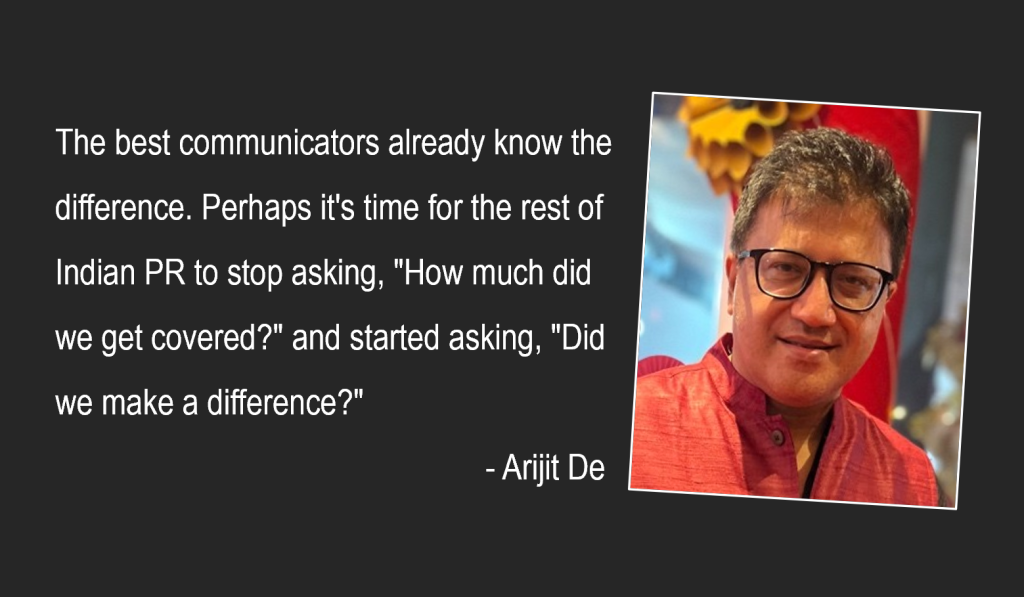
The best communicators already know the difference. Perhaps it’s time for the rest of Indian PR to stop asking, “How much did we get covered?” and started asking, “Did we make a difference?”
By Arijit De
(Director, Adfactors PR)
_________________________________________________________________________________________________
The views and opinions published here belong to the author and do not necessarily reflect the views and opinions of the publisher.

