

Part 1
Student distraction reflects declining classroom relevance, not shrinking attention spans; curiosity offers a powerful, practical path to re-engagement
Walk into almost any classroom today and you’ll see the same scene: a smart, capable group of students, half-locked into your discussion, half-distracted by buzzing phones and AI-powered tools promising instant entertainment.
Educators are competing with platforms engineered to hijack attention, and losing is not an option if we want a generation that can still think deeply, not just scroll quickly.
The good news: you don’t have to, or rather you can’t, out-entertain Instagram and the likes. You just have to offer more meaning than it does. When students feel that their ideas matter, they will give you the kind of focused attention social media can’t buy, says research on curiosity and learning.
Short attention span is not the problem
On the surface, it appears as if Gen Z just can’t focus. But the data tells a more nuanced story. Studies show that curiosity and psychological safety correlate with higher academic performance and well-being. When students feel safe to ask questions, be wrong, and explore, they engage more deeply. It appears thus that a safe space might be the solution to the lack of engagement in a classroom.
What looks like a short attention span is often a rational response to environments that feel low on relevance and high on risk. If the classroom feels like a test of perfection, the brain does what it has been trained to do: seek faster, easier dopamine elsewhere.
The implication for educators and institutional leaders is clear: attention is not a fixed trait tattooed individually or collectively on students to complain about; it’s a design outcome you can influence.
Curiosity is your competitive advantage
What is the competitive advantage of social platforms? They constantly keep users on the edge. What’s new and what’s next are big curiosity elements. Following this success mantra, classrooms should win the attention battle by sparking curiosity. The safe space built by classrooms should offer more than what meets the eye. Theories and concepts should be accompanied by curiosity-kindling applications.
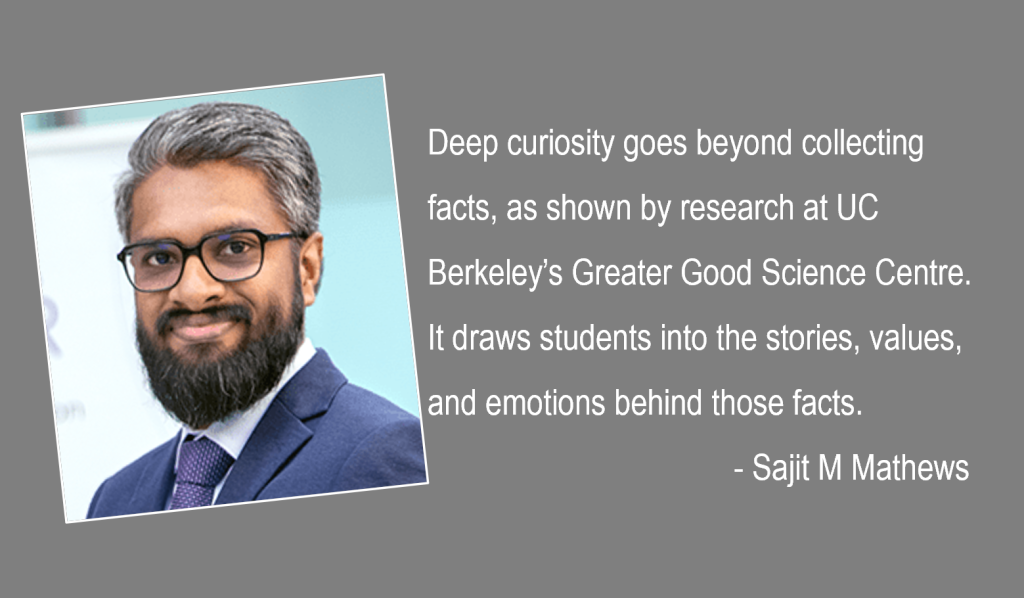
Deep curiosity goes beyond collecting facts, as shown by research at UC Berkeley’s Greater Good Science Centre. It draws students into the stories, values, and emotions behind those facts. It’s about building a human context around information, surfacing stories, values, and emotions. That kind of curiosity doesn’t just involve and keep students awake; it pulls them into relationships with concepts, their peers and instructors.
- Here is a simple example of how language shift can support this transformation: A professor’s “I don’t know” models intellectual humility. It shows it is ok to not have all the answers.
- “Tell me more” turns quick student comments into deeper dialogue. It signals that their bids for attention are worth your time. It values and rewards students’ curiosity.
- “Who else?” encourages silent students to come forward. It says, ‘you’re not background characters.’
One might feel that these are soft phases and don’t matter. But their impact is hard-edged. Such language brings more trust, encourages more participation, and creates more time spent thinking instead of checking out.
Design the lesson like a product experience
If tech companies succeed by investing heavily in user experience, educators can do the same for learning experience. Therefore, instead of planning a 60-minute lecture, create focused bursts of attention to fit the duration: short, focused segments, each with a clear cognitive payoff. In other words, we teachers should adapt to how our students consume information these days.
Here is a practical model of a focused burst of attention:
- Opening: a hook that ties content to students’ real lives — a recent headline, a dilemma, a viral social media story
- Input (high-value): a concept, a case, a demo
- Engagement: Use questions. “What surprised you? ”, “Where does this show up in your world?”, “What’s one question this raises for you?”
- Close: use a quick synthesis; students share insights or remaining questions.
Research on neuroscience and attention shows that information is more likely to stick when there is novelty, challenge, and relevance. You don’t need to gamify everything; you need to engineer moments where students feel their mental effort matters right now. In this effort, success depends less on covering the whole world of information and more on making specific ideas locally meaningful to the students in front of you.
___________________________________________________________________________________________________________
The views and opinions published here belong to the author and do not necessarily reflect the views and opinions of the publisher.