

When I founded my public relations consultancy twenty-six years ago, the client brief was blissfully straightforward. Success meant a flawless multi-city press launch, a brilliant feature story, or managing a localized crisis with a few well-placed phone calls. We were valued for our media relationships, our writing, and our ability to tell a compelling story.
Today, in 2026, my role feels less like a traditional PR partner and more like a combination of a geopolitical risk advisor and an organisational therapist.
My phone no longer rings with questions about press coverage. Instead, it buzzes late at night with frantic WhatsApp messages from CEOs asking: “If we pull our manufacturing out of this conflict zone, how do we handle the inevitable nationalistic backlash?” or “An AI-generated deepfake of our regional lead is going viral on social media—how do we stop our stock price from tanking before the opening bell?”
We are living in an era of permanent polycrisis. Regional conflicts fractured global trade alliances, hyper-nationalism, and weaponized algorithms have converged to make corporate reputation incredibly volatile. For agency founders, our greatest challenge isn’t just defending our clients’ brands anymore. It is maintaining our own sanity—and theirs—while steering organisations through global ideological minefields.
Here is the perspective I share with my team and our clients on how to stay grounded when the world feels like it’s spinning out of control.
- The Death of the Neutral Bystander
For decades, the safest advice a consultant could give a multinational brand was to stay politically invisible. The old ‘golden rule’ was simple: focus on the business, respect local laws, and leave international statecraft to the politicians.
That playbook is dead. In today’s hyper-connected, deeply polarized world, silence is routinely weaponized as complicity, while speaking out risks immediate retaliation.
Every operational decision a company makes is now viewed through a political lens:
- Choosing where to house a regional data center is no longer just an IT or cost calculation; it is a statement on data sovereignty and national security alignment.
- Exiting a market due to rising operational risks is instantly translated by the public as either a principled moral stand or a cold-hearted betrayal.
When clients panic, our job as consultants is to act as the circuit breaker. We have to look them in the eye and say: “You cannot be everything to everyone.” The moment a brand tries to appease every ideological faction across the globe, it loses its identity entirely. Sanity begins when we help clients define their non-negotiables before the world demands them.
- The Radical Power of Strategic Silence
The algorithmic outrage machine thrives on speed and volume. Whenever a global flashpoint occurs, there is an intense, immediate pressure on corporations to issue statements, take sides, or change their social media logos.
But thirty years in this business have taught me that the loudest voice in the room is rarely the most respected.
One of the most valuable services we can offer our clients today is the counsel of Strategic Silence. When a client’s leadership team is desperate to “say something” just to stop the noise, we must slow them down and run the situation through a strict, human gut-check:
- The Connection: Does this geopolitical event directly impact our people, our operations, or our core business purpose?
- The Impact: Can we actually do something tangible to help, or are we just participating in performative virtue signaling?
- The Cost of Consistency: If we take a public stance today, are we prepared to hold the exact same moral standard when a similar crisis occurs in a high-revenue market tomorrow?
A Note for the C-Suite: Authenticity cannot be manufactured in a crisis response document. If a client’s public words do not match their operational reality, a public statement is a major liability. True strategic counsel often lies in helping a client find the courage to remain silent publicly while taking quiet, meaningful action internally to support their employees and stakeholders.
- Navigating Synthetic Panic and Information Warfare
The nature of the threats we manage has evolved from critical op-eds to sophisticated information warfare. We are now defending clients against coordinated, AI-orchestrated disinformation campaigns and synthetic media designed to destabilize corporate trust within minutes.
When a highly realistic, AI-generated rumor can wipe millions off a market cap before lunch, traditional reactive PR fails entirely. To keep our clients sane and safe, we have to shift their infrastructure from defense to predictive resilience:
- From Monitoring to Threat Intelligence: Traditional social listening tools that track mere “brand mentions” are obsolete. We need to deploy threat intelligence to identify whether a negative narrative is growing organically among real customers or being artificially amplified by hostile bot networks.
- Pre-emptive Trust Architecture: You cannot build a shield while arrows are already flying. We must work with clients during peaceful times to build deep reservoirs of institutional trust with regulators, key media houses, and communities. When a synthetic crisis hits, a client’s reputation is protected by the historical credibility they have earned over years, not the speed of their rebuttal.
Contd…
- The Discipline of Deliberation: The instant instinct of a modern executive in a crisis is to post an immediate denial. As external advisors, we must have the institutional gravitas to say: “Stop. Rushing out an unverified statement into an information vacuum can compound the damage. We will respond when we have verified the reality.”
- The Agency Blueprint: Keeping Our Own Teams Sane
As consultancy founders, we need to talk about our own people. If our agency teams are burning out by chasing every digital fire, we cannot provide steady counsel to our clients.
To remain the ultimate sanity check for the boardrooms we advise, we must evolve our own agency dynamics:
Trade Press Releases for Geopolitical War-Gaming
Do not wait for a trade dispute or a regional conflict to disrupt a client’s market footprint. Bring their leadership teams into a room for quarterly simulation exercises. Map out hypothetical geopolitical fractures, identify the communication vulnerabilities, and draft response frameworks before the crisis hits the newsroom.
Cultivate Comms Professionals as Macro Analysts
The modern PR professional can no longer afford to be a specialist only in media relations. Our account leads and strategists must understand global macroeconomics, supply chain logistics, and regional policy. If an agency team cannot comprehend how a diplomatic shift impacts investor sentiment, they cannot provide meaningful counsel.
Conclusion: The Steady Hand on the Wheel
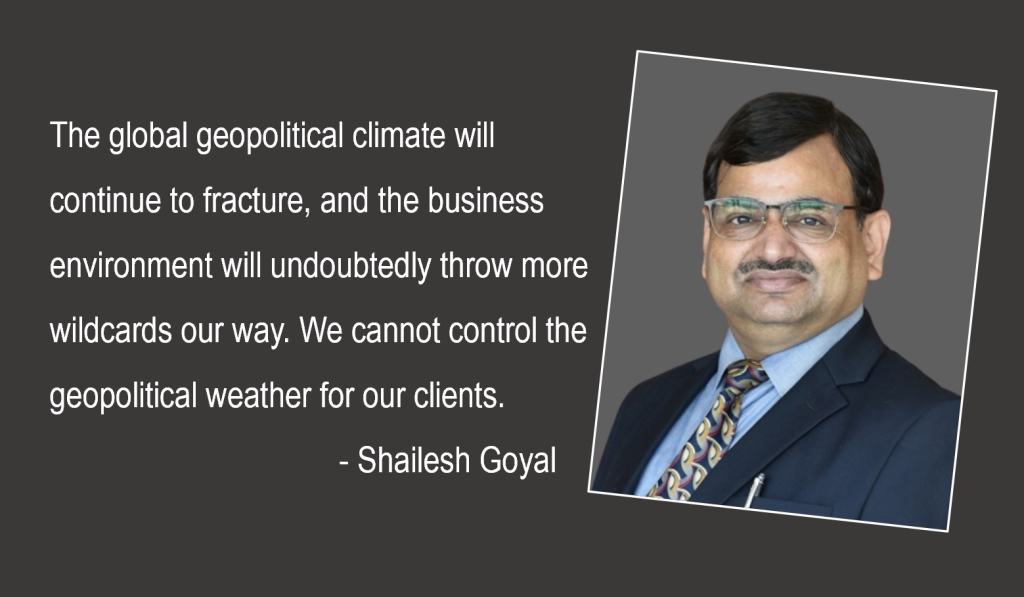
The global geopolitical climate will continue to fracture, and the business environment will undoubtedly throw more wildcards our way. We cannot control the geopolitical weather for our clients.
But as communications advisors, our true value lies in our ability to be the steady hand on the wheel—providing the objective, clear-headed, and deeply human perspective that helps businesses look past the daily noise, protect their reputations, and preserve their sanity.
(Dr Shailesh Goyal is Founder Director of Simulations Public Affairs Management Services Pvt. Ltd.,
a leading reputation management consultancy)
_________________________________________________________________________________
The views and opinions published here belong to the author and do not necessarily reflect the views and opinions of the publisher.

