

Let us face it. Too often PR is being presented as a series of outputs that look like marketing activity. Reports list placements and mentions as if ticking boxes is the same as earning influence. Strangely, the focus is shifting from reputation to volume, and what gets measured drives behaviour. When PR is treated like marketing, credibility erodes and visibility suffers. Clients notice it even if they cannot articulate it. Authority quietly declines while competitors who understand the distinction pull ahead.
Nothing in the PR profession is black and white. There are a thousand shades of grey. That said, the public often confuses Public Relations (PR) with Digital Marketing. While Digital Marketing can be part of PR activity, as most communications professionals understand, the consultancies that handle PR and those that handle Digital Marketing are usually different. Yet the public today seems largely oblivious to this. You will often see social media posts, influencers or even YouTubers blaming PR professionals for actions and outcomes that are actually the result of marketing maneuvers.
For anyone responsible for communications strategy, this is a blind spot you cannot afford. And this is why every communications leader must spot the difference before it costs your brand or your client’s brand.
Primary insight
The problem is deceptively simple. Digital Marketing pushes messages to an audience and is designed for measurable action and conversion. PR earns trust, builds authority and shapes perception through third-party validation. They are not interchangeable. Confusing the two creates misalignment and undermines long-term results. Marketing prioritises leads, clicks, impressions and direct response, often relying on paid or owned channels where control is absolute. Campaigns are constantly optimised for measurable conversion.
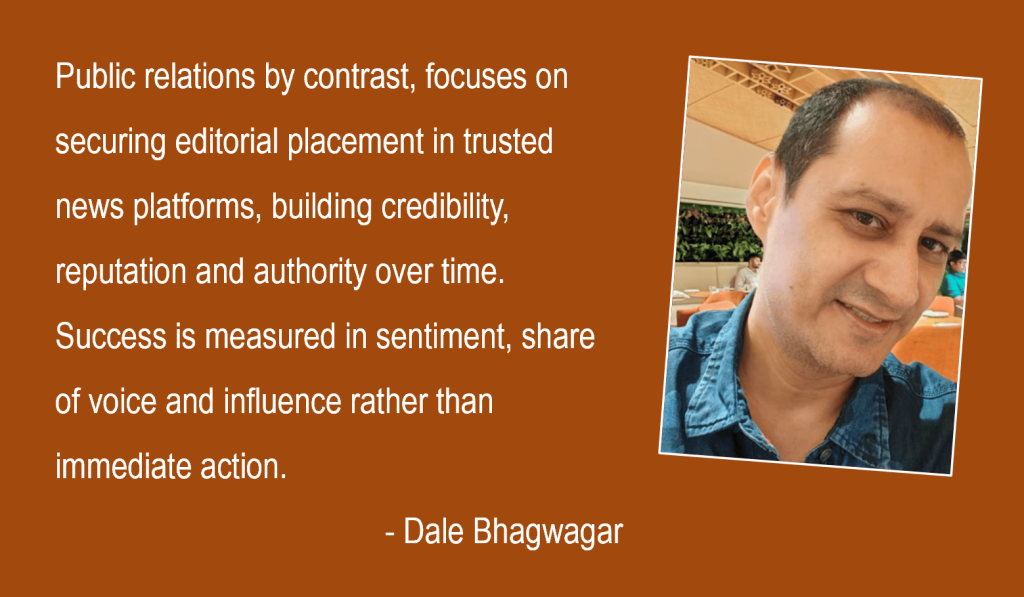
PR, by contrast, focuses on securing editorial placement in trusted news platforms, building credibility, reputation and authority over time. Success is measured in sentiment, share of voice and influence rather than immediate action.
Authority-first SEO
Brands that treat PR as Digital Marketing end up with reports full of placements that look impressive but do not shift perception. Authority is harder to measure but far more valuable. Authority-first SEO comprises a strategy that prioritises earned coverage in high-authority publications to generate backlinks, citations and credibility signals that boost long-term visibility.
How brands and publishers are responding
Some organisations are already making the distinction in practice. News and lifestyle publications now separate branded content teams from editorial teams completely. Sponsored content sits under Digital Marketing budgets while earned coverage remains a core editorial responsibility. This separation clarifies intent for both clients and audiences.
Corporate communications teams are adopting similar approaches. Many are creating dedicated earned media teams while leaving promotional campaigns, paid news placements, search campaigns or email marketing to other specialists. This is not just a structural decision. It signals a focus on what genuinely builds credibility and long-term trust with stakeholders.
Internal organisational impacts
These changes are quietly reshaping teams and roles. Firms increasingly recruit media relations specialists rather than combining PR and Digital Marketing responsibilities. Press releases and earned editorial coverage are treated differently from campaign outputs. Reporting lines are changing and resourcing decisions are shifting accordingly. Companies that continue to merge these roles risk falling behind competitors who understand the nuanced difference between building influence and driving conversion.
New strategy lever
Authority-first SEO is emerging as a critical lever for PR. It is not about keyword manipulation or volume coverage. It is about securing earned mentions in high-authority publications such as mainstream news sites including legacy websites and veteran websites, premium business portals and even top new-age lifestyle and entertainment news websites.
Editorial weight generates credibility, creates backlinks and signals authority to both audiences and search engines. Organic coverage in respected news publications delivers long-term visibility that paid campaigns cannot replicate. Teams that combine the trust signals of earned media with strategic SEO gain influence that compounds over time.
Brands that confuse PR and marketing struggle to maintain trust and authority. Those who get it right see their reputation strengthened, their visibility amplified and their long-term influence secured. Authority is earned. It cannot be bought or faked. The organisations that embrace this reality are the ones that win consistently in a crowded and noisy market.
Stop chasing metrics and start building credibility
The lesson is clear. PR is not a checklist and it is not a performance metric you can optimise like a campaign. It is influence, credibility and authority delivered through the voices that audiences already trust. Brands and communications leaders who continue to blur the lines risk spending time, money and effort on outputs that never translate into genuine impact. Those who separate earned media from paid initiatives, who understand how to leverage editorial trust and authority-first SEO, gain something far more valuable than temporary visibility. They create perception that sticks, reputation that withstands scrutiny and influence that grows over time.
In a market saturated with noise, clarity becomes your advantage. Your ability to earn authority rather than buy attention is what will differentiate your brand, elevate your campaigns and ensure you are remembered for substance rather than volume. The choice is simple: Play the short game or secure the long-term win.
The views and opinions published here belong to the author and do not necessarily reflect the views and opinions of the publisher.

