

People quit people, not companies. I have always believed this, not as a slogan, but as a lived reality. While perks & numbers matter, but people rarely disengage because of them alone. They primarily disengage because of the way they are made to feel, especially from the leaders who end up leaving a longer imprint than any policy document.
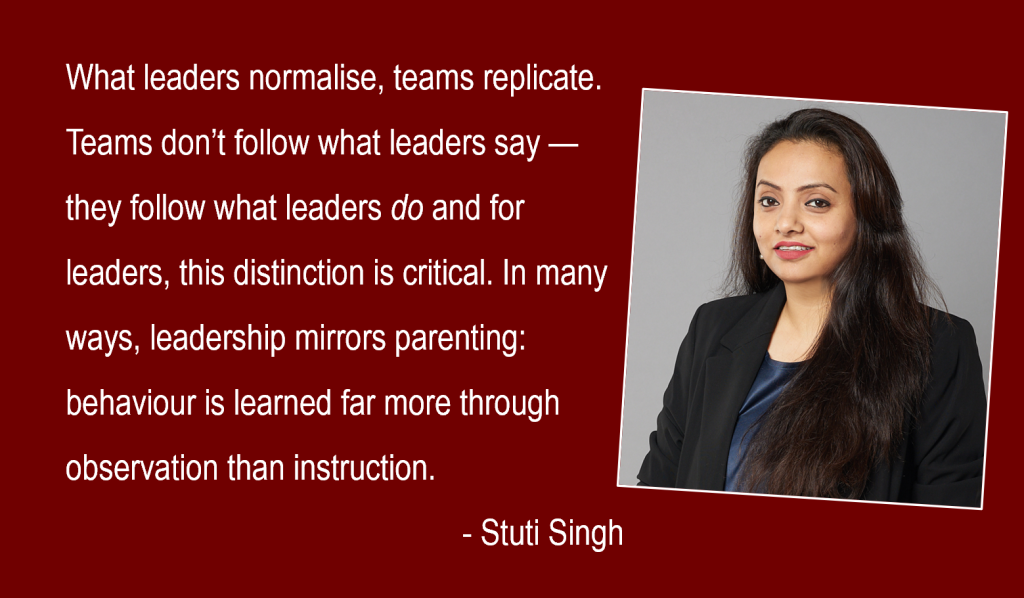
What leaders normalise, teams replicate. Teams don’t follow what leaders say — they follow what leaders do and for leaders, this distinction is critical. In many ways, leadership mirrors parenting: behaviour is learned far more through observation than instruction.
Leadership as Behaviour Modelling
From early on, I have been very conscious of the fact that my team would eventually reflect me — not my intent, but my conduct. That awareness shaped how I choose to lead. I always tried to build a relationship that was friendly, yet unmistakably professional. Not performative warmth, but psychological safety anchored in clarity. I wanted people to feel comfortable being honest, especially when honesty was inconvenient.
If someone was running late because they overslept, I would much rather hear that than an elaborate excuse about a doctor’s appointment. The truth may cause momentary discomfort; a lie compounds risk.
My rule was clear and consistent: If you are honest, we will handle it. If you are not, we may land up in trouble together.
The Small Moments That Shape Trust
I remember a team member once coming to me and saying, quite plainly, “Ma’am, can I leave early today? I need to get my hair washed. I promise I’ll finish all my tasks before I go.”
There was no rehearsed justification. No attempt to sound more important than the truth. Just honesty. For me, honesty mattered far more than the reason itself.
Whether it was applying for leave, requesting work-from-home, admitting a delay, or dealing with a difficult client conversation — honesty and sensitivity always mattered more than perception. Not because perception isn’t important, but because perception built on distortion eventually collapses.
Trust, once broken, is far harder to rebuild than a missed deadline.
What This Taught Me About Reputation
Over the years, this approach reinforced something fundamental: reputation is built internally long before it is visible externally.
People don’t remember leaders for the number of policies they introduced. They remember how safe it felt to tell the truth. They remember whether honesty was rewarded or punished. They remember whether leadership valued integrity over optics.
These moments rarely find their way into leadership narratives. They are too ordinary, too quiet. But they form the emotional memory of leadership — and that memory travels.
Employees carry it forward into how they speak about their leaders, their organisations, and eventually, their cultures.
Leadership Beyond Perception
In today’s environment, where visibility often competes with substance, it is tempting to prioritise perception over principle. But perception without integrity is fragile. It cracks under pressure.
For leaders, the responsibility is not just to be seen doing the right thing, but to consistently do the right thing when no one is watching. Especially when honesty is inconvenient. Especially when sensitivity is required. Especially when the moment offers no reputational upside.
Because leadership is not judged only in moments of applause — it is judged in moments of trust.
What Endures
Long after roles change and teams move on, people remember how leadership made them feel in everyday moments — when they asked for flexibility, admitted mistakes, or choose honesty over convenience.
They remember whether integrity was lived or merely articulated.
That is where reputation is truly built — not in policies or perceptions, but in the moments no one sees, and everyone remembers.
_______________________________________________________________________________________________________
The views and opinions published here belong to the author and do not necessarily reflect the views and opinions of the publisher.