

Most B2B organisations are not failing at Account-Based Marketing. They are failing the organisational test ABM exposes. Before ABM becomes a strategy, it becomes a mirror. One that reflects how decisions are made across teams, how teams really collaborate, and how comfortable leadership is with structural change, not just tactical upgrades.
This is not another how-to ABM article. I am writing this piece to create a reality check for leadership teams considering Account-Based Marketing as their next growth lever.
Let’s be honest. Most B2B organisations do not fail at ABM because of poor execution, weak messaging, or the wrong technology stack. They fail because ABM exposes organisational truths they are not prepared to confront. That discomfort, more than any tactical gap, is what causes ABM initiatives to stall or quietly disappear.
ABM is not a campaign. It is a stress test of how an organisation truly operates its sales and marketing alignment.
When Does ABM Break? At the Illusion of Alignment
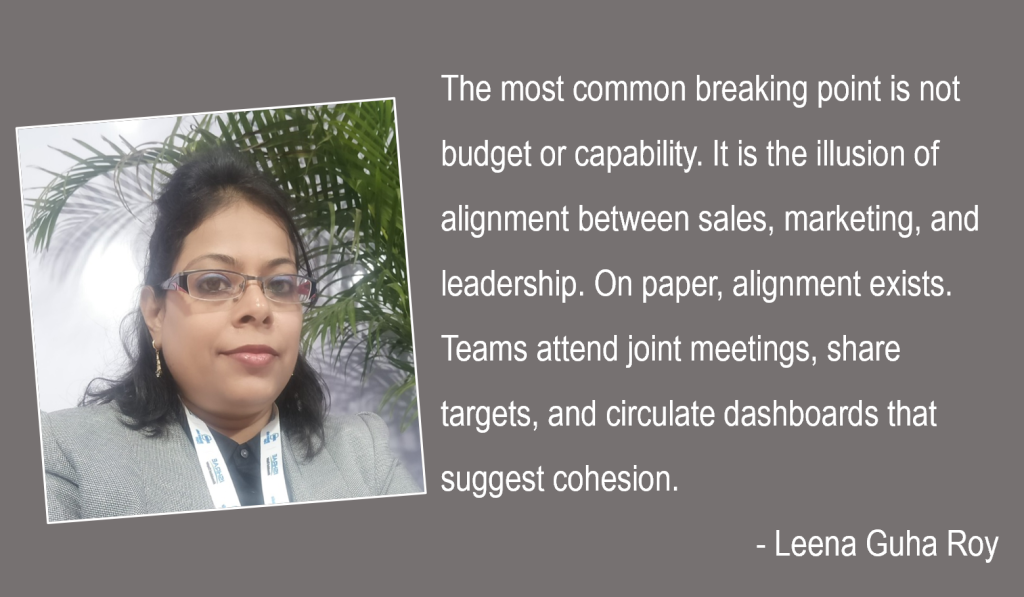
The most common breaking point is not budget or capability. It is the illusion of alignment between sales, marketing, and leadership. On paper, alignment exists. Teams attend joint meetings, share targets, and circulate dashboards that suggest cohesion. In practice, they optimise for different outcomes.
Marketing is rewarded for engagement and reach. Sales is rewarded for certainty and closure. Leadership is rewarded for forecast predictability. As long as volume exists, these differences remain hidden. ABM removes that cover.
When an organisation shifts from leads to accounts, misalignment surfaces almost immediately. There is no excess activity to mask confusion, no surplus leads to compensate for unclear ownership. Questions around accountability, prioritisation, and progress rise to the surface.
If alignment requires constant ‘sync calls’ to hold together, the organisation is not ABM-ready. In ABM, alignment must be structural, not conversational.
Buying ABM Tools Is Easy. Changing Behaviour Is Not.
This is where most organisations choose convenience over change. They invest in intent data, launch account-targeted advertising, and relabel existing reports as ABM dashboards. Externally, it signals progress. Internally, very little changes.
Sales continues to rely on intuition over data. Marketing still measures success through clicks and impressions. Customer teams remain downstream, involved only after key decisions are made.
At this stage, ABM does not fail outright. It gets quietly downgraded, often described as complex, slow, or unsuitable for the business. In reality, what failed was the willingness to change behaviour, not the ABM approach itself.
ABM does not forgive legacy habits. It exposes whether teams are prepared to make decisions differently, not just talk about them differently.
ABM Punishes Short-Term Thinking
Traditional B2B growth models are designed for speed and volume. They reward activity, rapid hand-offs, and short reporting cycles that create the illusion of momentum.
ABM operates on a different value system. It prioritises relationship depth over activity volume. Buying-group influence over individual leads. Sustained account progression over quick wins. For organisations accustomed to equating movement with success, this shift feels uncomfortable.
If leadership expects visible ROI before strategic patience has time to work, ABM will always appear inefficient. When quarterly optics matter more than long-term revenue quality, ABM is often the first initiative to be questioned.
This is not a flaw in ABM. It is a leadership constraint.
ABM Is Not a Marketing Upgrade. It Is an Operating Model Shift.
This is the conversation many organisations avoid because it challenges existing structures. ABM is often positioned as an evolution of marketing. In reality, it demands organisational redesign. True ABM requires shared ownership of revenue, a single version of account truth, and collective accountability when deals stall or expand. It removes the safety net of functional silos.
If teams still ask, ‘whose job is this?’, ABM has already failed. If pipeline friction is consistently blamed on another function, ABM will expose that behaviour quickly.
ABM does not coexist comfortably with fragmented accountability.
The Question That Actually Matters
Most leadership teams ask the wrong question. Not which ABM platform should we buy? But, are we ready to operate differently under an ABM model? ABM does not create organisational maturity. It reveals whether it already exists.
Below are the questions leadership should ask of themselves and of each team, before committing to ABM.
Leadership Readiness Checklist:
- Have we deliberately chosen fewer, higher-value accounts over broad-based scale?
- Are these accounts aligned with long-term revenue and strategic priorities?
- Is there shared ownership of target accounts across sales, marketing, and customer teams?
- Who is accountable when an account stalls, expands, or disengages?
- Do all teams operate from a single version of account truth?
- Are success metrics account-centric, not lead-centric?
- Do we track buying-group engagement, deal progression, and expansion?
- Do sales teams trust intent data enough to change their approach?
- Are pipeline, progression, and success defined consistently across functions?
- Is there clear governance for reviewing stalled or high-risk accounts?
- Is marketing measured on pipeline and revenue influence, not just engagement?
- Is technology investment driven by strategy, not vendor pressure?
- Do teams understand how intent, CRM, and engagement data work together?
- Are platforms integrated to support decision-making, not just reporting?
- Are customer teams involved early in account strategy?
- Are we willing to pause or stop ABM if readiness gaps are ignored?
How Boards Should Use This Checklist
- If most answers are unclear: Do not approve ABM yet. Fix the operating model first (GTM, and intent data alignment).
- If answers are mixed: Run a tightly governed, constrained ABM initiative; not a full rollout.
- If answers are strong: ABM can become a durable, scalable growth strategy.
Conclusion
ABM acts as a mirror held up to leadership. It reflects how decisions are made, how teams collaborate under pressure, and how comfortable an organisation is with long-term bets that do not deliver instant validation.
Before announcing an ABM strategy, pause and examine what the mirror is already showing. The answer may not be flattering. But ignoring it will be far more expensive than addressing it.
_______________________________________________________________________________________________________
The views and opinions published here belong to the author and do not necessarily reflect the views and opinions of the publisher.

