

If 2025 was the year the PR industry dipped its toes in the AI pool, 2026 is when the industry is cannonballing in, but with a life jacket made of pure human ingenuity. Imagine this: You’re in the pitching trenches, dodging algorithmic curveballs, and suddenly trust becomes your ultimate weapon.
Spray and pray tactics are dead in 2026. This year is about laser-focused strategies that prove PR isn’t simply fluff but the rocket fuel for business growth. As we kickstart 2026, the industry is buzzing with evolutions that blend cutting-edge technology with the magic of old-school relationships. Let’s dive into how public relations is morphing into a powerhouse of credibility, measurability and authenticity that will drive the success brands crave in an era of fast-paced, AI-dominated content.
AI is the sidekick, storytelling remains distinctively human
It’s a well-known anxiety: the fear that an algorithm might eventually draft your press releases, pitch your journalists, and take your seat at the table. As we’ve seen throughout 2025, the reality is far more interesting. AI isn’t the protagonist of the PR story. It’s the ultimate sidekick that handles logistics so PR professionals can focus on the soul of the narrative.
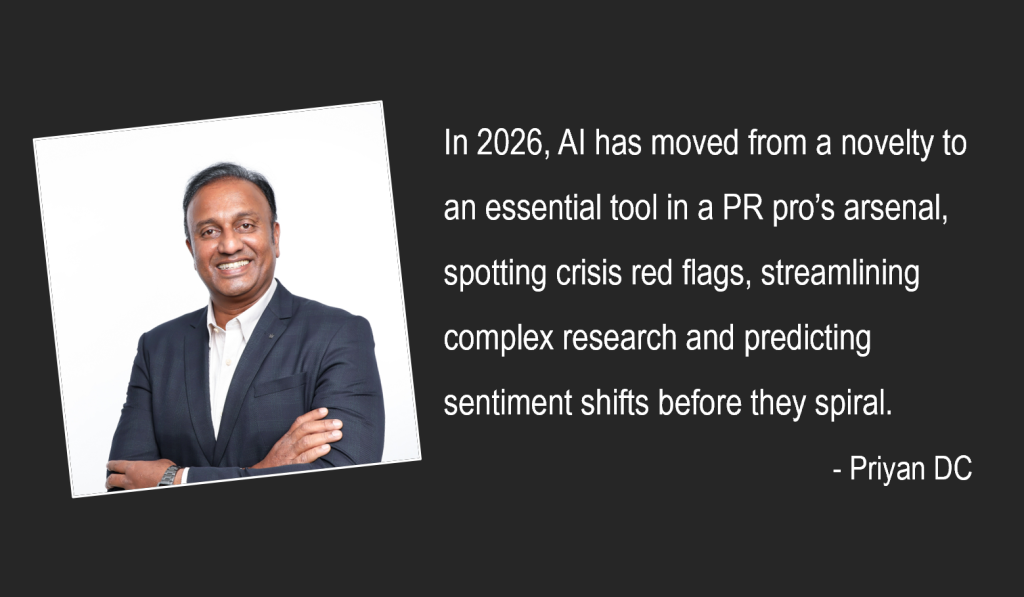
In 2026, AI has moved from a novelty to an essential tool in a PR pro’s arsenal, spotting crisis red flags, streamlining complex research and predicting sentiment shifts before they spiral. While 91% of PR professionals now use Gen AI for ideation and refinement, the “human moat” remains unbreachable. No algorithm can replicate the gut-level intuition or nuanced ethical judgement needed to turn a pitch into a meaningful earned media outcome.
It’s true that AI is a master of patterns but is a novice at context. A bot can spot a trend, but it can’t read the room and speak about a sensitive cultural moment. PR will always require humans to know when a pitch will land and what is tone-deaf versus timely. Humans understand the history of a specific journalist and their preferences. Ultimately, AI predicts, humans connect.
Human-centric PR is the anti-dote to AI slop
Everyone’s feeds are drowning in polished, AI-generated noise. When in fact, audiences are craving relatable, human-centric stories that feel like a chat over happy hour, not a corporate script. Media houses too now have their own guidelines on AI-generated content, with many mandating authentic storytelling. In 2026, authenticity reigns. Founder-led branding, imperfect human touches and genuine thought-leadership will cut through the clutter and stand out. While PR professionals experimented with increasing the volume of content with AI in 2025, this trend is shifting from volume to value and building trust through purpose-driven narratives and third-party validation like earned coverage, which is hard to fake. People seek real stories amid deepfakes and synthetic content. In 2026, expect target audiences to prefer real-life experiences as everyone is trying to combat digital fatigue.
While thought-leadership still remains relevant, the skills needed for writing longform PR are changing. Prompt engineering is fast becoming a must-have for PR professionals, and learning to work with AI is an on-demand skill that calls for upskilling. Thought-leadership content can no longer be SEO-focused. It’s not enough to rank number 1 on Google. It’s about ensuring your client is cited and sourced in AI-generated summaries. PR professionals in 2026 will become “architects of authority”. By mastering prompt engineering, PR professionals aren’t merely writing but structuring data and narratives so AI models recognise your client’s brand as the expert. While technical skills like prompt engineering and Generative Engine Optimization (GEO) have become the new “bread and butter,” humans still lead on strategy, empathy and soul. In this landscape, AI handles the grunt work, leaving teams to play the earned media game, where credibility always trumps clickbait.
Earned media for generative engine optimisation, smarter media relations
Earned media is the gold standard for credibility in an AI-powered search world. Shrinking newsrooms mean fewer journalists, so the game flips to deeper relationships, well-thought out personalised pitches, and authoritative storytelling that gets your brand cited in LLM outputs.
It’s important for PR professionals to claim this edge for brand visibility. Original, though-provoking messaging and news releases optimised for AI citations will become key. This is because third-party nods, like an earned media interview or mention in a major publication, become trusted sources that train algorithms to favour your client’s brand – effectively turning media relations into a strategic, relationship-first discipline as opposed to mass outreach.
Proving ROI and measurable impact
Executives and C-suite leaders aren’t buying “vibes” and “trends” anymore. They want hard links from PR wins to business outcomes like sales lift, share of voice, trust metrics, or reduced customer acquisition costs. This is where AI analytics is becoming the secret sauce, connecting media hits to real results with precision. Tighter budgets force creativity and in 2026 PR professionals will have to turn to always-on monitoring, multi-channel storytelling and narrative intelligence tools to predict risks and prove value. This is how we turn PR from a “nice-to-have” to a strategic growth engine, with teams proving ROI through citations in AI results and direct commercial ties.
Hyper-personalisation, and human-tech balance
In 2026, hyper-personalised campaigns and proactive reputation management, with a renewed focus on balancing tech with the human touch, will set winning PR teams apart from those that fall behind. Journalists aren’t deleting pitches because AI was used. They’re deleting them because AI made the pitch sound the same as everyone else’s. The tool itself isn’t the problem, but using it as a replacement for understanding what makes a pitch compelling is why many AI-generated pitches aren’t gaining traction. The teams getting real value from AI are those that use it for grunt work, then add the human layer that makes it relevant to specific journalists. When a journalist reads a pitch that feels like it was written specifically for them, that human touch is more likely to turn into an earned media win. Trust is the currency in the age of AI and a personalised pitch that shows you’ve done your research and you’re not spamming someone’s inbox is far more likely to get coverage that drives awareness, leads, or even converts to sales.
Final thoughts
Skills like storytelling, media savvy and AI literacy top hiring lists in 2026, while ethical dilemmas around AI get addressed head-on. The winners? PR professionals mastering the human-AI tango: using technology for efficiency and leaning on originality and irreplaceable elements like relationship building for authentic, purpose-driven narratives.
In the end, 2026 is PR’s moment for a real glow up. We’re architecting trust empires in a skeptical world by doubling down on what AI can amplify but can’t replicate: real connections, sharp strategy, and proven results. In 2026, adaptability isn’t optional. It’s a superpower. Those that adapt stand to win big.
____________________________________________________________________________________________________
The views and opinions published here belong to the author and do not necessarily reflect the views and opinions of the publisher.

