

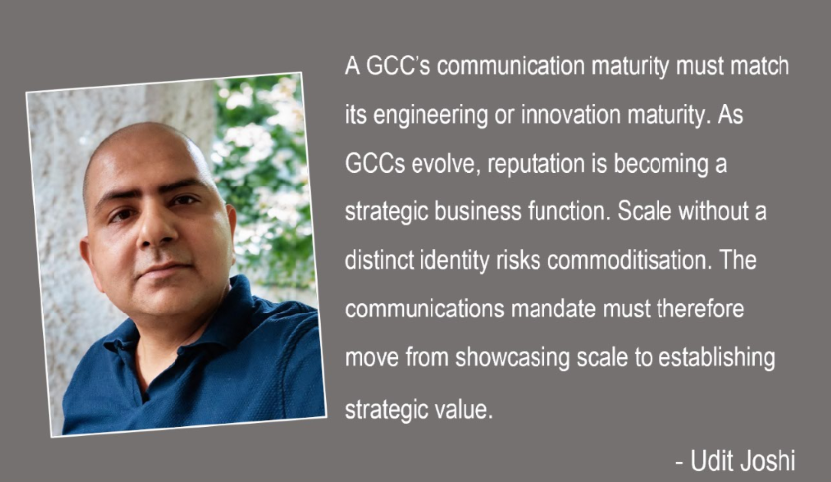
India’s GCC story has moved considerably faster than the communications brief around it. Walk through most centres in Hyderabad, Bangalore, Pune today and you will find teams taking end-to-end ownership of major global transformations. Zinnov and NASSCOM’s latest GCC landscape, classifies 39% of India’s GCCs as “Portfolio Hubs” with end-to-end ownership, and another 5% as “Transformation Hubs.” The operational reality of the market has changed, but the language used to communicate many of these centres has not caught up. Instead, it has led to the commoditization of GCCs. Everybody is starting to sound the same.
Employer branding remains important, but the brief of “make us attractive to talent” is becoming too narrow for a mature GCC. A careers campaign can help someone consider joining the centre, but it does very little to establish why headquarters should give that centre its next strategic mandate. Headquarters decides where the next product, technology platform, AI programme, or business function will sit. Those decisions are influenced by the credibility of the centre.
The talent equation has changed too. The most sought-after people in a GCC are often being approached simultaneously by product companies, startups, and other GCCs. They can afford to ask more sophisticated questions about the work itself: What will I build? How close will I be to the global business? What decisions will I influence? Who will I learn from? Whether the centre offers a good cafeteria or an impressive employee-value proposition is unlikely to compensate for limited ownership or a narrow career path. Zinnov’s 2026 talent research puts high-performer attrition in India’s GCC ecosystem at 16.5%, pointing to limited growth exposure and skill stagnation as important factors.
If employees discover that important decisions remain elsewhere, that local leadership has little visibility globally, or that career progression is limited, that gap becomes part of the GCC’s reputation. In a connected talent market, these realities travel quickly through professional networks, employee reviews, and informal conversations. The strongest employer brand is therefore often a consequence of the centre having a compelling proposition in the first place.
The more useful question for GCC leaders is therefore not simply, “How do we improve our employer brand?” It is, “What does this centre need to be known for?” There are numerous examples of launches where official press releases have not carried what the GCC does, and what it will do in India. Perhaps the HQ comms team expects the audience to already know about the company, and it’s legacy, but that is exactly where the local disconnect happens. I would encourage GCC Heads to focus on building a centre identity, rather than simply an employer brand.
There is also a very practical reason to have this conversation now. GCCs are working through their 2027 priorities and budgets, and employer branding generally has a recognisable home within talent acquisition or HR. Reputation management, PR, and external communications often do not. In some organisations, they remain entirely part of the parent company’s global communications mandate.
PR and reputation management deserve a separate budget conversation. They serve a wider stakeholder set – employees and candidates, certainly, but also global leadership, influencers, industry bodies, and partners. A meaningful allocation can support proactive storytelling around the centre’s work and leaders.
The timing matters because reputation is easiest to underestimate when everything is going well. A centre can spend years building a strong talent proposition and then find itself in the news because of a restructuring, leadership change, employee grievance, or technology incident. Take Walmart last year: an AI-first workforce restructuring quickly took on the narrative of lay-offs. At that point, it becomes clear whether the organisation has built relationships and credibility outside its recruitment ecosystem.
Another reason why organic PR will be more impactful is AI search. Gartner announced earlier this year that AI engines do not pull data from paid or sponsored articles. This is an important consideration for making enough room for PR in the budget to boost credibility and influence decision-making organically.
___________________________________________________________________________________________________________________________
The views and opinions published here belong to the author and do not necessarily reflect the views and opinions of the publisher.

