

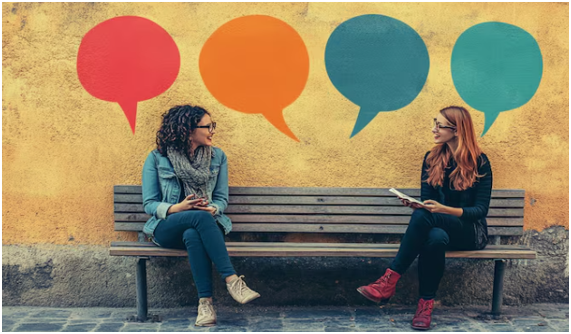
There was a time when the words, “Can we talk?” meant somebody would actually talk.
Today, the same conversation may begin with a WhatsApp message, continue through six replies, acquire two screenshots, produce an “Okay” whose emotional meaning is analyzed for twenty minutes, migrate into another conversation with a third person and eventually conclude with, “I think you misunderstood what I meant.”
According to me, and I keep saying this almost every now and then that all of this may have been resolved in a seven-minute phone call.
I am not nostalgic about technology. Messaging has made communication extraordinarily convenient. It allows us to communicate asynchronously across geographies, preserves information that needs to be referred to later and prevents every small query from becoming an interruption. There are many conversations that deserve a text rather than a call.
My concern is different. We have allowed the easiest communication medium to become the default communication medium, even when the conversation itself demands something richer.
That distinction matters.
A 2025 study in Computers in Human Behavior Reports challenges the popular belief that people routinely misinterpret the emotional tone of everyday texts and emails. Across two studies, researchers found that senders’ intended emotional valence and receivers’ interpretations aligned quite well. Check DOI That is an important corrective to simplistic claims that “text always gets misunderstood.”
But communication is more than recognizing whether somebody sounds positive or negative. Feedback, disagreement, disappointment, uncertainty, negotiation and reconciliation require us to process subtlety, respond to another person’s reaction and sometimes revise what we were going to say while saying it.
This is where the human voice still carries remarkable bandwidth. Research published in the Journal of Experimental Psychology: General found that interactions containing voice created stronger social bonds than text-based interactions, without producing the additional awkwardness people expected. Check PubMed
I think five quieter psychological shifts deserve our attention.
- We Are Losing the Information That Lives Between the Words
Consider the sentence: “Fine. Let’s do it.”
Agreement? Irritation? Resignation? Enthusiasm? Sarcasm?
The words remain identical. The human meaning can change completely.
Conversation carries what psychologists and communication researchers describe through various paralinguistic cues: pitch, pace, volume, hesitation, emphasis, pauses and rhythm. In person, facial expression and body language add further information. We rarely consciously decode all these signals. We simply experience them as part of understanding another human being.
The text compresses that bandwidth.
Interestingly, newer research on voice notes demonstrates that simply adding voice does not magically solve everything. A 2026 experiment involving 793 working-age participants found that voice notes could reduce negative interpretation bias compared with email when they reduced ambiguity but could worsen interpretation for some people when ambiguity remained. Check ScienceDirect
That nuance is important. The lesson is not “voice good, text bad.” It is that the medium should match the psychological complexity of the message.
“Meeting moved to 4 pm” needs almost no emotional bandwidth. “I was disappointed with how you handled yesterday’s meeting” carries considerably more.
We should stop using both as though they were the same communication problem.
- Text Gives Us Editing Control, but Conversation Gives Us Relational Feedback
There is something psychologically seductive about texting: we control our performance.
We can type, delete, rewrite, soften, add an emoji, remove the emoji, wait five minutes, reread the message and finally press send. Conversation denies us much of that control. It requires us to think in the presence of another person’s response.
That apparent disadvantage may actually be one of conversation’s greatest virtues.
In a real conversation, I hear your hesitation. I notice when you become quiet. I realize that the sentence I considered harmless has landed differently than I expected. I can immediately say, “That came out more strongly than I intended.”
Communication therefore becomes self-correcting while it is happening.
Text separates expression from reaction. By the time I discover how you interpreted my words, you may already have spent an hour constructing a story around them.This becomes particularly consequential in leadership. Feedforward and feedback should rarely be reduced to beautifully worded paragraphs exchanged asynchronously when the subject is sensitive. The objective of feedback is not merely to transmit an assessment. It is to create enough shared meaning for behaviour to change.
A message can deliver information. A conversation can negotiate meaning.
- Ambiguity Invites the Receiver to Become the Co-Author
One of the least discussed psychological consequences of text is that whatever the medium removes, the receiver must mentally supply.
When tone, expression and immediate clarification disappear, interpretation draws more heavily on context, expectations and the receiver’s existing mental model of the sender. Classic experimental work found that ambiguity in email could allow prior expectations about another person to exert greater influence on impressions than voice communication did, even when the actual words were held constant. ScienceDirect
This does not mean every “Okay” becomes a psychological crisis. Recent evidence, as noted earlier, shows that people can be quite competent at reading everyday textual tone. ScienceDirect
The problem appears when ambiguity meets emotional significance.
A delayed reply from someone I trust may mean “busy.” The same delay during a conflict can acquire an entirely different meaning. “Let’s discuss this later” from a supportive manager can feel procedural. From a manager with whom trust is already fragile, it can become ominous.The words have not necessarily changed. The psychological context has.
This is why complicated conversations conducted entirely through text can become surprisingly exhausting. We are no longer merely reading language. We are continuously interpreting punctuation, timing, brevity, silence and context.
Sometimes we are spending more cognitive effort understanding the message than we would have spent having the conversation.
- Messaging Can Create Communication Without Creating Connection
There is a paradox here that I find particularly interesting. We can now remain in contact with more people, more continuously, than at any previous point in human history, while still having fewer substantive conversations with some of them.
Frequency of contact and depth of connection are different psychological variables.
An experimental study published in 2025 compared support delivered in person, by video, voice and text after participants experienced a stressful task. In-person, video and voice communication produced broadly similar perceived support, satisfaction and affective outcomes. Text recipients, however, reported lower positive affect, less laughter and smiling, and perceived the support as less empathetic than those receiving it in person. Check PubMed
That finding should make us think beyond work.
A friend is going through something difficult, so we send a heart emoji. A colleague has experienced a setback, so we type, “Don’t worry, you did your best.” Someone shares important personal news and we respond with the appropriate combination of words and symbols.Nothing is wrong with these responses. The question is whether convenience sometimes allows us to mistake acknowledgement for presence.
A voice carries something a blue tick cannot.
- We May Be Saving Interruption While Creating Cognitive Residue
Text feels efficient because it is asynchronous. I can respond when convenient. You can read when convenient. Nobody needs to synchronize calendars for a two-minute exchange.
For transactional communication, this is enormously useful.
But difficult conversations behave differently. A 2022 study examining text-based communication during tasks requiring people to resolve ambiguity and reach shared understanding found that text-based interaction was more difficult than face-to-face communication for these “convergence” tasks and could leave participants more depleted for subsequent complex reasoning. ScienceDirect
Newer workplace research similarly highlights the double edge of instant messaging. A 2026 study found that workplace IM can support task accomplishment while also increasing employees’ need for recovery through perceived interruption. ScienceDirect
This exposes the false economy of some text conversations.
Think of it this way – A ten-minute call occupies ten consecutive minutes. A messaging exchange may consume three minutes here, two minutes there, another reply forty minutes later, a rereading of the earlier message, an interpretation of the latest response and part of our attention remaining attached to the unresolved thread throughout the afternoon.
The clock records fragments. The brain experiences continuity.
I would call this Conversational Residue, the portion of an unfinished interaction that remains cognitively active because meaning has yet to settle.
This is why the most efficient medium is not necessarily the one requiring the fewest uninterrupted minutes. It is the one that creates sufficient shared understanding with the least total cognitive and relational cost.
Choosing the Medium Is Now Part of Communication Intelligence
I am not advocating a return to an era where every small question required a telephone call. That would simply replace one communication problem with another. Messaging is excellent for logistics, confirmations, simple updates, documentation, links, factual questions and communication that genuinely benefits from asynchronous thought.
But the moment a conversation contains emotion, ambiguity, disagreement, developmental feedback, conflict, negotiation or relationship repair, we should at least ask whether our thumbs are being asked to do work that our voices would do better.
There is also a useful personal test. If you have rewritten the message four times, if the exchange has crossed ten replies, if you are wondering what the other person’s “Sure” actually means, or if you are discussing the text with somebody else in order to interpret it, the medium may already have failed you.
Call.
We have spent the last decade making communication faster. The next maturity may be learning when speed is no longer the point.
To end this piece, I’d say text is extraordinarily good at carrying words. Conversation carries words, tone, hesitation, warmth, repair and presence. Communication improves when we stop asking which medium is easiest and start asking which medium gives this particular human conversation the richness it deserves.
________________________________________________________________________________________________________________________________
The views and opinions published here belong to the author and do not necessarily reflect the views and opinions of the publisher.

