

In 2026, the expansion of computer vision is nothing short of profound, and today it is not just confined to labs and research teams anymore. In the industry for sports broadcasting, computer vision has become a practical, working layer of the production process, where its value lies not in the technology itself, but in what it makes possible, helping broadcasters turn what cameras capture into insights that can actually be used on air. The market for computer vision in sports and entertainment was valued at around US$690.8 million in 2024 and is expected to grow at a compound annual growth rate of about 19.3 per cent through 2030, indicating sustained investment in this area of broadcast technology.
At its simplest, computer vision teaches systems to understand the game as it unravels. Raw video is translated into structured information that feeds analysis, graphics, and editorial decision making in real time.
During sports coverage, the starting point for computer vision is not insight but detection. Cameras capture continuous streams of visual information, tracking player movement, ball trajectories, field markings, and the spatial relationships between them. Computer vision systems process these inputs frame by frame, identifying objects, tracking motion and recognising patterns that would be difficult to extract manually at speed. This forms the basis for many of the real-time insights that now appear on screen during coverage.
As these systems mature, the focus has transferred from what can be detected to what can be trusted. Live broadcasts demand absolute accuracy, consistency, and precise timing, particularly when visuals are tied to live play. Coverage has to remain consistent in changing light, from multiple camera angles, with players constantly moving in and out of frame, even in packed stadiums, without slowing the broadcast.
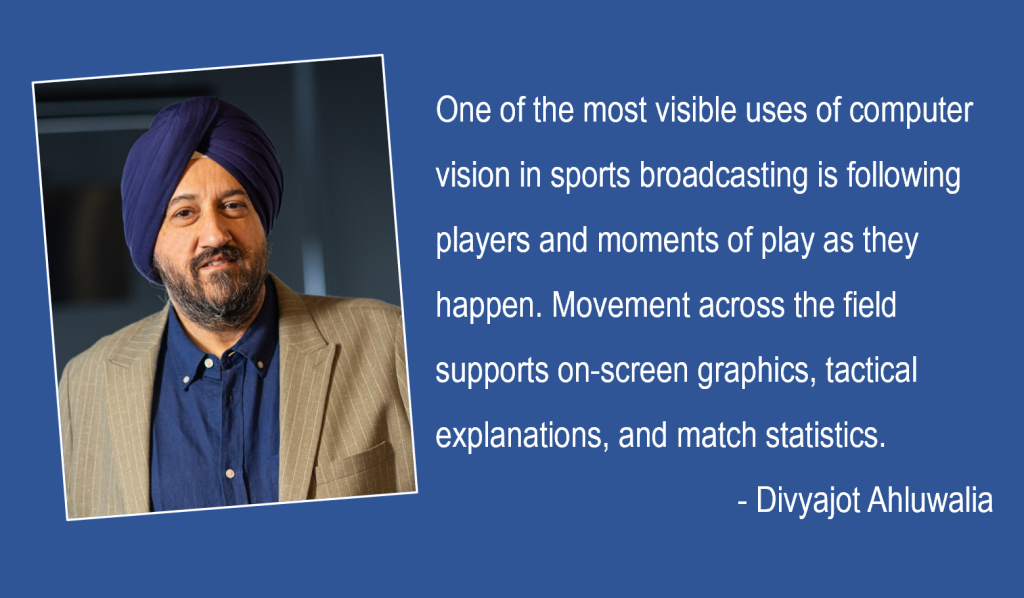
One of the most visible uses of computer vision in sports broadcasting is following players and moments of play as they happen. Movement across the field supports on-screen graphics, tactical explanations, and match statistics. When tied directly to the playing surface, these visuals stay connected to live action rather than appearing as standalone numbers.
Beyond tracking, computer vision also supports segmentation, which separates players and key areas of the field from the background. This capability allows graphics to interact more naturally with live pictures, particularly in crowded scenes where depth and overlap are constant challenges. Clear separation of visual elements keeps the action readable on screen while allowing additional context to be layered in.
At wTVision, computer vision operates within the broadcast workflow, tracking and visual separation are developed alongside graphics and live production systems. On-screen output follows broadcast requirements and live production constraints.
Live coverage is not the only place these visuals appear, they can also be seen in studio segments and post-match coverage which include movement, tactical sequences, and longer-term performance patterns as part of the broadcast. Integrated into analysis rather than layered on top of it, these visuals give structure to discussion without distracting from the broadcast.
As with other broadcast technologies, restraint also plays a critical role. Not every detected event or data point needs to surface on screen, decisions around what to show, when to show it and how long it remains visible are as important as the underlying detection itself. Computer vision delivers the raw capability, but editorial judgement determines its impact.
Within sports broadcasting, computer vision is assessed by its fit within live production environments. Its production depends on tools that operate predictably, integrate with broadcast graphics, and continue to function under the timing and pressure of live transmission. These elements sit within the production flow, supporting coverage without interrupting live transmission or distracting from on-screen action.
_________________________________________________________________________________________________________
The views and opinions published here belong to the author and do not necessarily reflect the views and opinions of the publisher.