

Part 2 of 2
As ChatGPT evolves from trusted adviser to commercial platform, the real question is whether users will continue to trust its answers.
OpenAI’s introduction of sponsored products inside ChatGPT answers is, at its core, a bet that conversational attention is worth monetising. We have already looked at what this means for brands — the upside of explicit intent and frictionless discovery, set against the risk of ‘pay-to-win’ perceptions and conversational brand-safety failures. The other half of that equation is the person on the other end of the chat window, and what this bargain looks like from their side.
Implications for consumers: the good
- Less intrusive retargeting: If ads are matched to the current conversation, and OpenAI shares only aggregated performance data rather than individual user data, you may see fewer “I mentioned this once and it followed me across the internet” moments.
- A cleaner, more legible bargain than today’s ad tech maze: A clearly labelled sponsored module is, at least, visible. Compared to invisible tracking and opaque auctions, “this is an ad” is refreshingly transparent.
Implications for consumers: the bad
- Advice-shaped ads: In chat, the sponsored unit can feel like the natural next step of the answer — a soft sell that borrows authority from the model’s tone. Even if the ad is separate, the organic answer can prime acceptance.
- Narrowing of choice: Search is messy but plural. Chat is tidy but singular. If the experience nudges you towards one option, you may lose the breadth you would otherwise see on a results page: price ranges, alternatives, dissenting reviews, and ‘good enough’ options.
- A paywall split in neutrality: Reuters reports ads are appearing for Free and Go, not for higher-priced tiers in the test phase. This may create the perception that the ad-free tier is the ‘unbiased friend’, while the free tier is the ‘monetised friend’.
A pattern of ‘jobs’: shopper vs scholar
A bigger pattern here is how AI tools are choosing different roles in different parts of your life. Your shopping assistant wants commerce. Your tutoring assistant wants learning outcomes. Google’s Gemini is openly leaning into the ‘personal tutor’ identity — partnering with The Princeton Review to offer full-length SAT practice tests inside Gemini and highlighting this in its 2026 updates.
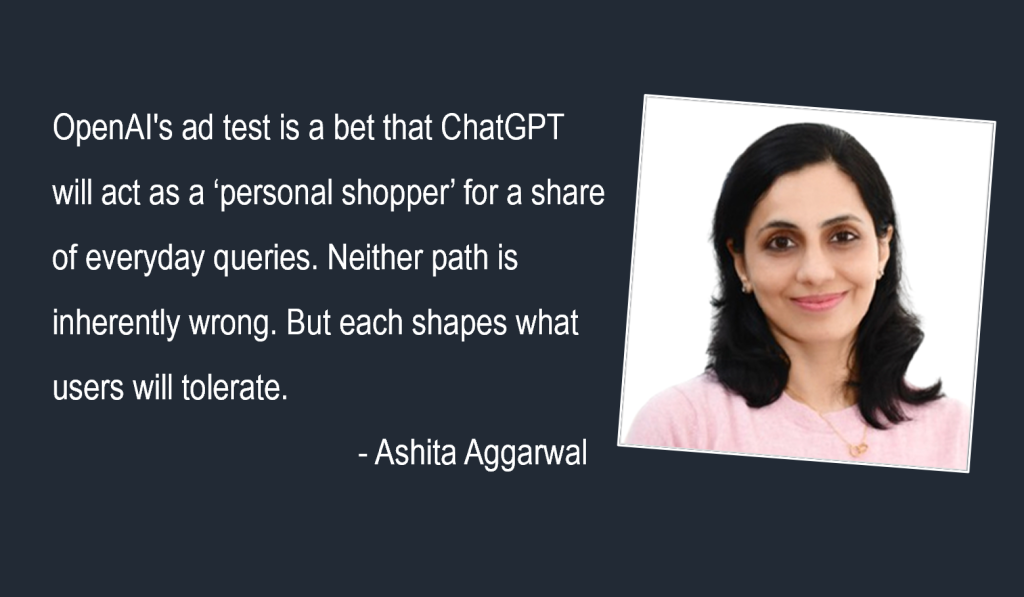
OpenAI’s ad test is a bet that ChatGPT will act as a ‘personal shopper’ for a share of everyday queries. Neither path is inherently wrong. But each shapes what users will tolerate.
For brands: supply the trust
- Optimise for AEO/GEO: Focus on Answer Engine Optimisation (AEO). Ensure product data — specifications, claims, and pricing — are verifiable and structured for AI synthesis, including follow-up questions.
- Plan like a scientist: Since traditional tracking is limited, use lift studies and holdout tests to measure the true impact of conversational attention.
- Protect the channel: Define where you should never appear and demand appropriate controls. Short-term wins in a low-trust channel can translate into long-term brand damage.
For consumers: demand the truth
- Audit the bias: Explicitly ask: “Exclude sponsored products and rank these options objectively.”
- The anti-prompt: Ask: “What would make this a bad choice for me?” This can push the AI out of a sales tone and back into an advisory one.
- Use controls: Dismiss irrelevant ads and use “Why am I seeing this?” to interrogate the AI’s logic.
Ads in ChatGPT could become either a ‘sponsored shortcut’ that funds access, or the beginning of advice-shaped persuasion that erodes what made the product distinctive. OpenAI is signalling the right intentions: separation, labelling, and clear restrictions.
But the real test is cultural: do users still feel the assistant is on their side? Because what is at stake is not whether you see an advert for protein powder. It is whether, the next time you ask a question that matters, you still trust the answer.
Continued from Part 1: ChatGPT has a new sponsor — and that changes the vibe
About the author: Ashita Aggarwal is Professor of Marketing at the S.P. Jain Institute of Management & Research (SPJIMR).
Views are personal.
______________________________________________________________________________________________________________________________
The views and opinions published here belong to the author and do not necessarily reflect the views and opinions of the publisher.

