

Once upon a time, organisations believed they could manage reputation. A press release was drafted, a journalist was briefed over coffee and a few favourable stories appeared the next morning. The clippings reached the boardroom and everyone felt reasonably reassured that the organisation’s reputation was intact. It was a comforting arrangement, but it is history now.
Today, reputation does not sit inside a department of corporate communications, it sits on somebody’s smartphone. It lives in Google searches, Glassdoor reviews, LinkedIn posts, Instagram comments, YouTube videos, WhatsApp forwards and online conversations that may begin without the organisation even knowing they exist. And sometimes, reputation is even reduced to a 20-second video. Twenty years of trust can suddenly find itself competing with twenty seconds of content. Welcome to the uncomfortable world of Digital PR.
You Don’t Own Your Reputation Anymore
Perhaps the first lesson organisations need to learn is also the hardest that you don’t own your reputation anymore, your stakeholders do. For decades, corporations have become accustomed to controlling narratives and they have been deciding what information to be released, when it would be released and, to a considerable extent, who would receive it. Digital media demolished that comfortable hierarchy. Everyone with a smartphone is now potentially a publisher, be it the dissatisfied customer, or the disgruntled employee, or the raging activist, or the protesting student, or the unhappy passenger.
The smartphone has democratised communication in ways that organisations are still learning to understand. This has created a peculiar reversal of power. A company may have a multimillion-dollar communication budget, a sophisticated PR agency and an army of consultants. Yet one authentic post from an ordinary individual can sometimes carry greater credibility than the entire machinery of corporate communication.
Audiences have become suspicious of perfection. The perfectly photographed CSR initiative, the carefully rehearsed CEO interview and the immaculately written corporate statement may communicate professionalism. But they do not necessarily communicate truth. And in the reputation economy, truth or at least what people perceive to be authentic, travels in the speed of light.
Time to Stop Talking and Start Listening.
It is ironic that corporate communicators today have more tools to communicate than ever and yet many organisations still don’t know how to listen. Look at an average corporate social-media feed, it is flooded with awards, conferences. leadership photographs, product announcements, CSR initiatives, festival greetings, and inspirational quotes. Essentially, making it a digital notice board.
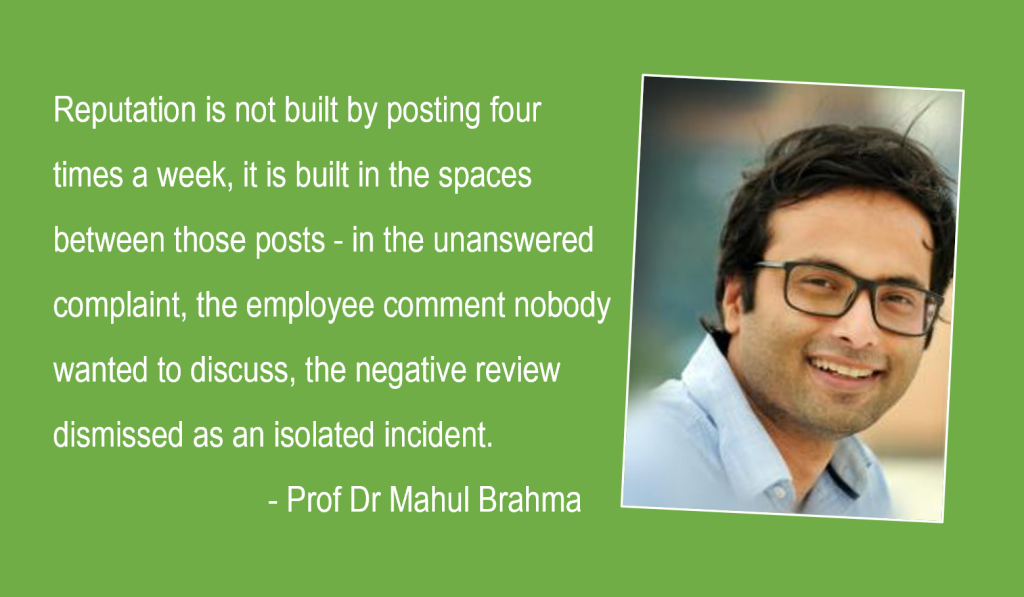
Reputation is not built by posting four times a week, it is built in the spaces between those posts — in the unanswered complaint, the employee comment nobody wanted to discuss, the negative review dismissed as an isolated incident. Social listening software can measure sentiment, mentions, engagement and trends. Artificial intelligence can analyse thousands of conversations almost instantly. Behind every dashboard is something technology can easily make us forget: a human being. A negative sentiment score is not merely a number turning red on a screen. Somebody might be angry for real. The question is whether anybody inside the organisation is prepared to understand why.
The Age of Storytelling May Be Ending
For years, we in communication have celebrated storytelling in which every brand needed a story. Sustainability, diversity and purpose became a story. Even leadership became a story. It makes me wonder whether we have told too many stories. Because audiences are no longer merely listening, they are investigating. If a company talks about sustainability, somebody will examine its environmental record. If it celebrates diversity, employees may talk about what inclusion actually feels like inside the organisation. If it claims that customers come first, there will probably be a digital trail showing how customers were treated when something went wrong.
This changes the fundamental role of PR. The future of reputation management cannot simply be better storytelling. It has to be better truth-telling and the distinction matters.
Storytelling asks: How do we make ourselves look good?
Truth-telling asks: Are we actually as good as we claim to be?
That second question is far more uncomfortable but far more valuable.
Visibility Is Not Reputation
We have also become obsessed with visibility. The digital world has turned communication into a dashboard, and dashboards have a seductive quality. They make everything appear measurable, but what exactly are we measuring? A brand can have two million followers and very little trust. A CEO can have hundreds of thousands of LinkedIn followers and still appear disconnected when a genuine crisis arrives. An organisation can dominate Google search results and still fail the simplest reputational test of trust. Visibility can be bought, attention can be engineered, reach can be amplified but not trust. Trust remains stubbornly analogue in a digital world. It comes from keeping promises. Treating people decently. Acknowledging mistakes. Correcting them. And behaving consistently when nobody is applauding.
A Crisis Now Begins Before the Meeting Does
The old crisis-management model assumed something that organisations can no longer afford – time. Today, while that meeting is being scheduled, the crisis may already have accumulated 500,000 views. Screenshots travel. Old posts resurface. Commentators speculate. Algorithms reward outrage because outrage keeps people engaged. The organisation is suddenly not merely managing a crisis, it is managing the velocity of emotion. This does not mean organisations should respond recklessly. Speed without facts is dangerous. But silence has changed meaning too. Online, an information vacuum rarely remains empty. Somebody will fill it, usually with speculation. Sometimes the most credible first response is remarkably ordinary: “We know there is a concern. We are investigating it. We will return with verified information.”
The CEO is Part of the Reputation
Leadership once had the luxury of hiding behind the corporate identity. Not anymore. A leader’s digital behaviour increasingly becomes part of the organisation’s reputational architecture. A thoughtful CEO can humanise an institution. An arrogant one can humanise it too, just not in the way the PR department intended. Employees, customers, investors, journalists observe leaders. So, during a crisis, silence from leadership can sometimes communicate as loudly as a statement. This is why leadership communication cannot simply be outsourced to communication professionals. A PR team can polish language. It cannot manufacture empathy.
Reputation Is Memory
We usually define reputation as perception. I increasingly think reputation is something else. Reputation is memory. It is what people remember about you after the campaign has disappeared from their feed. It is how a customer remembers being treated when a product failed. How an employee remembers the organisation behaving during a difficult year. How society remembers what a company did when doing the right thing became expensive. And how people remember whether an apology resulted in actual change.
Digital PR can influence these memories. It can contextualise events, correct misinformation and amplify responsible action. But it cannot permanently compensate for irresponsible behaviour. That may be the most important reputational lesson of the digital age.
The future will bring AI-generated content, synthetic influencers, deepfakes, algorithmic misinformation and reputational crises we have probably not yet imagined. Technology will make communication faster, cheaper and infinitely more abundant. Which means something else will become increasingly scarce – credibility.
Perhaps the organisations that survive the coming crisis of credibility will not be those that communicate the most. They will be those whose communication most closely resembles their behaviour. Because reputation has finally left the boardroom.
_____________________________________________________________________________________________________________________________
The views and opinions published here belong to the author and do not necessarily reflect the views and opinions of the publisher.