

In today’s hyper connected world, where social media platforms serve as both megaphones and magnifying glasses, misinformation spreads with the speed of a click and the impact of a headline. For communication professionals like me, this presents a formidable challenge— and an even greater opportunity. The landscape of crisis communication has fundamentally shifted. We are no longer just managing crises; we are managing the perception of truth.
The Double-Edged Sword of Digital Access
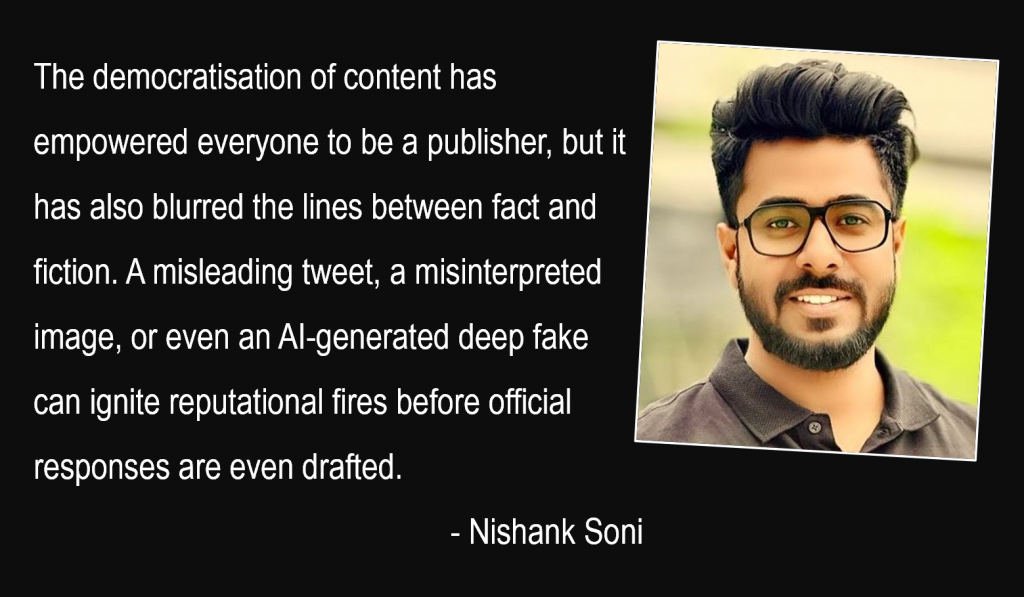
The democratisation of content has empowered everyone to be a publisher, but it has also blurred the lines between fact and fiction. A misleading tweet, a misinterpreted image, or even an AI-generated deep fake can ignite reputational fires before official responses are even drafted. Misinformation doesn’t wait for a press release—it trends, travels, and transforms within minutes.
As someone entrusted with safeguarding corporate reputation and public trust, I have seen how rapid response and message discipline are now only the starting points of a more nuanced strategy.
From Reactive to Proactive
The old crisis playbook—acknowledges, responds, recovers—is no longer sufficient. In an age where false narratives can gain more traction than the truth, we need to shift from reactive to proactive communication. This means investing in social listening tools, scenario planning, and crisis simulation exercises that include misinformation response tactics.
During one campaign last year, our team noticed a misrepresented info graphic circulating on social media. It could have undermined months of branding efforts. Because we had real-time monitoring in place and a pre-approved escalation protocol, we were able to counter the narrative within 30 minutes—using a combination of fact-based visuals, influencer amplification, and direct audience engagement.
Speed, Transparency, and Empathy
When misinformation arises, speed is critical—but not at the cost of credibility. Stakeholders are looking for not just facts, but authenticity. Robotic statements devoid of empathy do more harm than good. That’s why every response must be rooted in three principles: speed, transparency, and empathy.
Being transparent does not mean divulging every internal detail. It means acknowledging what you know, what you don’t know, and what you’re doing to find out. Empathy, meanwhile, means addressing concerns from the perspective of those affected—be it customers, employees, or the wider public.
The Human Voice Matters
One powerful antidote to misinformation is the human voice. Whether it’s the CEO addressing the issue via LinkedIn, or a subject-matter expert explaining the facts in a short-
form video, real people telling real stories cut through digital noise. This is why we actively invest in media training for leaders and empower teams to communicate with both facts and feelings.
Building a Resilient Communication Culture
The ultimate defense against misinformation is trust—a currency earned over time through consistent, transparent, and values-driven communication. Organisations must embed crisis readiness into their culture. This means:
- Equipping employees to identify and flag
- Creating cross-functional crisis response
- Simulating misinformation scenarios to test agility and
In conclusion, the age of misinformation is not a temporary disruption—it is the new reality. But with the right tools, training, and mind-set, it is a reality we can not only manage but master. As communicators, we are the first responders of the reputation economy. Let us embrace the responsibility not just to inform—but to illuminate.
The views and opinions published here belong to the author and do not necessarily reflect the views and opinions of the publisher.

