

PRAXIS 2026
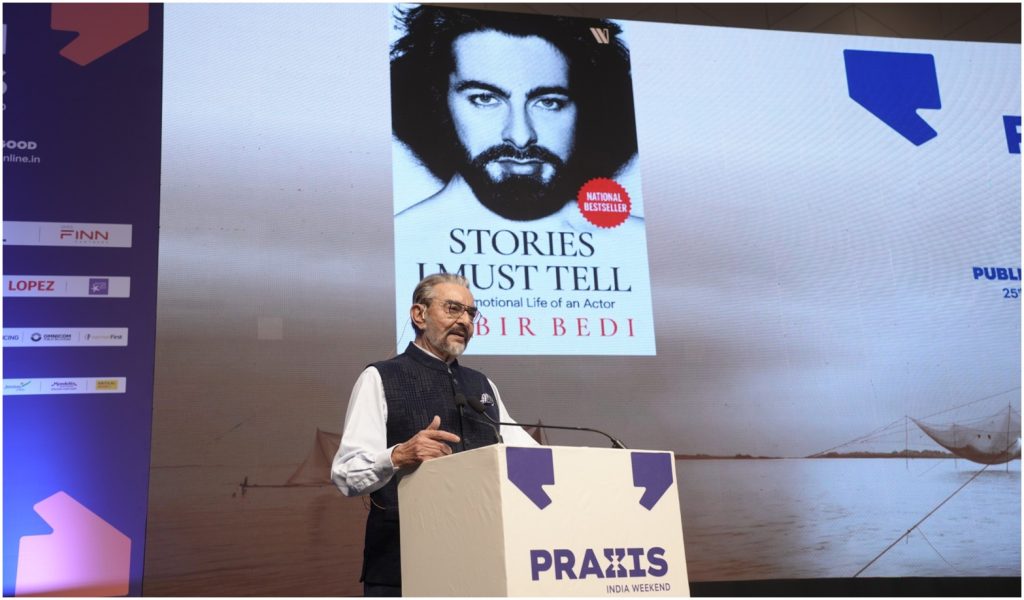
Keynote Address 5: Kabir Bedi, actor & author
Storytelling as a Force for Good
In #PRAXIS2026, we paid attention to a popular person as he elaborated on storytelling, loss, reinvention, and his award-winning autobiography.
Born to a Sikh father and an English mother, Kabir Bedi, actor and author, has always been a fusion of ideologies and creativity. Before films and television, he explored radio, advertising, and theatre. His career now spans more than five decades and several mediums. At the session on “Storytelling as a Force for Good,” he actually showed that he is as compelling on stage as he is on screen!
The Oldest Technology We Have
Bedi, who worked in the corporate communications world before becoming an author, opened with a question: what is the oldest technology humanity possesses?
His answer was immediate. “It was stories which made us more human, because it gave a context to everything!”
He moved through a wide range of storytelling traditions, from Kerala’s Kathakali to Uncle Tom’s Cabin, Schindler’s List, the Ramayana, the Mahabharata, and the diary of Anne Frank. Then he turned to his own book, describing “the prism of stories that made me go back and forth in time.”
From Freedom Fighters to a “Mission Impossible”
Bedi’s parents were idealistic freedom fighters who turned to spirituality after independence. That upbringing shaped him, and he described spirituality’s influence on his life as “immense.”
After college, he set out on what he calls his “mission impossible”: interviewing the Beatles. His early career took in All India Radio and ad agencies including Lintas and Ogilvy, before the screen found him.
The Story He Was Reluctant to Tell
The hardest chapter for Bedi to write was the loss of his son, which had a “dramatic impact” on him. He nonetheless chose to share the story of his son’s battle with schizophrenia.
“I wanted people to understand more about it,” he said. “It’s not just the person going through it who suffers. The tragedy affects his entire family as well. I want to remove the stigma that is attached to mental illness.”
Why do stories matter? Why are we so fascinated by stories? Bedi’s answer was that “the strength of a great story is that it gives meaning.” He then turned the idea inward: “The most important story is the story you tell yourself.”
“You shape and can reshape the story you tell yourself, and what you believe shapes your reality!”
His autobiography, Stories I Must Tell, won the Most Popular Biography award. It has been translated into Italian and Spanish, as well as Hindi and Marathi, and Bedi is planning another edition.
Then we heard about Sandokan and the Italian craze. In conversation with Naina Bhalla, EVP, Growth & Strategy at V360 Group, Bedi said nothing in his career has matched the popularity of Sergio Sollima’s 1976 mini-series Sandokan, the saga of a romantic Southeast Asian pirate in the era of British colonialism.
“Sandokan became a craze in Italy and across Europe. It continues to this day. Sandokan has made me a part of their consciousness,” he said. “I lived in Italy like no other person had done. I got the glory, but the director is the real hero!”
On the subject of reinvention, Bedi was direct: “The biggest risk for a creative person is stagnation,” he said, urging people to reinvent themselves to discover every side of who they are.
With his parents being spiritual, what was the impact of spirituality in his life? It was an immense”!
Your creativity is your reinvention – it will change your life which you cannot imagine, was his parting shot.
______________________________________________________________________________________________________________________________
The views and opinions published here belong to the author and do not necessarily reflect the views and opinions of the publisher.