

When a company prepares to go public, every word spoken by its leaders can greatly influence its listing journey. A single slip of tongue can trigger regulatory scrutiny, spook investors, or detail months of planning. Yet many companies treat media training as a checkbox exercise rather than the strategic imperative.
In the previous blog, I talked about the key elements of a successful public debut and the role of a robust communications strategy during the pre-IPO phase. Today, let’s focus on one of the most critical aspects of IPO communications – Media Training for Leadership. Media training is the most underrated yet important aspect of communications, which can greatly influence a company’s public perception. In this high-stakes environment of intense scrutiny from key stakeholders, media training becomes a non-negotiable component of the IPO comms strategy.
Why Media Training Matters
The Securities and Exchange Board of India (SEBI) has laid down clear guidelines on what companies can communicate and disclose in the public domain to avoid potential influence on investors and the market. Hence, forward-looking statements or unverified claims are strictly prohibited during the IPO phase. Leaders are brand ambassadors of the company, and every statement they make has a huge influence on the market debut.
Media training ensures that leaders:
- Understand the dos and don’ts of IPO-phase communication
- Engage with the media confidently and handle difficult questions with composure
- Present the IPO story with authentic data and an engaging narrative
- Maintain consistency across all stakeholder interactions
- Navigate the fine line between being transparent and being compliant
Cost of Poor Media Preparations
In my experience working with IPO-bound companies, I’ve observed three common pitfalls that proper media training prevents:
- The Overshare: Leaders who reveal strategic information not yet disclosed in the offer book/ prospectus
- The Defensive Stance: Executives who become visibly uncomfortable when questioned about rational behind valuation, risks or competitive threats
- The Jargon Trap: Spokespersons who fail to translate complex business models into language that resonates with diverse audiences
- I know Everything farce: Leaders who appear delusional, less open to criticism and too much indulged in organizational pride
Role of the Comms Team in Getting Leaders Media Ready
The comms team plays a significant role in equipping leaders with resources and techniques for a successful media briefing. They identify coaches, prepare training modules, and draft briefing documents and media FAQs. The comms team should have a clear understanding of the goals of media training to get optimum results. Here is a checklist for comms for a successful media training:
Owning the Narrative: A strong and compelling story can not only give you an edge but also help build credibility among media, investors, employees, and other key stakeholders. Define the company’s vision, growth story, financial strength, and future roadmap. Focus on simplicity over jargon-led communication. Ensure the communication is in line with SEBI guidelines. Avoid forward-looking statements and anything that won’t be part of your offer book.
Preparing Spokespersons: Identify key spokespersons (MD, CEO, CFO, etc.) and their talking points. Prepare briefing documents on valuation, financials, risks, and the competitive landscape. Equip spokespersons with information on the media landscape, key publications, journalists, interview formats, etc. Align all spokespersons on the same narrative to avoid miscommunication. Focus on building trust, emphasize the core message, back it up with strong facts and figures, and highlight USPs.
Getting Familiar with Media: Facing the media can be overwhelming and lead to anxiety and nervousness. Train spokespersons on various formats of interviews such as offline, live on TV, and virtual. It is important that they are comfortable with the technology and gadgets such as microphones and other instruments. Body language, voice modulation, pitch, eye contact, emphasis & content, clothing, and grooming are other crucial elements of winning media interviews that leaders should be trained on. Record mock interviews and organize in-house press conferences with imaginary crisis situations to prepare them for high-pressure scenarios.
Nonverbal Communication: People not only catch words, but they also catch expressions and reactions. Sometimes, leaders lose temper or become defensive while handling uncomfortable questions. Train them on mindfulness and handling media tactically. Teach techniques to steer conversations back to key messages without sounding disrespectful toward the other person.
Social Media Profile Audit: As leaders are at the center of attention, what they speak and write on social media platforms also comes under media scrutiny. A thorough audit of leaders’ personal social handles is important to avoid any reputational crisis that might harm the IPO. Comms should conduct thorough audit 6-8 months in advance. Review all posts, comments, and interactions across LinkedIn, Twitter/X, Facebook, Instagram. Identify and address potential red flags: controversial political statements, inflammatory language, inconsistent messaging. Most importantly, check for any activism or advocacy that might conflict with corporate positioning.
Regular Review: Media training is not a one-time activity; it extends beyond public listing. Once public, media training needs shift from IPO compliance to ongoing investor relations, crisis preparedness, and thought leadership positioning. Periodically review media engagements, conduct sentiment analysis of interviews and coverage to identify negative trends. Analize media engagement strategies of competitors to learn from their best practices. Training on podcast interviews, LinkedIn Live, social media takeovers prepare leaders to engage with new age media. Informal media gatherings are another way to get familiar with journalists.
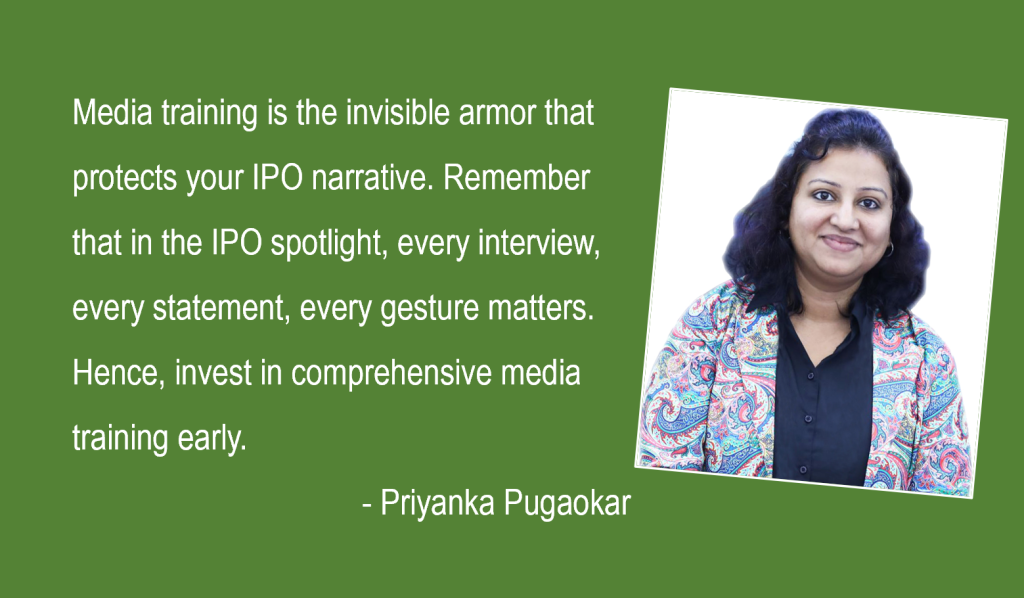
Media training is the invisible armor that protects your IPO narrative. Remember that in the IPO spotlight, every interview, every statement, every gesture matters. Hence, invest in comprehensive media training early.
_____________________________________________________________________________________________
The views and opinions published here belong to the author and do not necessarily reflect the views and opinions of the publisher.