

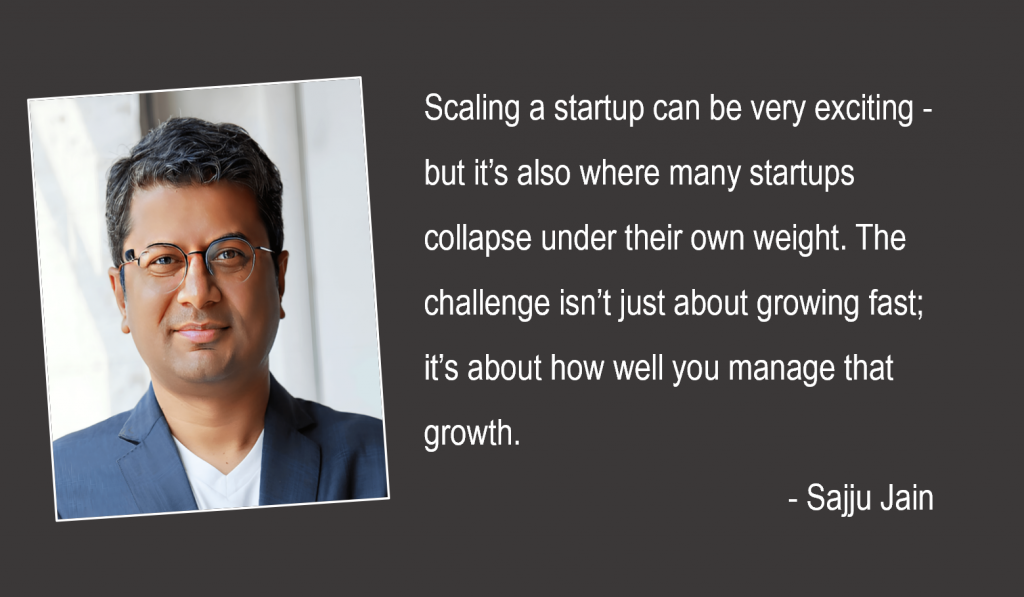
Scaling a startup can be very exciting – but it’s also where many startups collapse under their own weight. The challenge isn’t just about growing fast; it’s about how well you manage that growth. Without structure, rapid expansion can lead to chaos – high cash burn, bloated teams, and loss of focus.
So, how do you scale smartly – without losing control?
The answer lies in validating your growth strategy, prioritising wisely, hiring strategically, managing cash flow, and implementing scalable processes. Let us break it down.
Step 1: Validate Before You Scale – Use MMP, Instead of MVP
A common mistake founders make is scaling before truly validating their product. Most choose to use the Minimum Viable Product (MVP) approach – the simplest functional version of their product to test market demand.
But in India, an MVP often isn’t enough. Indian consumers expect quality and reliability from Day 1. That’s why a Minimum Marketable Product (MMP) is a better approach. Unlike an MVP, an MMP isn’t just about testing an idea – it’s a version that is good enough to attract paying customers and build early traction.
Example: Flipkart learnt from Amazon’s history and initially didn’t launch as a one-stop e-commerce store. It focused on just selling books and creating a smooth buying experience before expanding to other product categories. That’s MMP in action – start small but with a marketable product instead of just a raw prototype.
Step 2: Set Priorities – Avoid Distractions
Once your product gains traction, the real battle begins: What should you focus on next?
Many startups try to expand everything at once – new features, new markets, and bigger teams. That’s a recipe for chaos. Instead, focus on what actually drives growth.
Here are two proven prioritisation techniques:
- a) The 80/20 Rule (Pareto Principle) – Identify the 20% of actions that drive 80% of results and focus on them.
- b) RICE Scoring (Reach, Impact, Confidence, Effort) – Before saying yes to any initiative, score it low or high based on:
Reach: How many customers will benefit?
Impact: How much value does it add?
Confidence: Are we sure this will work?
Effort: How much work does it take?
If an idea has Low Reach + Low Impact + High Effort? Drop it.
Step 3: Hire Slow – Fire Fast
Hiring too early creates unnecessary overhead. Hiring too late slows growth. So, what’s the sweet spot? Only hire when absolutely necessary. If an automation tool can replace manual work, use that first.
Next, hire problem-solvers and builders, not just employees. In a startup, you don’t need people who just “complete tasks.” You need owners who can figure things out.
And finally, fire fast. If someone gets through who is slowing things down or is a poor culture fit, don’t delay the tough decisions. A bad hire can set you back months.
Example: Zerodha built a billion-dollar company with just over one thousand employees, while its competitors hired tens of thousands. Their secret? Automating operations instead of bloating the team.
Step 4: Manage Cash Wisely – Growth Doesn’t Mean Burning Money
Scaling a startup is expensive but burning cash without a plan is a death sentence. Many startups fail not because they don’t grow, but because they run out of money before reaching profitability.
Follow these three key financial principles:
- Track your burn rate and runway on a weekly basis. Always know how many months of cash you have left.
- Focus on revenue over funding. Investors worldwide are increasingly prioritising profitable growth over reckless spending. Focus on making money, not just raising money.
- Understand unit economics thoroughly. If every new customer costs you more than they bring in, you’re scaling a broken model. Fix this before expanding.
Step 5: Process Equals Stability – Chaos Kill Growth
A fast-growing startup without processes is like a car with no brakes. If you don’t build scalable systems, you will see breakdowns everywhere – operations, customer service, hiring, and even decision-making.
Here are some simple frameworks to keep things running smoothly:
- Utilise Time Blocking – Set fixed hours for activities like meetings, deep work, and admin tasks. Avoid random, unplanned calls as much as possible.
- Implement OKRs (Objectives and Key Results) – Instead of unorganised to-do lists and projects, set measurable goals and align your different team around them.
- Automate As Much As Possible: From customer support chatbots to payroll systems, remove manual effort wherever you can.
Example: Swiggy and Zomato faced scaling challenges as their delivery networks grew. They solved this by investing in automation and AI-driven logistics to optimise delivery routes, instead of just hiring more people.
Final Thoughts – Grow Smart, Not Just Fast
Scaling isn’t just about speed – it’s about sustainability. The startups that survive aren’t the ones that grow fastest, but the ones that grow smartest. So, how will you scale? Will it be with chaos or with control? The choice is yours.
The views and opinions published here belong to the author and do not necessarily reflect the views and opinions of the publisher.