

India’s series sweep against Zimbabwe give Smriti Mandhana a winning start as captain. Her bigger challenge is building a consistently successful team
India’s 3–0 ODI series sweep against Zimbabwe, completed on 28 October, gives Smriti Mandhana an emphatic start as India’s full-time captain. Coming after a 3–0 sweep in the T20I series, the results marks a winning momentum across formats. Yet, beyond the trophies and the clean sweep, a more consequential question awaits Mandhana: how does a captain turn a successful start into a sustained culture of winning?
Mandhana inherits a team that has already crossed a historic threshold. Under Harmanpreet Kaur, India won its maiden Women’s ODI World Cup in 2025, marking a defining moment for Indian women’s cricket. Mandhana now has the opportunity to build on that achievement. Her two Women’s Premier League (WPL) titles with Royal Challengers Bengaluru (RCB) also provide valuable experience of leading a winning side. The challenge is to ensure that success becomes repeatable rather than episodic.
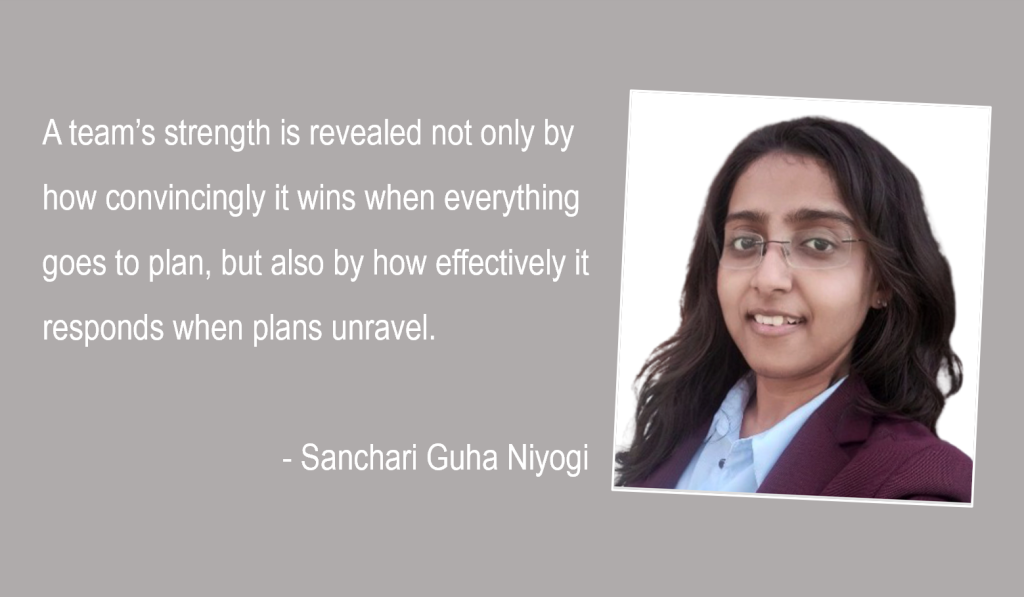
There is an important management lesson here. Winning a series is an outcome; building a consistently successful team is an organisational capability. A team’s strength is revealed not only by how convincingly it wins when everything goes to plan, but also by how effectively it responds when plans unravel.
For Mandhana, this means looking beyond immediate results. How does the batting order respond when early wickets fall? Are bowling changes guided by a coherent match strategy or dictated by the pressure of the moment? And when familiar weaknesses resurface, does the team merely acknowledge them or change the way it prepares?
Sustained performance depends on how effectively a team learns. Post-match analysis has limited value if the same mistakes recur without corrective action. Teams must recognise patterns, understand why they persist and translate those insights into training, selection and match preparation. The objective is not to eliminate every error, which is impossible in competitive sport, but to ensure that experience improves the quality of subsequent decisions.
Mandhana’s opening series victories provide a positive foundation, but stronger tests will emerge against more demanding opposition and under less favourable conditions. Her leadership will be judged by whether India can preserve its composure when the advantage shifts, adapt its tactics when opponents find a weakness and recover collectively from setbacks. A winning culture is not one in which a team never loses; it is one in which losses generate learning rather than recurring vulnerabilities.
Equally important is the distinction between individual excellence and collective performance. Mandhana’s batting stature gives her considerable influence, but a captain cannot be expected to provide every answer or rescue the team in every difficult situation. India needs experienced players who take ownership of their roles, younger players who feel trusted to make decisions and a dressing room where difficult conversations can take place without every failure becoming a permanent label.
This is where distributed leadership becomes important. When responsibility is shared, the team becomes less dependent on a single individual’s form or judgement. Players are more likely to take initiative, communicate problems early and make sound decisions under pressure. The captain’s authority is not diminished by empowering others; it is strengthened when the team can function effectively even when individual performances falter.
Mandhana must also balance immediate results with the longer-term development of the side. Building a successful national team is different from assembling a competitive franchise for a defined tournament. It requires continuity, clear role definition, the integration of emerging players and the ability to prepare for different formats without losing sight of the team’s broader identity. Maintaining strategic direction while remaining willing to adapt will be central to her tenure.
There is also a legacy to preserve. Harmanpreet’s contribution cannot be reduced to individual results or isolated setbacks. The 2025 World Cup triumph demonstrated what Indian women’s cricket could achieve and raised expectations for what should follow. Effective succession is not about replacing the past with a new leadership identity; it is about preserving what works while creating the conditions for further progress.
For Indian women’s cricket, the stakes extend beyond the boundary. As the sport attracts greater visibility and ambition, the team has an opportunity to establish standards of performance that endure beyond a captain, a tournament or a generation of players. That means developing collective discipline, tactical adaptability and institutional learning rather than relying disproportionately on a handful of extraordinary individual performances.
Mandhana could hardly have asked for a more encouraging start. But the significance of these series victories will ultimately depend on what follows. Her greatest contribution may lie less in the trophies she lifts than in the players she develops, the decisions she enables others to make and the standards she establishes when India is under pressure. The real measure of her leadership will be whether she builds a team capable of sustaining success.
__________________________________________________________________________________________________________________________________
The views and opinions published here belong to the author and do not necessarily reflect the views and opinions of the publisher.