

If outrageous thinking is so central to meaningful innovation, the obvious question is whether it belongs in the classroom at all. And if it does, how can it be taught without tipping into fantasy or irresponsibility?
This is not a call for reckless thinking or fantasy planning. Just as effective negotiators understand constraints, creative managers must remain grounded in business realities. The difference lies in sequencing. Creativity demands that imagination precede constraint, not the other way around. When constraints dominate too early in the thinking process, they shrink the solution space before it has had a chance to expand.
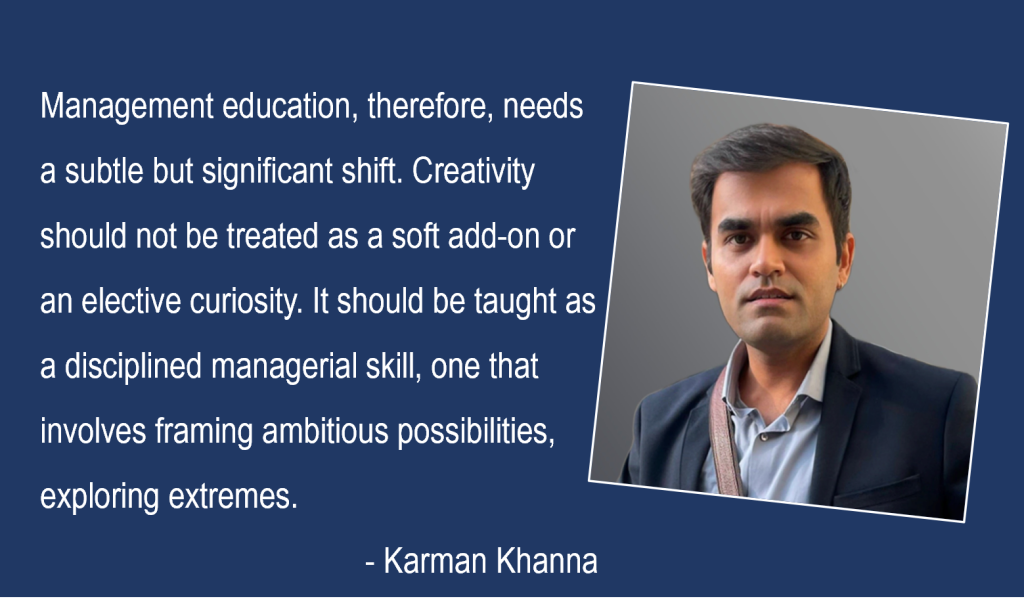
Management education, therefore, needs a subtle but significant shift. Creativity should not be treated as a soft add-on or an elective curiosity. It should be taught as a disciplined managerial skill, one that involves framing ambitious possibilities, exploring extremes, and then systematically working toward feasibility. Students should be rewarded not only for arriving at ‘correct’ answers but also for demonstrating how far they were willing to stretch before negotiating their way back. For business leaders and recruiters, this shift has practical implications. The managers who will lead organisations through uncertainty are not those who merely adapt to reality, but those who can actively shape it. They are comfortable proposing ideas that initially sound unreasonable, because they understand that progress often lies somewhere between audacity and feasibility.
If management education is serious about preparing graduates for leadership in an unpredictable world, it must legitimise outrageous thinking – not as rebellion, but as rigour. Just as negotiation teaches future managers to aim high before settling smartly, creativity teaches them to imagine boldly before executing wisely. And in today’s business environment, that may be the most realistic skill of all.
(You might have noticed that the author has not made any reference to AI in the article. He believes enough has been written and said about AI, and one can imagine the importance of outrageous human thinking in the AI age.)
This article is in continuation to the article posted last week – Part 1
_____________________________________________________________________________________________________
The views and opinions published here belong to the author and do not necessarily reflect the views and opinions of the publisher.