

Small chances rarely feel compelling, but recognising them can help us make better decisions, learn faster, and spot opportunity
Rukhmini stared at the proposal on her desk for the third time. Her team wanted to test a new customer loyalty programme in five different stores. The investment was modest. If it worked, it could strengthen customer loyalty and shape future decisions. But success was far from certain.
“What if it doesn’t work?” someone asked. It seemed like a sensible question. An equally important question crossed Rukhmini’s mind: “What if we never find out because we never tried?”
Ideas are postponed, new approaches go unsuggested, and learning is put off when the outcome is uncertain. When the chances of success seem small, waiting feels safer.
Yet there is another side to the story.
A small chance of success may feel insignificant. But zero chance guarantees the outcome. The moment a decision is made not to try, the result is already decided. This is where probability becomes useful, not as mathematics, but as a way of thinking about choices. Every closed door removes uncertainty. It also removes opportunity.
When small chances are worth taking
Probability is not about predicting the future. It is about making better decisions when the future is uncertain. It can shift thinking from seeking certainty to considering what is possible. Businesses face this dilemma every day.
Imagine a company considering a small experiment with a new pricing strategy. The likelihood of success may be only 1%. Many decision-makers stop their analysis there: this is too small to matter. But probability asks a different question: What happens if that 1% succeeds?
Sometimes a low-probability event carries a large payoff. Experimentation creates learning. Even when an initiative does not achieve its desired outcome, it can provide information that improves future decisions.
How organisations can turn possibility to practice
Organisations face similar choices. Rather than waiting for certainty, organisations can learn through small experiments before making larger commitments. This approach has become part of how modern organisations make better decisions.
Retailers test promotional campaigns in a few stores before scaling up. Manufacturers introduce process improvements on a single production line before implementing them across an entire plant. Banks continuously refine fraud-detection models through controlled testing before deploying them at scale.
From A/B testing and Lean Startup to evidence-based management, these approaches share a common philosophy: uncertainty is reduced not by waiting but by learning.
Why we miss small improvements
Returning to Rukhmini, she approved the pilot proposal. After the first week, sales had improved only slightly, not enough for anyone to be confident that the change was real. One executive suggested discontinuing the experiment, while another recommended waiting.
Three weeks later, the pattern became difficult to ignore. Another lesson from probability is that important changes are often small. People tend to notice dramatic improvements. A 50% increase in sales attracts attention. A 0.3% improvement rarely does.
Yet many meaningful gains accumulate through small, repeated improvements: fewer defects, a better customer experience or higher retention. Individually, these changes may seem insignificant. At scale, they can transform outcomes. The challenge is that small effects are easy to miss. Sometimes an improvement exists, but it is hidden by normal variation and noise.
Seeing what others miss
Taking action moves a situation from a zero chance of success to at least some chance of success. But creating a possibility is only the first step. There is another challenge that people face every day: how to recognise an opportunity when it appears?
There is a useful concept in statistics: power. It is the ability of an analysis to detect a real effect when one exists, even when the signal is initially obscured by random variation.
Rukhmini didn’t abandon the pilot after the first week. She waited. She collected more evidence. The pilot didn’t simply improve customer loyalty. It changed the way her team made decisions. That subtle shift in thinking can change every discussion that follows. The improvement was small. Its business impact was not.
Managers don’t make decisions because they have certainty. They make them because waiting is also a decision. Every day, they choose whether to launch a product, redesign a processor explore a new idea, rarely with complete certainty The best decisions aren’t about eliminating uncertainty. They are about asking better questions, running thoughtful experiments, recognising meaningful signals, and learning before committing to bigger bets.
That’s why probability is more than a branch of mathematics. It is a way of thinking about what might be possible.
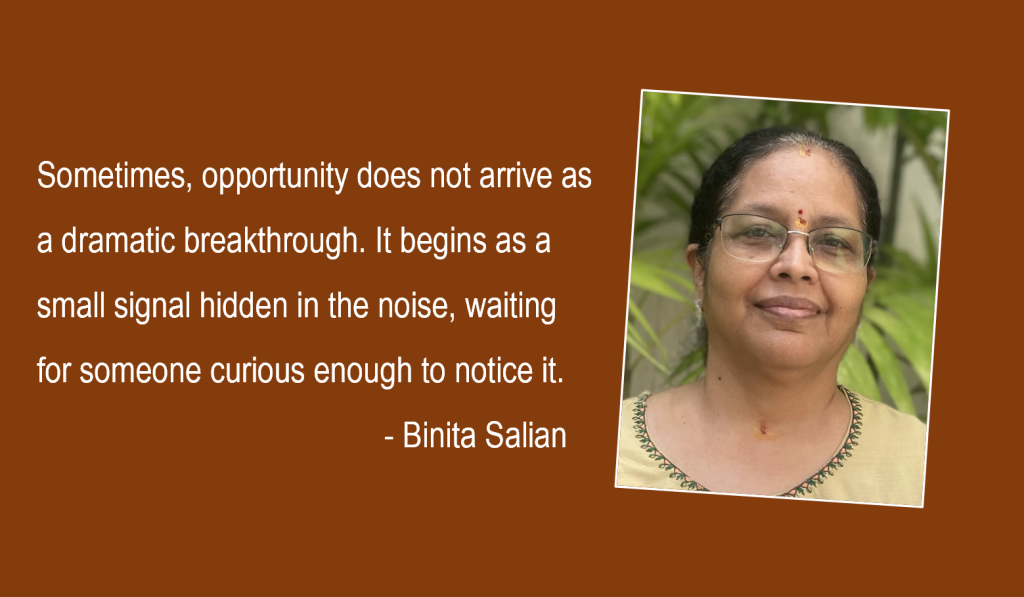
Sometimes, opportunity does not arrive as a dramatic breakthrough. It begins as a small signal hidden in the noise, waiting for someone curious enough to notice it.
____________________________________________________________________________________________________________________________________
The views and opinions published here belong to the author and do not necessarily reflect the views and opinions of the publisher.