

Marketing today is built on the belief that more data leads to better understanding. Every scroll, pause and repeat visit has become a signal to decode. Over time, this created an environment where brands grew confident in their ability to “read” their audience. The science sharpened. The targeting improved. The dashboards became the source of truth. Yet even as precision increased, something else quietly shifted. Communication began to feel more accurate but less alive. That slow emotional drift is what many now recognise as the empathy gap.
This gap forms when brands mistake visibility for understanding. Behavioural data shows actions, but actions rarely reveal the inner landscape of a person’s experience. A metric can say someone clicked twice or watched a video to the end, but it cannot explain what they felt in that moment. When brands rely too heavily on these surface readings, their communication becomes technically correct yet emotionally thin. It works on paper, but not in the heart.
When Accuracy Stops Feeling Human
A striking example of this has been playing out across the internet recently. AI-generated videos have become a global fascination. They look flawless. They are stitched together with extraordinary technical skill. Entire scenes unfold without a human stepping behind a camera. People watch them in awe, celebrating the achievement. But a few seconds in, something feels missing. The scenes are smooth yet strangely hollow. The emotion is present visually, but not experientially. They impress, but they rarely move.
This cultural reaction mirrors what happens in marketing when data takes charge without empathetic interpretation. A campaign can check every analytical box and still feel distant. Consumers notice when a message is assembled from insight rather than guided by understanding. Precision becomes the priority, but authenticity is the casualty.
The same pattern appears across categories. High engagement is often misread as strong affinity, when it stems from confusion or frustration. Repeated browsing is interpreted as intent, even when it is just a habit or a distraction. Algorithms assign meaning because they must, but real people behave in ways that are rarely that linear. When marketing follows these automated assumptions, communication begins to sound sure of things it cannot possibly know. That is when the disconnect widens.
Rebuilding a Human Centered Lens
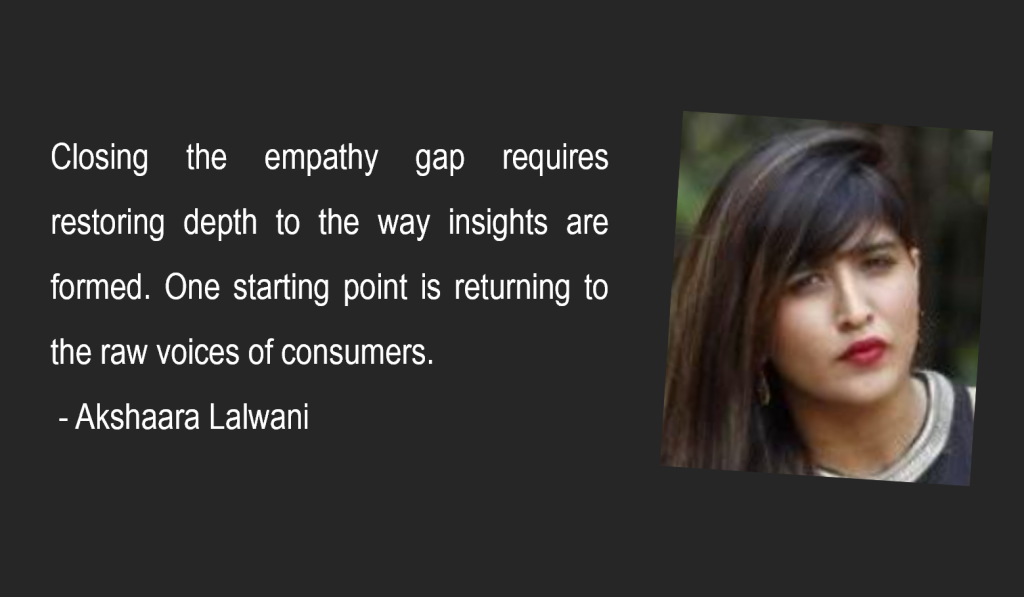
Closing the empathy gap requires restoring depth to the way insights are formed. One starting point is returning to the raw voices of consumers. Conversations on support lines, comment sections and community threads reveal emotional layers that dashboards cannot. Tone, rhythm, hesitation and humour offer cues that data alone cannot capture. These small signals rebuild the texture lost in purely quantitative reading.
A second shift involves complementing big data with thick data. Thick data adds context, cultural nuance and emotional motivation. It explains why the behaviour occurred and what may have been happening in someone’s life when it did. When these layers sit alongside numerical patterns, the resulting insight becomes more human and less mechanical.
Segmentation also evolves under this approach. Demographic groups, while convenient, rarely reflect the complexity of modern identity. Mindset-based clusters create communication that feels more intuitive. When people are understood for how they think rather than who they statistically are, marketing naturally becomes more empathetic.
This rebalanced mindset transforms internal processes as well. When creative teams participate at the insight stage rather than at the end, emotional interpretation becomes richer. They notice subtleties in behaviour and language that give the data meaning. Strategy and creativity begin to inform each other, and the final output feels grounded in real life rather than just guided by metrics.
The path forward for brands is not to abandon data but to humanise it. Data provides patterns. Empathy provides interpretation. When the two coexist, marketing becomes not just targeted but attuned. Not just relevant but resonant.
The rise of AI-generated content has made one truth impossible to ignore. Technical brilliance does not automatically equate to emotional connection. The same holds for marketing. Behind every behaviour sits a story. Behind every metric sits a mindset. When brands honour that, they cross the empathy gap and move toward communication that feels not only accurate but genuinely understood.
_______________________________________________________________________________________________________________
The views and opinions published here belong to the author and do not necessarily reflect the views and opinions of the publisher.

