

As AI scales competence, leadership’s true test in 2026 is no longer speed or control, but connection and trust.
If we looked only at corporate dashboards, 2025 was a triumph. Digital transformation targets landed ahead of schedule. Generative AI moved from novelty to necessity. Productivity charts across Mumbai, Bengaluru, and Gurugram glowed a reassuring green. On paper, the modern organisation has never been more efficient.
And yet, step into any office—or log into any Zoom—and you can feel it: a quiet exhaustion, a hollowness in teamwork, a sense that the gears are turning while the engine’s soul has dimmed. 2025 wasn’t the year business collapsed. It was the year the human element flickered.
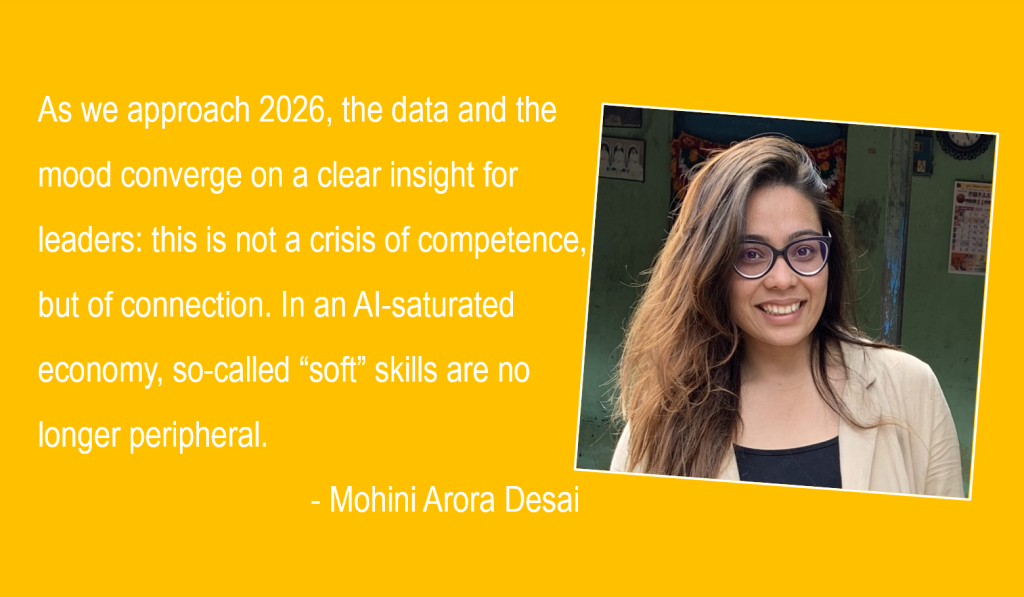
As we approach 2026, the data and the mood converge on a clear insight for leaders: this is not a crisis of competence, but of connection. In an AI-saturated economy, so-called “soft” skills are no longer peripheral. They have become the hardest leadership capabilities to cultivate and the most decisive for trust, alignment, and sustained performance.
Consider how our daily interactions changed. For decades, leaders relied on a rich spectrum of signals—tone, posture, expression—to read a room and steer a conversation. In hybrid and remote environments, those signals dim. Meetings become grids of static faces or worse, black boxes with names. We miss the fidget that telegraphs discomfort, the exchanged glance that signals scepticism, the silence that means not “I agree,” but “I give up.”
Sociologists have a name for this: digital flatness. In flat contexts, nuance evaporates. The hallway smile that once softened a curt email is gone. A joke in a chat thread, stripped of laughter, lands as sarcasm. Presence—once a leader’s safety net—doesn’t travel through a webcam. We are left with our words, and as generative systems remind us daily, words alone are now abundant.
We also changed how we listen. AI’s core mechanic is prediction — the next word, the next likely sequence. Subtly, many of us have started treating each other the same way: listening not to understand but to reply, mentally auto-completing the other person’s sentence so we can get to the fix. The result is a sharp drop in what Nancy Kline calls “generative attention” — the kind of listening that improves the speaker’s thinking by its quality alone.
This erosion of attention has quieter consequences. When people sense that feedback is automated, attention is divided, or conversations are merely procedural, commitment thins. Discretionary effort is not purchased; it is earned. When interactions feel templated and transactional, the social contract weakens. People respond in kind — doing what is required, but little more. In environments where individuals are treated as optimisable resources, work inevitably becomes a transaction rather than a relationship. It is equally tempting to cast AI as the villain in this story. That lets us off the hook.
Technology, after all, has always amplified what we bring to it. In this sense, AI is not the antagonist; it is the mirror. It has commoditised the middle: the tidy summary, the serviceable draft, the routine update. If leadership is defined by task assignment, hour tracking, and report aggregation, an algorithm will now perform those tasks faster, cheaper, and without ego. That may be threatening for managers. It is clarifying for leaders. As machines assume more cognitive load, the value of human work shifts decisively towards the social and emotional. The leader who thrives is the one who asks the questions that matter, who can surface productive conflict without breaking trust, who can detect the temperature of a room and adjust the conversation so thinking improves.
We’ve seen this play out at scale. Consider Microsoft’s transformation under Satya Nadella. The company’s bold investments in AI were widely covered. Less appreciated is the cultural bet that preceded them: a deliberate turn toward empathy and a growth mindset. In India, a similar shift is visible in the Tata Group under N. Chandrasekaran, who has emphasised a collaborative ‘One Tata’ approach to drive synergies and simplification across the conglomerate. That shift was not soft branding; it was a strategic reorientation — an acknowledgment that, in a world of near‑infinite compute, the scarce resource is connection. Organisations that treat culture as an operational asset, not a poster on a wall, surface reality faster and act on it together.
If there is a mandate for 2026, it is this: we must rebalance our obsession with efficiency by re‑grounding in humanity. Face-to-face isn’t about surveillance; it’s about signal. Cameras on are not about control; they’re about eyes meeting at key moments, so meaning travels. Polished prose is no longer a differentiator; imperfect honesty is. In an age when a paragraph can be spun in milliseconds, the value of a leader’s voice lies not in its smoothness but in its sincerity.
Caring is not sentimental. It is operational. It is the soil in which accountability grows. It is the condition under which hard facts can be surfaced without fear, bad news can travel quickly, and complex problems can be framed honestly enough to be solved. When we get this right, velocity returns but it is a different kind of velocity, born not of pressure but of shared purpose.
Look again at the dashboards. Keep them. Improve them. But read them alongside the room. Ask what the green lights have obscured. Listen for what your teams are not yet saying. Notice what only presence reveals. Because the work that matters most in an age of intelligent machines is not the work machines can do but the work only leaders can do: to make people braver in speaking the truth, clearer in their thinking, kinder in their disagreements, and sharper in their judgement; to build the conditions in which trust compounds and talent can do its best work.
This places a new demand on leadership in 2026 and beyond. A leader’s value no longer lies in being the smartest person in the room or the fastest decision-maker — machines have assumed much of that advantage. It lies in sense-making, in holding ambiguity without rushing to false certainty, and in creating spaces where human judgement can surface before problems harden into failures. Leadership must look less like supervision and more like stewardship: of attention, of energy, and of meaning.
We spent the last five years building the artificial. The next five must rebuild the authentic. Efficiency will continue to compound; so will intelligence. The open question for leaders is whether connection will keep pace. In the end, people do not follow dashboards, and they do not follow algorithms. They follow leaders who are present enough to be trusted, and human enough to be worth following.
_____________________________________________________________________________________________________________
The views and opinions published here belong to the author and do not necessarily reflect the views and opinions of the publisher.

