

3. Governance Failures Are Now the Central Reputational Risk
Corporate reputation has always been influenced by governance, but in today’s environment governance failures rarely remain confined to regulatory filings or boardrooms. They quickly become public narratives that influence investor confidence, employee morale, customer trust and political attention almost simultaneously.
Recent developments in India illustrate how dramatically the dynamics have changed. Across banking, manufacturing and the start-up ecosystem, governance-related controversies have demonstrated that the reputational impact of an incident is often determined less by the underlying issue than by how rapidly it becomes visible and how effectively leadership responds.
Several cases from the last eighteen months illustrate the pattern:
- IndusInd Bank: a March 2025 self-disclosure regarding discrepancies exceeding ₹1,500 crore in its foreign exchange derivatives portfolio triggered an immediate market reaction, wiping out more than a quarter of the bank’s market value in single-day stock decline and culminating in the departure of both its CEO and Deputy CEO – becoming one of the most significant leadership shake-ups in Indian banking in years.
- Rajesh Exports: Following a whistleblower complaint, a forensic review raised questions over the company’s overseas subsidiary structure and the verifiability of a significant portion of its reported revenues. Regulatory scrutiny quickly shifted what may once have remained an accounting matter into a broader debate about corporate credibility and governance oversight.
- Start-up governance: High-profile governance concerns involving companies such as BYJU’S, BluSmart and others have reinforced a growing expectation among investors that founder credibility and governance maturity are Venture capital firms increasingly assess governance frameworks alongside business models, recognising that operational growth alone cannot compensate for weaknesses in transparency or financial discipline.
What connects these cases is not the specific mechanism of failure but the speed of consequence. Where earlier governance failures in India (Satyam, IL&FS, Yes Bank, DHFL, etc) played out over weeks or months, today’s episodes compress into days: disclosure, market reaction, media coverage, regulatory intervention and leadership accountability can now unfold within a single news cycle.
The interval between an internal issue and widespread public scrutiny has also shortened dramatically. Digital media, real-time financial reporting and continuous public commentary leave organisations with little opportunity to shape the narrative before external stakeholders have already formed one.
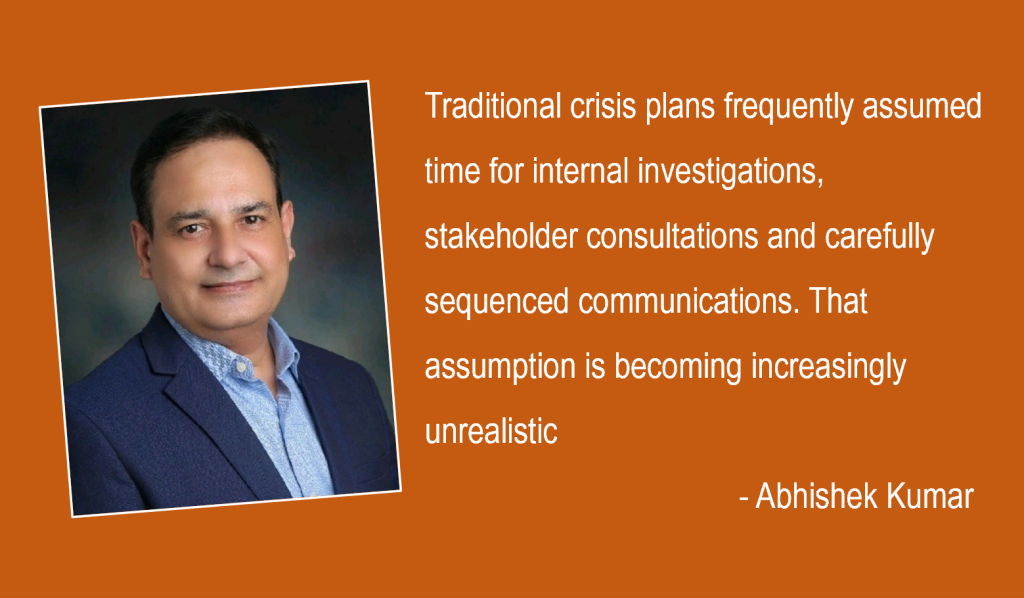
This acceleration fundamentally changes crisis preparedness. Traditional crisis plans frequently assumed time for internal investigations, stakeholder consultations and carefully sequenced communications. That assumption is becoming increasingly unrealistic. The first public interpretation of an event often emerges before an organisation has completed its own assessment.
Consequently, governance can no longer be viewed solely as a legal or compliance responsibility. Every governance decision now carries communications implications, while every communications strategy must be informed by governance realities.
For reputation and communications leaders, this represents a significant evolution in role. Protecting reputation increasingly depends on participating earlier in organisational decision-making rather than responding only after problems become public. Reputation resilience begins long before the first media query arrives.
4. ESG Moves from Compliance Checkbox to Reputation Currency
India’s ESG disclosure regime, anchored in SEBI’s Business Responsibility and Sustainability Reporting (BRSR) framework, has moved decisively from voluntary best practice toward enforceable reputational infrastructure. Mandatory BRSR Core reporting has expanded in phases from the top 150 listed companies to the top 1,000, with third-party assurance requirements and value-chain disclosures phasing in through FY 2026-27. Companies now file this data in machine-readable format on stock exchange portals, making it accessible to everyone.
Today these reports are increasingly consumed by institutional investors, lenders, analysts, journalists, civil society organisations and competitors, all of whom use publicly available information to evaluate corporate performance and governance standards. The quality of disclosure has therefore become an important signal in itself. Stakeholders are no longer assessing only what companies report; they are also evaluating how consistently, transparently and credibly those disclosures are prepared.
The reputational stakes of this shift are becoming visible: incomplete, inconsistent, or recycled ESG disclosures are starting to draw exchange queries and investor scrutiny in their own right, independent of a company’s underlying sustainability performance. In effect, the quality of a company’s ESG reporting has itself become a signal that stakeholders read as a proxy for broader governance discipline. Boards that historically treated BRSR as an annual-report formality now do so at increasing reputational risk.
In practical terms, ESG reporting now serves two interconnected purposes. It satisfies regulatory obligation and at the same time, it provides visible evidence of organisational discipline. Today, the discipline with which those initiatives are measured, verified and communicated has become equally influential. Reporting quality has become part of reputation. This evolution also reflects a broader expectation around corporate transparency.
Transparency, therefore, is emerging as a source of competitive differentiation. Companies that invest in reliable data, strong governance processes and consistent disclosure practices are likely to strengthen stakeholder confidence over time.
______________________________________________________________________________________________________________________
The views and opinions published here belong to the author and do not necessarily reflect the views and opinions of the publisher.