

PART 1
Executive Summary
Corporate reputation in India is going through a significant shift. The country’s organisations score among the most trusted in the world on paper, yet the last two years have delivered a steady tide of governance failures, boardroom exits, and social-media criticism that have tested how resilient that trust actually is. Reputation is no longer shaped primarily by brand campaigns or media visibility. It has matured into a distinct and more strategic discipline – one that boards, CEOs, and regulators now treat as part of the core business infrastructure rather than a defensive afterthought.
Over the past few years, several structural developments have converged to redefine how organisations earn and protect credibility. Regulatory expectations around disclosures have become more rigorous, investors are placing greater emphasis on governance quality, chief executives have emerged as highly visible public representatives of their organisations, and social media has accelerated the pace at which isolated incidents become national conversations. Artificial intelligence has introduced another layer of complexity by changing how information is created, amplified and consumed.
These developments suggest that reputation can no longer be managed as a communications exercise alone. It now intersects with board oversight, enterprise risk management, regulatory compliance and organisational culture. Decisions made within finance, legal, sustainability, human resources and executive leadership increasingly influence public perception as much as traditional communication channels.
India presents a particularly interesting context for this transformation. Despite consistently ranking among the world’s most trusted markets across institutions, recent governance failures and public controversies demonstrate that confidence is far more conditional than headline trust figures imply. Stakeholders continue to place faith in a business, yet they are also quicker to question organisations that appear inconsistent, opaque or disconnected from broader societal expectations.
This report brings together the latest global and India-specific data on trust, governance, ESG disclosure, executive branding, viral risk, and AI-driven threats to answer a practical question for business and communications leaders: what does it now take to build and protect a reputation in India? Seven shifts stand out, and each is examined in turn below: the trust paradox, the professionalisation of the reputation function, governance as the new reputational fault line, ESG’s move from compliance to currency, the rise of the CEO as the primary reputational asset, AI’s impact on reputational landscape and virality itself as a reputation multiplier capable of turning a single unofficial clip into a national crisis within hours.
1. India’s Trust Paradox
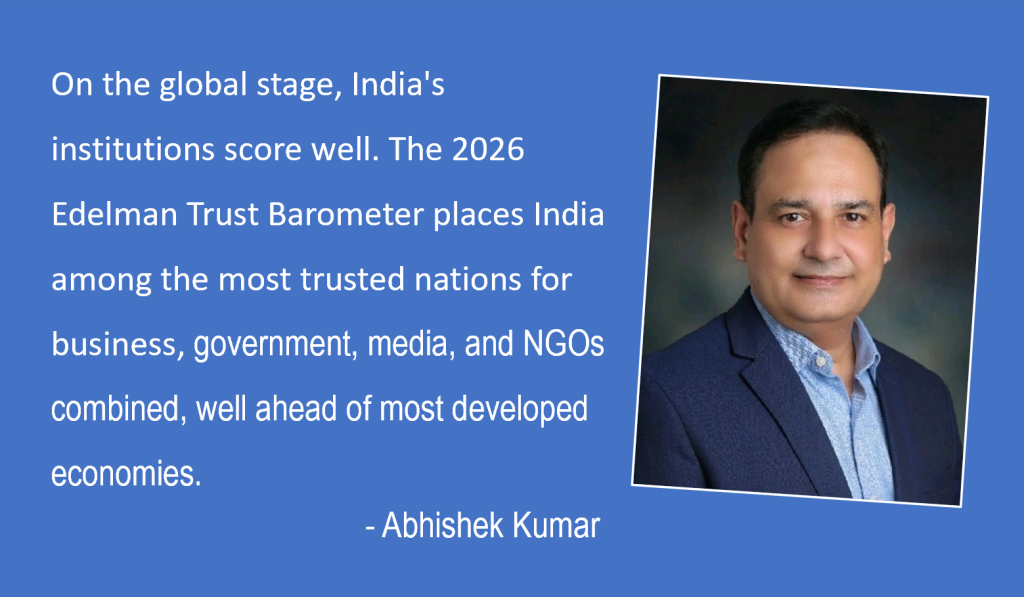
On the global stage, India’s institutions score well. The 2026 Edelman Trust Barometer places India among the most trusted nations for business, government, media, and NGOs combined, well ahead of most developed economies, whose trust scores continue to sit at multi-year lows. Globally, business is now viewed as more ethical and competent than any other institution, a position it has steadily built since the pandemic.
But headline trust numbers mask a more fragile undercurrent specific to India. The same Edelman research indicates a noticeable decline in public optimism about future economic prospects, particularly regarding whether younger generations are likely to enjoy better opportunities than their predecessors. India has recorded one of the sharpest deteriorations on this measure, despite maintaining strong institutional trust overall.
That combination is telling: people trust institutions in the abstract, but they are increasingly anxious about outcomes. For corporate reputation practitioners, this is the paradox to plan around, high baseline trust that can erode quickly the moment a company is seen to be extracting value without delivering broad-based benefit.
This apparent contradiction can have important implications. A company may enter a crisis with substantial reputational capital accumulated over many years, but that capital can diminish rapidly if stakeholders perceive that leadership has failed to respond appropriately or governance standards have been compromised. Trust still provides organisations with resilience, but it no longer guarantees immunity.
For communications leaders, this changes the starting point of reputation strategy. Aggregate trust indices remain valuable indicators of the broader environment, yet they provide only limited protection against organisation-specific failures. Reputation management therefore requires a far more granular understanding of stakeholder expectations than broad national trust rankings alone can offer.
2. Reputation Has Become a Boardroom Discipline
The clearest sign that reputation management has matured in India is the industry built around it. According to PRCAI’s SPRINT 2026 report, prepared with Ipsos and Astrum Reputation Advisory, India’s public relations and communications industry grew 11% in FY26 to reach roughly ₹3,230 crore, now accounting for over a tenth of the entire Asia-Pacific PR market. Although annual growth has moderated compared to previous years, this moderation reflects the characteristics of a maturing industry rather than slowing demand. The conversation is shifting from expansion alone towards strategic value creation.
| PRCAI SPRINT 2026 — India Communications Industry Snapshot | |
| Industry size, FY26 | ₹3,230 crore |
| Projected size by 2030 | ₹4,500 crore |
| Share of Asia-Pacific PR market | 12.6% |
Perhaps the strongest evidence of this maturity lies in who is investing in reputation.
| PRCAI SPRINT 2026 — India Communications Industry Snapshot | |
| Government’s share of top clients (2022 → 2026) | 4% → 11% |
| Start-ups’ share of top clients (2022 → 2026) | 6% → 22% |
| Communicators who say PR now drives business outcomes | 46% |
Two structural shifts stand out. First, the client base is diversifying: government and start-ups now account for a third of the industry’s top clients between them, up from a tenth just four years ago, while traditional private corporates have ceded share. Second, the regional India is no longer peripheral, communicators now rank Tier-2 cities among their primary growth drivers, and regional PR’s share of revenue has nearly doubled in three years. For agencies and in-house teams alike, this means reputation strategy can no longer be Delhi-Mumbai-Bengaluru centric by default.
Together, these shifts point towards a broader recognition that reputation influences outcomes well beyond media visibility. For governments, effective communication supports public legitimacy, policy acceptance and citizen engagement. For emerging businesses, reputation directly influences investor confidence, customer acquisition and talent attraction. For established corporations, it increasingly shapes regulatory relationships, market resilience and licence to operate.
Another trend reinforces this transformation. A growing proportion of communications professionals now believe that public relations contribute directly to business outcomes rather than functioning solely as a support discipline. This reflects an important organisational shift. Reputation is increasingly being evaluated alongside commercial performance because both are recognised as mutually reinforcing. As a result, communications functions are becoming more closely integrated with strategic decision-making rather than operating primarily as external messaging units.
The report also highlights a credibility: influencer marketing revenue has doubled in three years, even as the overwhelming majority of communicators say the blurring of paid and earned content is actively weakening audience trust. Growth in reach is outpacing growth in verification, a gap that will increasingly define which brands are seen as credible versus merely loud.
In an environment where audiences question authenticity more readily, organisations that prioritise transparency and verifiable communication may ultimately build stronger reputational advantages than those relying primarily on scale and amplification. The communications profession, therefore, is evolving from a discipline focused largely on storytelling into one increasingly responsible for safeguarding institutional trust.
____________________________________________________________________________________________________________________________
The views and opinions published here belong to the author and do not necessarily reflect the views and opinions of the publisher.