

Sales has always been about relationships, persuasion, and trust. But by 2035, the function will have evolved into something far more nuanced, a discipline where leadership is expressed less through authority and more through empathy, insight, and adaptability. The leaders of tomorrow’s sales teams will not simply be closers; they will be translators between human needs and technological capabilities.
From Transactions to Transformations
In 2035, sales will be less about closing deals and more about co-creating value. As industries integrate advanced AI, quantum computing, and immersive virtual environments, products and services will be personalised to the point where “selling” becomes an act of collaborative problem-solving. Sales leaders will need to speak a new language, one that blends technical fluency with human-centric storytelling.
Clients won’t just be buying a product; they’ll be engaging in an ongoing value exchange. The sales conversation will revolve around impact metrics, sustainability outcomes, and shared growth, requiring leaders to be fluent in both business strategy and ethical responsibility.
Data as the New Dialect
By 2035, data will no longer be a supporting tool in sales; it will be the primary medium of communication. Predictive analytics will map buying behaviour with uncanny precision, while AI-driven insights will anticipate client needs before they arise. However, the competitive edge won’t come from the data itself, it will come from how leaders interpret and narrate it.
The new sales leader will be a data storyteller, able to translate streams of numbers into compelling narratives that inspire action. They’ll also have to guard against over-reliance on algorithms, ensuring that intuition and context still shape decision-making.
The Human-AI Symbiosis
Automation will take over repetitive aspects of the sales process, lead qualification, proposal drafting, and even preliminary negotiations. This will free human leaders to focus on high-touch interactions that AI cannot replicate: building trust, navigating complex stakeholder ecosystems, and making judgment calls in ambiguous situations.
The “new language” here will involve fluently switching between human and AI modes. Leaders will need to manage AI like a team member, assigning roles, monitoring performance, and ensuring ethical use. Those who can orchestrate this symbiosis will achieve not just efficiency but exponential impact.
Emotional Intelligence Becomes the Core Curriculum
By 2035, emotional intelligence (EQ) will no longer be a soft skill; it will be a survival skill in sales. With AI delivering logical arguments in milliseconds, the human differentiator will be empathy, the ability to read unspoken cues, respond to emotional undercurrents, and make clients feel genuinely understood.
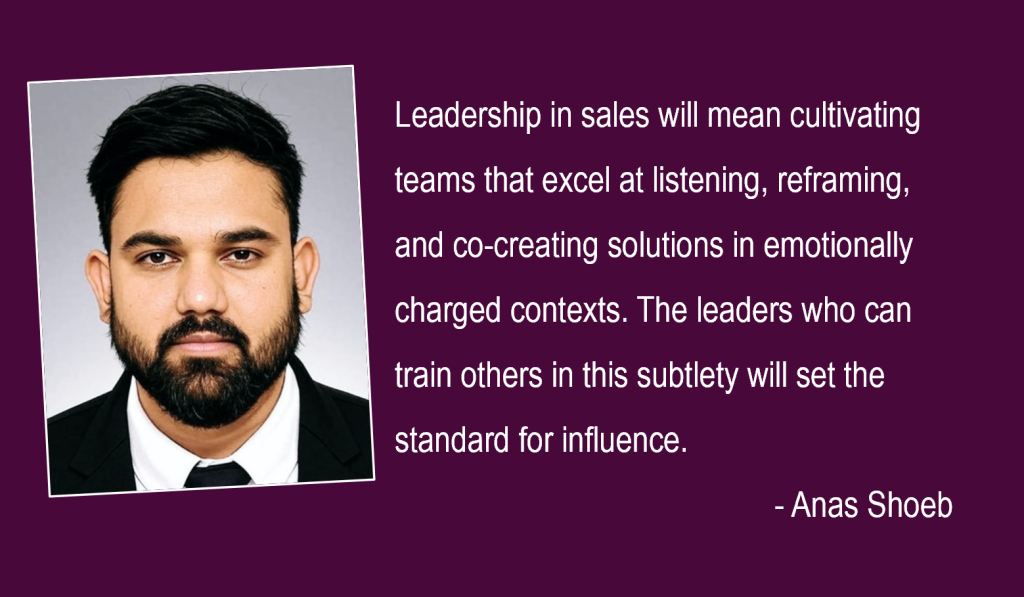
Leadership in sales will mean cultivating teams that excel at listening, reframing, and co-creating solutions in emotionally charged contexts. The leaders who can train others in this subtlety will set the standard for influence.
The Global, Borderless Marketplace
Geopolitical and technological shifts will make the sales landscape truly borderless. Virtual reality will allow immersive product demonstrations without travel. Real-time translation AI will make language barriers irrelevant. Cultural intelligence, however, will remain critical.
The leaders of 2035 will be cultural navigators, able to adapt communication styles for different markets without losing authenticity. They will embody a global mindset, fostering inclusive sales strategies that resonate across diverse contexts.
Purpose-Driven Selling
Sustainability, ethics, and corporate purpose will dominate sales narratives. By 2035, clients and consumers will expect sales leaders to articulate not just how a product works, but why it matters in the larger context of environmental and social impact.
The new language of leadership will integrate corporate purpose into every sales conversation. Leaders will have to be fluent in sustainability metrics, transparent about supply chains, and committed to authentic, measurable impact.
Continuous Learning as a Leadership Imperative
Technology and customer expectations will evolve so quickly that static knowledge will be obsolete in months. The most effective sales leaders will not be those who know it all, but those who learn the fastest. They’ll foster a culture where experimentation, feedback loops, and micro-learning are built into the workflow.
By 2035, leadership will be less about being the most experienced voice in the room and more about creating the conditions for collective intelligence to flourish.
Leading in the Language of 2035
In conclusion, the sales leader of 2035 will be part strategist, part technologist, part anthropologist, and part ethicist. The new language of leadership will be multi-dimensional:
- Analytical, to interpret data.
- Empathetic, to connect with people.
- Ethical, to align with purpose.
- Adaptive, to thrive in constant change.
In this future, leadership in sales will not be about commanding from the top, it will be about guiding from the centre, where technology, humanity, and purpose converge. Those who can speak this new language fluently will not just sell more; they will shape the very future of commerce.
The views and opinions published here belong to the author and do not necessarily reflect the views and opinions of the publisher.