

The year has been a tragic one for India. One disaster after another has claimed lives and left communities grappling with grief and uncertainty. Amidst the chaos, one striking trend has emerged—the growing influence of micro-influencers in shaping public discourse during crises.
The Air India crash has shown that information no longer trickles out in hours or days; it explodes in seconds. More importantly, the first wave of reaction comes not from established media or official sources but from a swarm of micro-influencers across X, WhatsApp, and Instagram. While these voices sometimes provide real-time, ground-level updates, they also frequently fan the flames of speculation, outrage, and misinformation.
Misinformation on the move
Minutes after the crash, in a convenience store some 30 km from the heart of Cochin, phones started to buzz. The entire shop—strangers moments before—became a forum for collective shock and speculation. Some customers turned to their regional YouTube news influencer; the shop owner checked updates on X, and some found themselves bombarded with forwards in their WhatsApp groups.
Dissemination in the age of social media is increasingly shaped by social media platforms and micro-influencers, who establish narratives even before agencies can verify facts. With modest yet highly engaged followings, micro-influencers occupy a unique niche in the information ecosystem. Their perceived authenticity and relatability make their content feel more trustworthy than institutional voices.
Virality over veracity
But during crisis events, that trust can be dangerously misplaced. According to research by Tandoc et al. (2018), audiences are increasingly unable to distinguish between credible and misleading content, especially when it is shared by familiar or charismatic personalities. Add the algorithmic amplification of emotional or sensational content (as detailed by Vosoughi, Roy, & Aral, 2018), and the result is a digital environment primed for virality over veracity.
Air India issued its first communication about an hour after take-off, acknowledging that an incident had occurred and promising further details in due time. By then, however, the narrative surrounding the crash had already been shaped on social media. Passenger and crew manifests—including names, ages, nationalities, and even passport numbers—were circulating widely, raising serious concerns over privacy and ethical reporting. Videos documenting the take-off, the crash, and speculative causes flooded platforms, with theories ranging from flap deployment failures to potential sabotage, all gaining traction before any factual clarity was established. Influencers jumped in, each pushing a different angle to drive engagement.
Images from inside BJ Hospital’s mess—where students had been eating when the plane crashed into the building—began circulating across social media, making a spectacle of the disaster.
The ethics gap
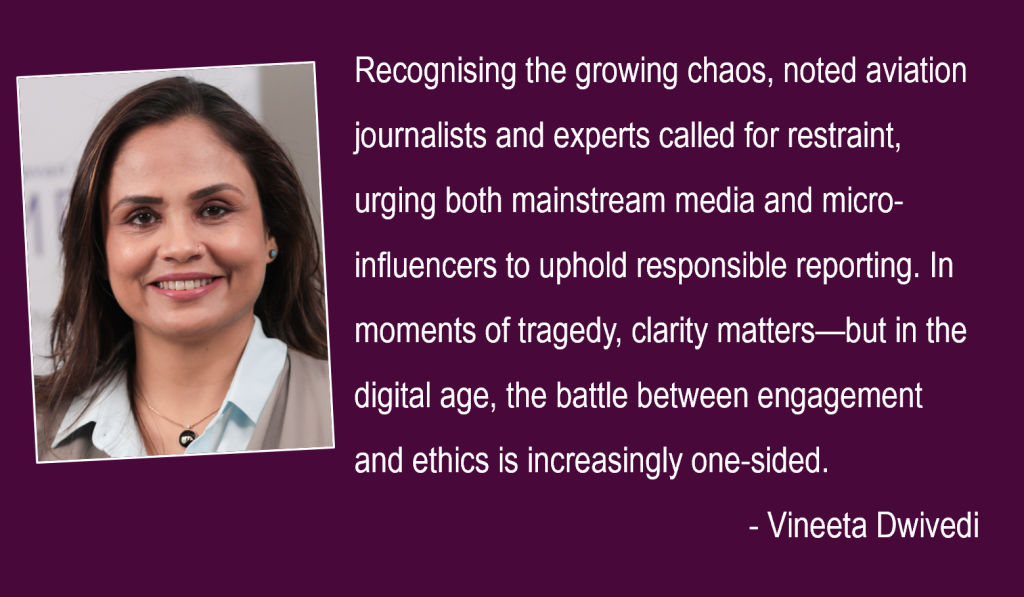
Recognising the growing chaos, noted aviation journalists and experts called for restraint, urging both mainstream media and micro-influencers to uphold responsible reporting. In moments of tragedy, clarity matters—but in the digital age, the battle between engagement and ethics is increasingly one-sided.
Consider the social media panic during the COVID-19 lockdown in India; misinformation played a central role in fuelling chaos, especially during the mass exodus of migrant workers.
As the government announced a sudden nationwide shutdown with little notice, rumours began circulating on WhatsApp, YouTube, and regional-language accounts that buses and trains were being arranged to take migrants back to their home states. Many of these claims were false or prematurely shared, but they were amplified by local micro-influencers and community leaders with significant digital reach.
The result was a humanitarian crisis, as thousands gathered at transport hubs like Delhi’s Anand Vihar bus terminal, leading to crowding, stampedes, and clashes with authorities, all during a public health emergency. These should not be treated as isolated incidents but as symptoms of a broader phenomenon, for which a strategy needs to be put in place by governments and organisations.
From a media studies perspective, this shift is the disintermediation of traditional gatekeepers in the information flow. In moments of uncertainty, people seek quick, emotionally resonant answers.
From a psychological lens, it is a classic case of confirmation bias meeting cognitive overload. In a crisis, people are overwhelmed and seek patterns. The human brain prefers a wrong but clear narrative over a complex or delayed truth.
Crisis communication in the digital age: A framework
In this environment, organisations facing crises must not merely react but must pre-emptively shape the narrative. This is where Situational Crisis Communication Theory (SCCT), developed by W. Timothy Coombs, becomes relevant. SCCT suggests that stakeholders’ perceptions of a crisis and of the organisation’s responsibility should guide communication strategy.
Crucially, Coombs emphasises timing, transparency, and tone. Silence, ambiguity, or excessive caution is often interpreted as guilt. Companies should actively monitor social media chatter—not just official hashtags but the ecosystem of influencer content—and issue clear, consistent messaging through diverse platforms. More importantly, they must consider using trusted third-party voices to relay messages, including collaborating with credible micro-influencers who are willing to share verified information.
Air India’s response
As speculation spread unchecked across social media, Air India’s strategic crisis communication stood in stark contrast to the chaos of misinformation. While influencers pushed unverified theories to maintain relevance, the airline delivered clear, factual updates, trying to control the narrative before speculation could spiral further.
In a symbolic response, their social media profiles turned black, reflecting the gravity of the tragedy. The airline’s website, along with the Tata Group homepage, adopted a monochromatic design, reinforcing the sombre mood of a nation grappling with the unfolding disaster.
Campbell Wilson, CEO of Air India, who was enroute to Paris when the incident occurred, was flown back to Delhi within the hour. Later that evening, in a calm yet reassuring press conference, he addressed the nation, outlining measures of relief and support. In a moment when clarity and coordination were paramount, the Tata Group’s communication team delivered an exceptional response, setting a benchmark for corporate crisis handling.
Lead the narrative
Looking ahead, the intersection of AI-generated content, micro-influencer culture, and growing global uncertainty means that crises will become even harder to contain. Deepfakes, synthetic audio, and manipulated visuals will further blur the line between truth and fiction. In this ‘infocalypse,’ the speed of misinformation will continue to outpace fact-checking.
The future of crisis communication, therefore, lies in agility, authenticity, and algorithmic literacy. Organisations must build digital credibility before the storm hits.
In this new landscape, information voids are dangerous and short-lived. If an organisation does not fill them with clear, human-centred, and timely communication, others—many with less commitment to accuracy—surely will. The choice is no longer whether to engage in the digital discourse during a crisis but how quickly and credibly you can lead it.
The views and opinions published here belong to the author and do not necessarily reflect the views and opinions of the publisher.

