

Management education prides itself on teaching skills that leaders actually use. Strategy, finance, marketing, operations, and negotiations are not abstract ideas but lived business realities. Yet one of the most critical managerial capabilities remains poorly taught, often misunderstood, and sometimes actively discouraged in classrooms: Creativity. Not creativity as artistic expression, but creativity as a way of thinking that allows managers to negotiate with reality rather than simply accept it. To understand why creativity deserves a central place in management education, it helps to draw a parallel with something business leaders intuitively understand – negotiation.
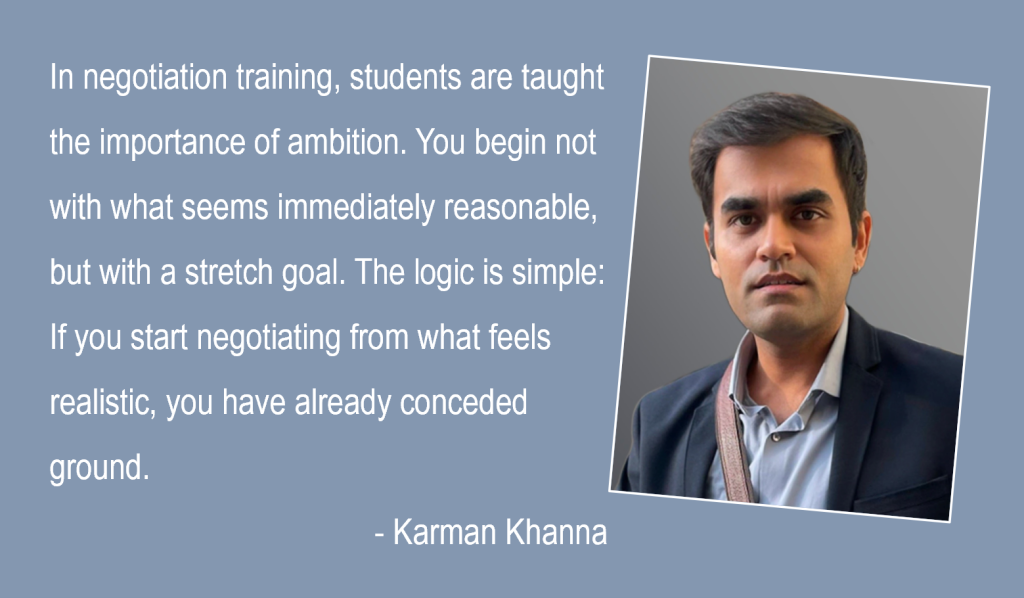
In negotiation training, students are taught the importance of ambition. You begin not with what seems immediately reasonable, but with a stretch goal. The logic is simple: If you start negotiating from what feels realistic, you have already conceded ground. Stretch goals expand the space of possibility. They force you to think beyond constraints, challenge assumptions, and explore outcomes that might otherwise remain invisible. Creativity works in much the same way.
At its core, creativity is a negotiation with reality. It begins by imagining an idea that feels exaggerated, improbable, or even bizarre when viewed from the present moment. This is not because such ideas are meant to be implemented as is, but because they help establish the outer boundary of what might be possible. Much like an aggressive opening position in a negotiation, an outrageous idea creates distance from the status quo, and that distance matters. Once that stretch point is defined, the real managerial work begins. You backtrack. You explore the space between current reality and that ambitious idea. You ask what could move, what could be reconfigured, and what assumptions might be relaxed. Variables such as technology, capital availability, regulatory constraints, organisational culture, and market readiness come into play. Gradually, you begin to identify a ‘zone of possible agreement’ between the idea and reality. A version of the original vision that is bold, viable, and differentiated.
This is precisely how innovation happens in practice. Breakthrough products, new business models, and category-defining strategies rarely emerge from incremental thinking anchored too tightly to existing conditions. They emerge when leaders allow themselves to think beyond what seems feasible today and then negotiate their way back to something executable. The problem is that much of management education trains students to do the opposite. In many classrooms, thinking begins from the current reality. Cases reward convergence rather than divergence. Frameworks are applied to diagnose problems efficiently, not to reimagine them radically. Risk is implicitly penalised, either academically, socially, or sometimes even morally. The unintended consequence is that students learn to optimise within boundaries they never questioned in the first place.
For recruiters and business leaders, this limitation becomes visible soon after hiring. Graduates are competent, structured, and analytically sound but hesitant when asked to propose something unconventional. They look for benchmarks before imagining alternatives. They wait for permission to challenge assumptions. Their ideas hover close to existing practices, resulting in improvements that are sensible but rarely transformative.
Without thinking outrageously at the outset, ideas tend to linger around the current reality. They feel safe, defensible, and well-reasoned, but they fail to make an impact.
Part 2 to be continued in the next week’s column.
__________________________________________________________________________________________________
The views and opinions published here belong to the author and do not necessarily reflect the views and opinions of the publisher.