

In a lesser-known yet profoundly significant song, “Wipe Out the Jargon,” folk singer Susmit Bose encouraged listeners to prioritise simplicity, clarity, and honesty in communication. He wasn’t merely making a musical point; he was challenging those who influence public discourse. Today, his lyrics resonate as a clarion call for a new generation of communication professionals—journalists and public relations experts alike—who seem to be drifting away from the fundamental principles of their profession.
We find ourselves in an age where content is seen as currency. The relentless demand for reels, blogs, tweets, statements, and soundbites means that too many professionals are now placing speed above substance, spectacle over truth, and shareability over authenticity.
What is being sacrificed in this rush? Research, accuracy, structure—and perhaps most sadly, language itself.
The Decline of Diligence
A decade ago, a well-respected journalist or PR professional was characterised by their thorough research and analysis. It was unheard of to submit a report or draft a press release without verifying facts, understanding the context, or citing credible sources. Nowadays, many young professionals hastily compile content drawn from the first few Google search results, Wikipedia, or even worse, AI-generated summaries—neglecting to conduct deeper inquiry. This results in shallow storytelling at best, and misleading, error-laden material at worst.
PR practitioners often circulate media pitches featuring outdated information, generic angles, or inaccurately attributed quotes. Journalists have increasingly leaned on paraphrased press releases rather than conducting thorough investigations or reporting from the ground. Both professions are increasingly failing to ask the essential questions—Why? So what? What’s the broader context?
Informal, Conversational, and Sometimes Negligent
With the decline of thorough research has come an overwhelming prevalence of casual language in professional communication. While being accessible or conversational is essential in modern communication, when press releases mimic chat messages or news articles are filled with social media slang, we have crossed a line.
Terms like “super cool move,” “crushing it,” or “a total game changer” are now infiltrating once-formal communications—especially among professionals in digital media. These headlines often lean more towards clickbait than credibility. A phrase like “Govt totally ghosted the proposal” may generate laughs online, but it has no place in responsible journalism.
While this informality may attract younger audiences, it risks jeopardising professional credibility. Language is more than just a means of communication; it signifies intent, seriousness, and skill.
The Erosion of Vocabulary
Another concerning trend is the diminishing use of professional terminology—the right kind of jargon. Journalists once commonly used terms like “lede,” “nutgraf,” “dateline,” and “double-checking sources.” PR professionals spoke of “stakeholder mapping,” “earned media strategy,” “key message development,” and “media audit reports.” These were not simply buzzwords; they were vital tools of the profession.
Today, such terms are rarely heard from the new generation. Instead, phrases like “let’s vibe with this line,” or “we’ll just go with a trending hashtag and wing it” dominate conversations. This lack of precision in thought is reflected in their language, leading to poorer campaigns, superficial articles, and a troubling decline in the quality of public discourse.
The Role of Algorithms
This shift can partly be attributed to the impact of algorithms. Platforms reward brevity, sensationalism, and speed. Journalists face pressure to break news quickly rather than report it thoroughly. Meanwhile, PR professionals are encouraged to “create engagement” over crafting meaningful narratives. Consequently, shortcuts prevail—diluting what was once deliberate, well-researched communication.
It’s worth pondering—are we catering to the audience or merely to the algorithm?
Restoring Rigor and Respect
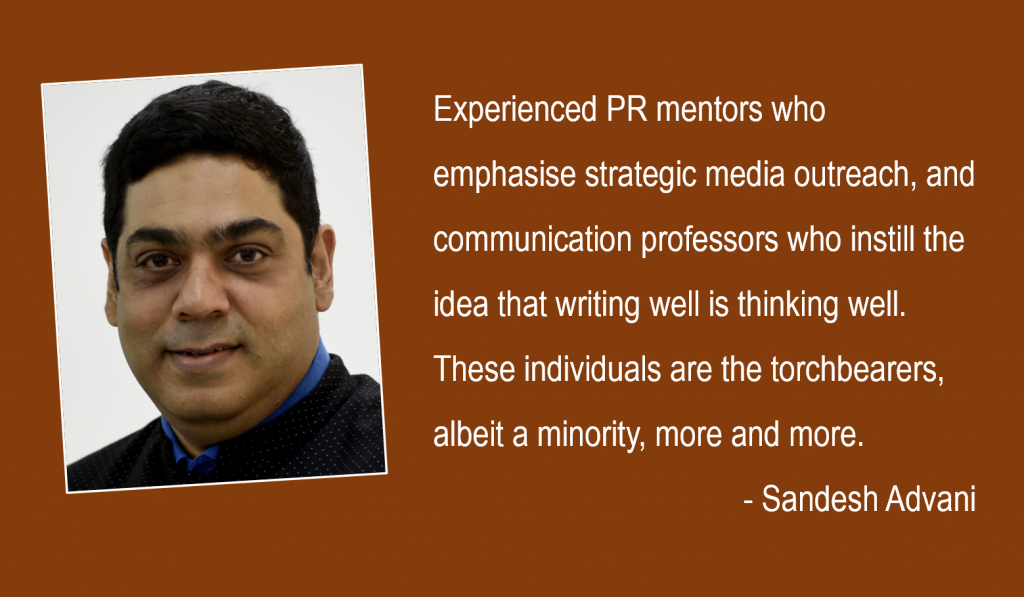
However, it’s not all doom and gloom. Many still hold a passion for the craft. Dedicated editors who diligently review incomplete stories, experienced PR mentors who emphasise strategic media outreach, and communication professors who instill the idea that writing well is thinking well. These individuals are the torchbearers, albeit a minority, more and more.
The rest must catch up. We need communication professionals committed to not just writing quickly, but writing effectively. Those who don’t merely rely on slogans, but convey meaningful ideas. Those who consider research a necessity, not a luxury. Above all, we need to recognise that good language is not decorative—it is essential.
As Susmit Bose once sang, “So wipe out the jargons we wrote on the wall / Those writings have nothing to say / We wrote with such feelings yesterday / but they don’t hold at all for today.” May this be more than just a line of lyrics but serve as a manifesto for communicators today—and in the future.
The views and opinions published here belong to the author and do not necessarily reflect the views and opinions of the publisher.

