

Walk into any communications huddle today and you’ll hear the same quartet playing on loop: AI, CSR, storytelling and brand building across multimedia surfaces. They’re called “hot topics” for a reason. But if the past two years have taught us anything, it’s that treating them as a playlist of trends misses the point.
What separates resilient reputations from the rest is the ability to translate these headlines into repeatable capabilities: ways of working that survive leadership changes, platform shifts and quarterly pressures.
I’ve had a front‑row seat to that evolution—first as a journalist, then in corporate communications and CSR leadership. And the pattern is unmistakable: organisations that bring these four threads together don’t just win a news cycle; they compound trust.
Consider AI. Beyond faster drafting, its real value is diagnostic and directional: using live sentiment, media graphs and pattern recognition to see the story before it breaks, and to shape responses with clarity and care. When communicators use AI to augment—not replace—judgment, the function becomes more anticipatory and less reactive.
CSR follows a similar arc. The least effective programmes treat CSR as compliance theatre; the most effective make it an organising principle. When purpose sits upstream—informing product choices, supply chains and leadership narratives—CSR stops being a cost and starts acting like strategic capital. That shift turns campaigns into commitments, and commitments into compounding equity with customers, employees and investors.
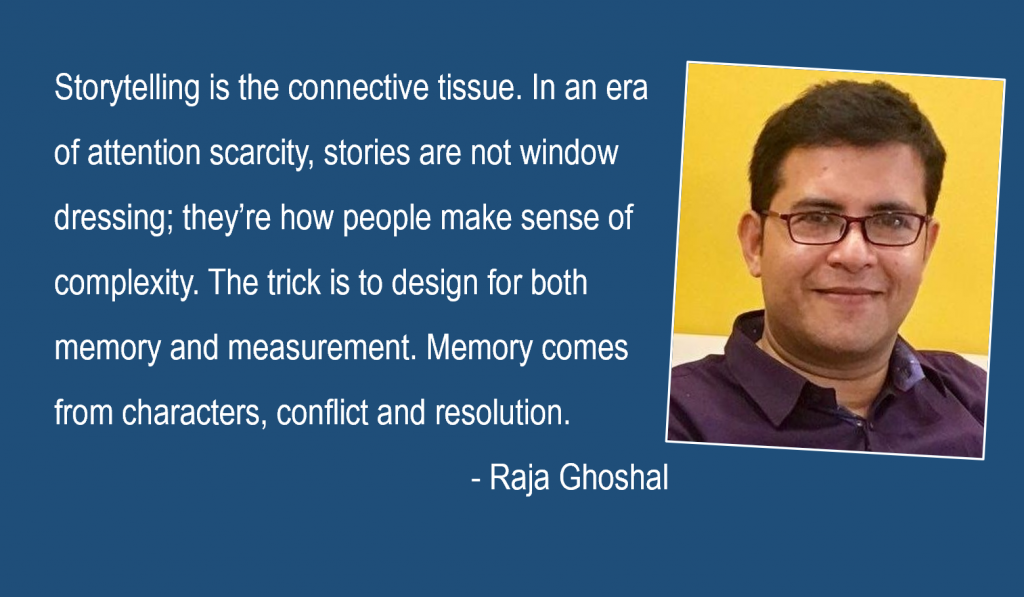
Storytelling is the connective tissue. In an era of attention scarcity, stories are not window dressing; they’re how people make sense of complexity. The trick is to design for both memory and measurement. Memory comes from characters, conflict and resolution—human stakes that travel across short video, podcasts and long‑form explainers. Measurement comes from defining outcomes beyond vanity impressions: sentiment change, employee advocacy lift, inbound talent quality or progress on behaviour you’ve asked audiences to take. When stories are architected for both heart and dashboard, they scale without losing soul.
And branding? In 2025, branding is a choreography problem. Logos and guidelines matter, but consistency of meaning matters more. The organisations that feel contemporary are those that can harmonise a thousand small moments—press notes, founder posts, service scripts, frontline videos—into a recognisable truth. That requires a tight handshake between PR, marketing and product, shared OKRs, and modular narrative assets that can be remixed quickly without diluting voice.
If there is a single mindset shift I would argue for, it is this: move from “initiative‑led” communications to “conditions‑led” communications. Initiative‑led teams ship campaigns. Conditions‑led teams build the conditions under which good outcomes become predictable: integrated listening, cross‑functional war rooms, employee advocacy systems, clear escalation paths, and a house style for empathy in moments of pressure. The output still looks like articles, videos and decks—but the input is a reproducible operating system.
Three practical disciplines help anchor that operating system:
First, convergence. Treat PR and marketing as two gears in one transmission. Let PR seed insight‑rich narratives and marketing amplify them with precision targeting. Shared dashboards and weekly joint reviews prevent message drift and sharpen ROI. In a world of fragmented feeds, convergence is coherence.
Second, humane automation. Use generative tools to accelerate ideation, localisation and repurposing—but keep humans squarely in charge of truth, nuance and tone. Build an “AI library” of approved prompts, guardrails for data privacy, and a review cadence that catches bias and hallucinations before they catch you.
Third, purpose with proof. If your CSR promise doesn’t change a behaviour, a process or a budget line, it’s probably a slogan. Anchor purpose in choices you can measure, then tell the human stories those choices enable. That’s how you turn purpose into power—and why employees remain your most credible storytellers.
This integrative approach is also where the CCO’s seat at the table truly matters. Communications leaders now co‑own culture, risk sensing and change adoption. The role is less about polishing messages and more about aligning systems—so that when the unexpected arrives (and it will), your organisation’s default is empathy, speed and clarity.
In recent months, I distilled these learnings into an e‑book reflecting on the emerging dynamics of corporate communications and CSR. But the thrust of that work—and of this article —is a call to treat the “rage topics” as infrastructure: durable capabilities that help us earn and keep trust.
The views and opinions published here belong to the author and do not necessarily reflect the views and opinions of the publisher.

