

The room went silent when American president Donald Trump made claims about intervention between India and Pakistan. The air hung heavy with performance, seemingly a carefully timed moment crafted to project influence and authority.
That claim traces back to July 2019 when Trump said at the White House that Indian Prime Minister Narendra Modi had asked him to mediate on Kashmir. India quickly and formally rejected the assertion. Indian foreign minister S Jaishankar told Parliament that no such request had been made and reaffirmed that Kashmir is a matter for India and Pakistan alone.
In May 2025, tensions between India and Pakistan escalated following the Pahalgam terror attack in Kashmir. After a four-day military standoff, Donald Trump asserted that his threat of imposing steep tariffs on both nations was instrumental in averting a potential nuclear conflict. Trump also mentioned the impact of military tensions, referencing aircraft losses. These statements came as new US-imposed tariffs on India took effect.
Fast forward to June 2025, and the script had been sharpened. President Trump hosted Pakistan’s army chief, Field Marshal Asim Munir, for a rare one-on-one lunch at the White House. It was the first such meeting with a Pakistani military head since 2001. Before and after the meeting, Trump kept declaring that he stopped the war, attributing the ceasefire to his own influence. India responded strongly, insisting the ceasefire resulted from direct military to military talks.
The competing narratives immediately collided in public view. Pakistan moved to nominate Trump for the Nobel Peace Prize, highlighting his falsely claimed role in de-escalating the conflict. India, on the other hand, doubled down on its stand that the ceasefire was achieved through bilateral dialogue and not by third-party mediation. The contradiction could not be sharper. Trump’s repeated claims are flatly denied by India.
This episode mirrors the infamous propaganda axiom about the “big lie”. According to Wikipedia, Adolf Hitler’s propaganda minister Joseph Goebbels put forth a theory which has come to be commonly associated with the expression “big lie”. Goebbels wrote the following paragraph in an article in 1941, sixteen years after Hitler first used the phrase. The article, titled ‘Aus Churchills Lügenfabrik’ (‘From Churchill’s Lie Factory’) said, “The essential English leadership secret does not depend on particular intelligence. Rather, it depends on a remarkably stupid thick-headedness. The English follow the principle that when one lies, one should lie big, and stick to it. They keep up their lies, even at the risk of looking ridiculous.”
The tactic works in the short term as PR because repetition shapes perception. But it corrodes credibility when reality does not align. This is a clear case of manufacturing consent, a concept explained by Noam Chomsky to describe how among other things, repeated framing can shape public belief regardless of truth. Here, repetition and spectacle overshadow verifiable facts.
Each stakeholder projects a different PR signal. Trump seeks to broadcast strength, authority and deal-making flair. India asserts autonomy, sovereignty and disciplined denial. Pakistan highlights its access to Trump and alignment through Munir, using the optics of White House visits to gain influence, business and cooperation, possible tariff relief and leverage in the international community.
The friction is spilling beyond the bilateral space. India is recalibrating its ties with China while expressing concern over what it sees as US insensitivity toward its security interests. The PR spin from Washington is forcing New Delhi to show greater resolve in its foreign policy choices.
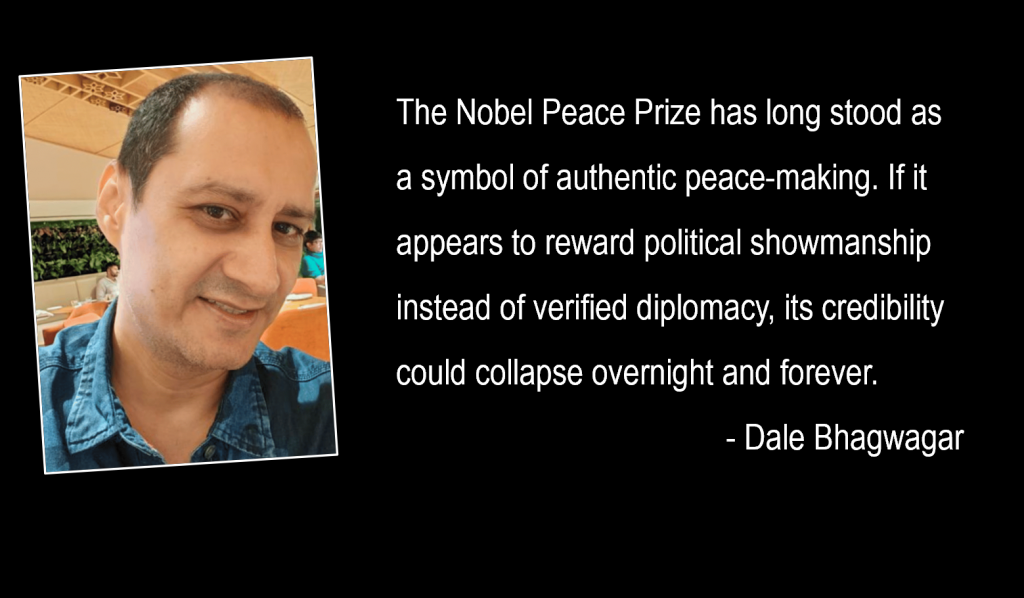
At the centre of this theatre lies the Nobel committee. The Nobel Peace Prize has long stood as a symbol of authentic peace-making. If it appears to reward political showmanship instead of verified diplomacy, its credibility could collapse overnight and forever. Once damaged, such moral authority is nearly impossible to restore.
Meanwhile, India’s consistent record on refusal of any external party mediation on Kashmir adds weight to its case. Even the 2025 ceasefire, came from direct military dialogue. And though Trump’s claims remain denied, he chooses to keep repeating them loudly and dramatically in a way that confuses audiences across borders.
The Nobel risk is real. Under these circumstances, awarding Donald Trump the Nobel Peace Prize, would not only diminish the Nobel’s value permanently but also be insulting to all the past Nobel laureates who earned it through authentic effort and sacrifice. The power of PR is immense, but when it is built on shaky facts, the outcome is a collapse of trust.
The views and opinions published here belong to the author and do not necessarily reflect the views and opinions of the publisher.

