

Amidst all our chatter and obsession with Artificial Intelligence (AI), some of us wonder whether it is a blessing from heaven or a curse. Will it cause a catastrophe? Where will we be in the future with AI? Will life on Earth become unrecognisable? Young and old alike, including me, are all excited or eager to embrace AI, as if we were awaiting ‘Godot’ and his grand arrival. However, have we examined the issue rationally? Or are we simply behaving like weary acquaintances, meeting in a desolate, leafless land, waiting for blessings?
But one thing is certain: from producing beautifully written copies to movie scripts, postdoctoral theses, and charming moving images; from self-driving cars and talking machines to climate pressures and staying beneath a dome on Mars, humanity stands at a pivotal moment. Here’s what researchers say our future might look like, and the choices we make today about AI and how we communicate it, could shape the future for generations to come.
The Next 20 Years: The Tech-Driven Tipping Point:
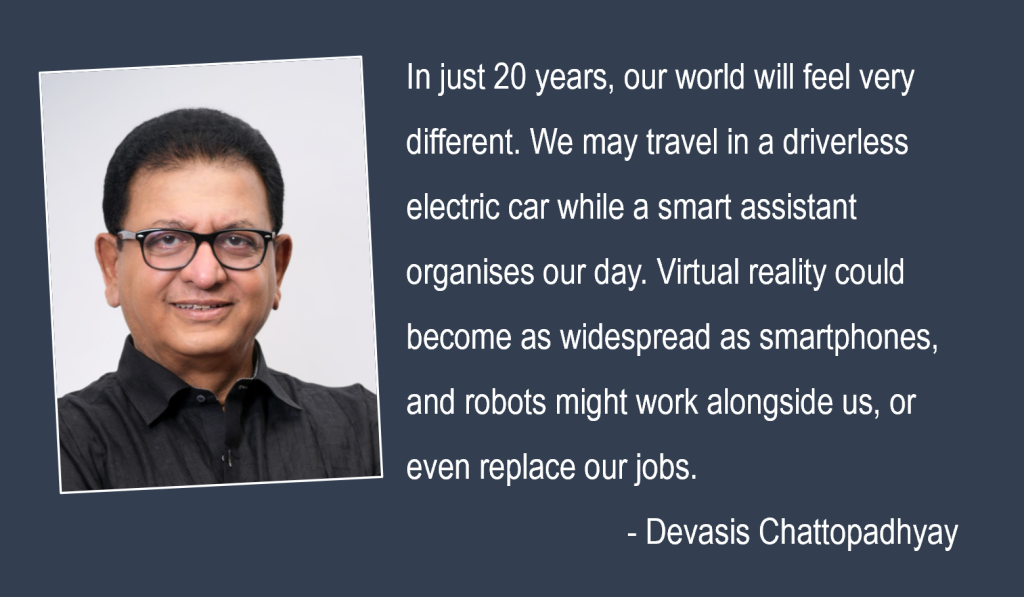
In just 20 years, our world will feel very different. We may travel in a driverless electric car while a smart assistant organises our day. Virtual reality could become as widespread as smartphones, and robots might work alongside us, or even replace our jobs. We know some of this. We also understand that, behind the scenes, not only chatbots but also powerful artificial intelligence (AI) will manage everything from customer service to surgery. Some experts believe up to half of today’s jobs could be automated by 2045.
But it’s not all smooth sailing. The urban-rural divide and climate change will significantly impact us, bringing more heatwaves, extreme weather, and food shortages. This could lead to increased political tension, conflict, and waves of migration as some regions become progressively harder to inhabit. We are already seeing such issues manifest in the Middle East and Africa.
On the bright side, clean energy sources like solar and wind will have ample opportunities to replace most fossil fuels by then. However, if our economies continue pursuing endless and reckless financial growth, we might push Earth’s resources to the breaking point. MIT’s ‘Limits to Growth’ model even warns of a potential societal collapse by the mid-21st century unless we shift towards a more balanced, people-centred value system.
Years Ahead: Reinventing the Way We Live:
Imagine cities filled with green buildings, rooftop gardens, and streets where electric buses glide silently through traffic. Homes operate entirely on renewable energy, and nearly everything we use, from clothing to gadgets, is part of a recycling loop, thanks to circular economies, reminiscent of a scene from a neo-Nordic Netflix series.
Researchers are developing futuristic materials and nanotechnology that could revolutionise everything from construction to medicine. AI will be deeply integrated into daily life, not only helping but also collaborating and competing with humans. In certain limited areas of the Middle East, these developmental experiments are already underway. Did we notice Sam Altman’s company’s deal with the United Arab Emirates? This is what some headlines said – ‘UAE makes ChatGPT Plus subscription free for all residents as part of a deal with OpenAI’. What makes this development especially significant is that every resident in the region will now have free access to ChatGPT Plus. This will enable millions of people to utilise OpenAI’s most advanced tools for tasks such as writing, studying, coding, and planning. Or Saudi Arabia’s ‘Neom’ project, a futuristic, high-tech pilot megaproject launched in 2017 as a cornerstone of the Kingdom’s Vision 2030 economic diversification plan. However, both of them sparked criticism and geopolitical tensions in the region.
However, as our technology advances, our social challenges remain. Scientists evaluate our civilisation using the Kardashev scale, which measures the amount of energy a civilisation can harness. Currently, we are at about 0.73 out of 1. In the next 40 years, we might reach 0.75, bringing us closer to utilising all the energy our planet can provide. Yes, with an 8.2 Billion population a mere 0.02 percent increase makes a very huge impact globally.
By the second half of this century, the boundary between humans and machines may become blurry. With advances in biotechnology, it could be possible to repair, enhance, or even significantly extend human lifespan. Some researchers even imagine future humans living beyond 120 years, with their brains supported by AI systems to create a new form of intelligence. We might also explore beyond Earth. NASA, China, and private companies like SpaceX are actively planning for this. By 2070, humans could live and work in space, under a ‘dome’ on Mars. However, we’ll need to tackle many of our challenges on Earth first, I suppose.
But, alongside all this excitement, serious risks remain. Scholars warn of possible disasters, such as: 1) a very high risk of AI going out of control; 2) our climate on Earth reaching irreversible tipping points; 3) repeated pandemics caused by engineered viruses; 4) large-scale wars or nuclear deployment.
A study of Oxford’s Global Catastrophic Risk Institute opined that, unlike past civilisations that collapsed quietly in one part of the world and grew in another, ours is a deeply interconnected one. A collapse today could be global, devastating and complete. Dr. Jan Brauner, Department of Computer Science of Oxford, said, ‘Currently, the AI world is focused on pushing AI capabilities further and further, with safety and ethics as an afterthought’.
What Needs to Change?
Social scientists and researchers agree world over that technology alone won’t save us. To survive and thrive, we need governments that think long-term, not just in election cycles. We need economies that put people and the planet before profit. Global cooperation, not rivalry, on shared challenges such as migration, food and health security and safe sources of energy.
The next decade is not just about gadgets or AI. It is about values, choices, and how we define progress. And, how we, the ‘Communicators’, communicate it. If we get it right, we might build a civilisation more sustainable, inclusive, and resilient than any before, even with the help of AI. Otherwise, do we think that ‘Godot’ will help? I doubt it.
The views and opinions published here belong to the author and do not necessarily reflect the views and opinions of the publisher.

