

A great idea in advertising has always started with a great brief—one that’s clear, inspiring, and full of insights. Account teams and planners have long distilled what they know about the client, the company’s strategy, and the consumer into short, sharp documents that fuel outstanding campaigns. A focused and tight brief often makes the difference between good work and truly great work.
The same rule applies to public relations, though the steps can look a little different. When PR firms receive a complete, well-thought-out brief, they can craft smart messages, choose the right channels, and secure meaningful coverage. But they need to move beyond and this and look and explore more at research and data which will help in crafting sharper messaging.
This is where PR consultancies should spend more time on research and data, which most consultancies are following today. Also, with the entry of AI and more belief in research, PR has moved way ahead to leverage research insights for good PR strategy and sharp messaging.
So, what makes a PR brief really work? Every client should include the following 10 key elements to get your brief accurately.
- Share More Details About the Product and Company
Go beyond the standard template. Tell the story of your business—how it began, what it stands for, and what sets it apart. Include your mission, values, and culture, as well as the unique benefits or innovations each product brings. Understanding how your brand compares to competitors can reveal fresh story angles for the media, which will then entice the journalist to come out with a unique story.
- State the Clear and Measurable PR Goals
PR succeeds only when the goals are clear. Distinguish between business objectives (e.g., reputation, credibility, thought leadership) and product objectives (e.g., awareness, adoption). Each goal should be measurable: for example, “Position our CEO as a fintech thought leader within six months” or “Secure national coverage for our new health-tech launch.”
- Identify Your Target Audiences
Be specific about who you want to reach. Are they customers, executives, policymakers, employees, or partners? Go beyond demographics—consider what motivates them, where they get their information, and what they care about. Don’t overlook smaller but influential groups such as analysts or niche online communities. Try and cover every spectrum of your target audiences with the right media.
- Explain the Current Situation
Before planning begins, consultancies need a clear picture of the current landscape. Be honest about current perceptions. What do the media, customers, and employees think and perceive? Is existing coverage positive, negative, or neutral? Are you seen as a leader or one of many? Surveys, media audits, and feedback from sales teams can provide valuable context. While you do media audits, it is more important to get feedback from both internal and external stakeholders so that there is more clarity when you work on the pitch note.
- What should be the desired change in perception?
Clarify what shift you want to achieve. For instance, a tech company might aim to move from being viewed as a “reliable provider” to being recognised as an “innovator shaping the future of AI.” This ambition shapes your narrative, tone, and media focus.
- Identify Priority Media Targets
Not all outlets carry equal weight. Know which platforms, regions, and publications matter most. If you’re building investor confidence, prioritise financial media; for product awareness, lifestyle or digital channels may be more effective. If influencer partnerships or social PR are part of the plan, include them too. You need to granularly decide your media, but keep in mind it is within your target group. The more focused your media, the better ROI one can expect.
- Provide Useful Research and Insights
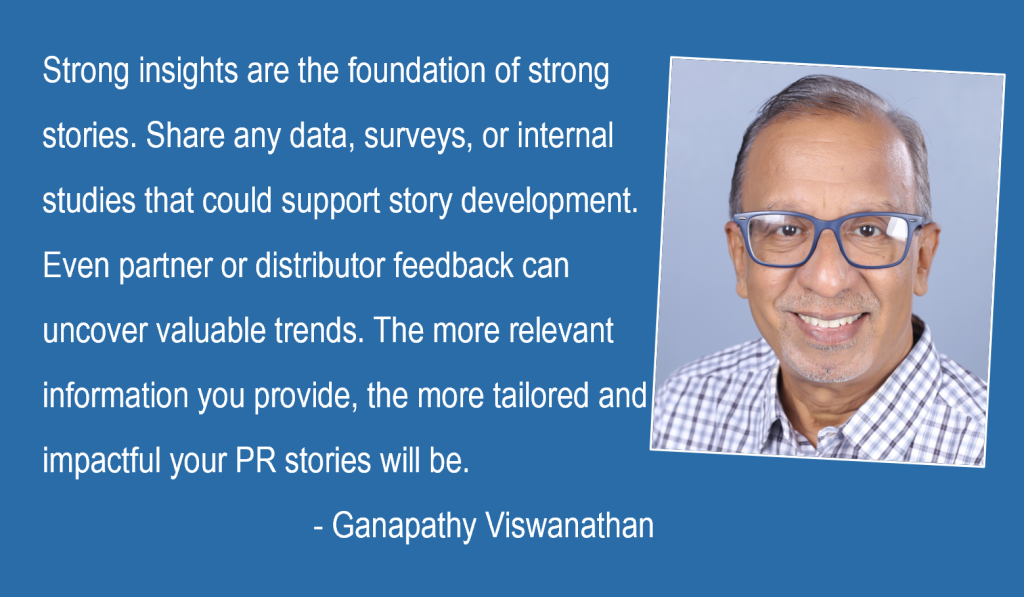
Strong insights are the foundation of strong stories. Share any data, surveys, or internal studies that could support story development. Even partner or distributor feedback can uncover valuable trends. The more relevant information you provide, the more tailored and impactful your PR stories will be. Don’t just rely on desk research. You must do specialised research through a professional research consultancy to get a deeper understanding of the company.
- Clarify Your Key Messages
Every campaign needs consistent core messages. List the themes you want to emphasise—trust, innovation, leadership, value—and back them up with facts, testimonials, or data. Consultancies will adapt these for different channels, but the central ideas should come from you. Once you get the central ideas in place, that will help your PR partner to go deep and work on the PR strategy.
- Define How Success Will Be Measured
Get your ROI clear from any campaign right at the beginning. Establish clear success metrics from the start—such as share of voice, sentiments, message recall, web traffic, or lead generation. Agreeing on these benchmarks early, ensures alignment on what success looks like. Hence, it is imperative the formula or the method you are going to adopt has an impact on the campaign.
- Set Clear Timelines, Resources, and Approvals
Clarity on process keeps everyone aligned. Outline major milestones, launch dates, and review periods so the consultancy can plan effectively. Identify who approves materials, what budgets and resources are available, and expected turnaround times for feedback. This prevents delays, reduces last-minute stress, and ensures a smooth campaign rollout. Finally setting expectations ad agreeing to that will help in seamless functioning.
The Bottom Line
A strong and focused PR brief isn’t just paperwork—it’s the foundation for success. When clients provide clear information, measurable goals, and consistent messaging, consultancies can deliver campaigns that build reputation, shape perception, and drive business growth. Great campaigns are created when both the client and consultancy work as teams and share all information and fill in all the gaps so that the brief becomes a good roadmap for the PR campaign. The more time you invest in your brief, the better your results will be. In short, clarity at the start leads to impact at the finish.
The views and opinions published here belong to the author and do not necessarily reflect the views and opinions of the publisher.

