
Two books – one rooted in history, the other forged in crisis – revealed how courage, ethics, and hope define entrepreneurs and intrapreneurs alike
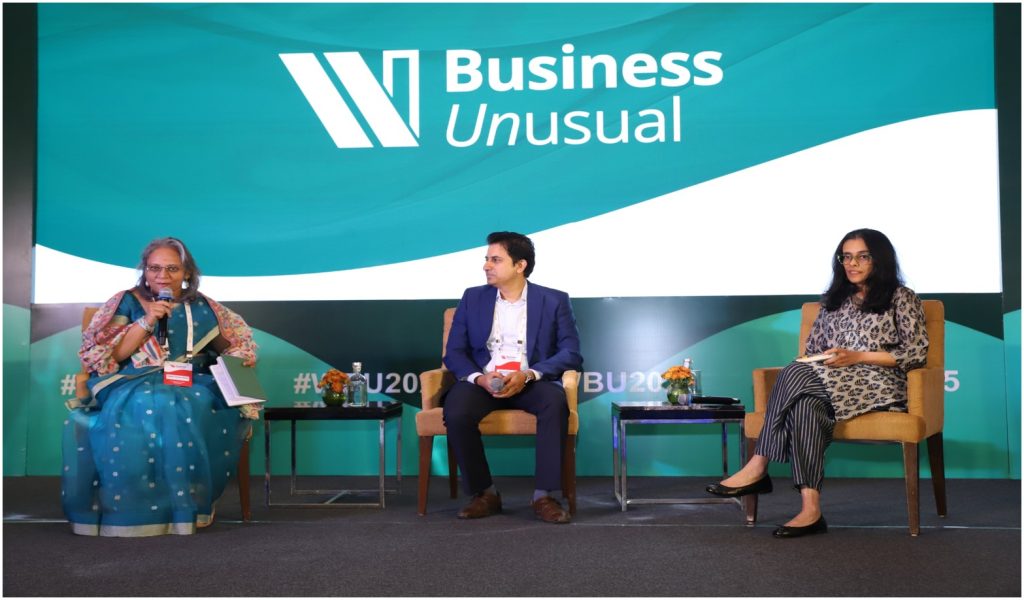
Session 6 of Business Unusual 2025 was a powerful reminder that Bombay, now Mumbai, has always been a city of risk-takers. Titled “Entrepreneurs and Intrapreneurs: Bombay Stories,” the session brought together Tejaswi Apte-Rahm, great-granddaughter of pioneering entrepreneur Vaman Shridhar Apte, and Mayuresh Kore, CFO & Head–Legal of Imagicaaworld Entertainment Ltd – in conversation with Nupur Pawan Bang. What emerged was a compelling contrast between two journeys separated by a century, yet united by resilience, values, and the courage to act in moments of uncertainty.
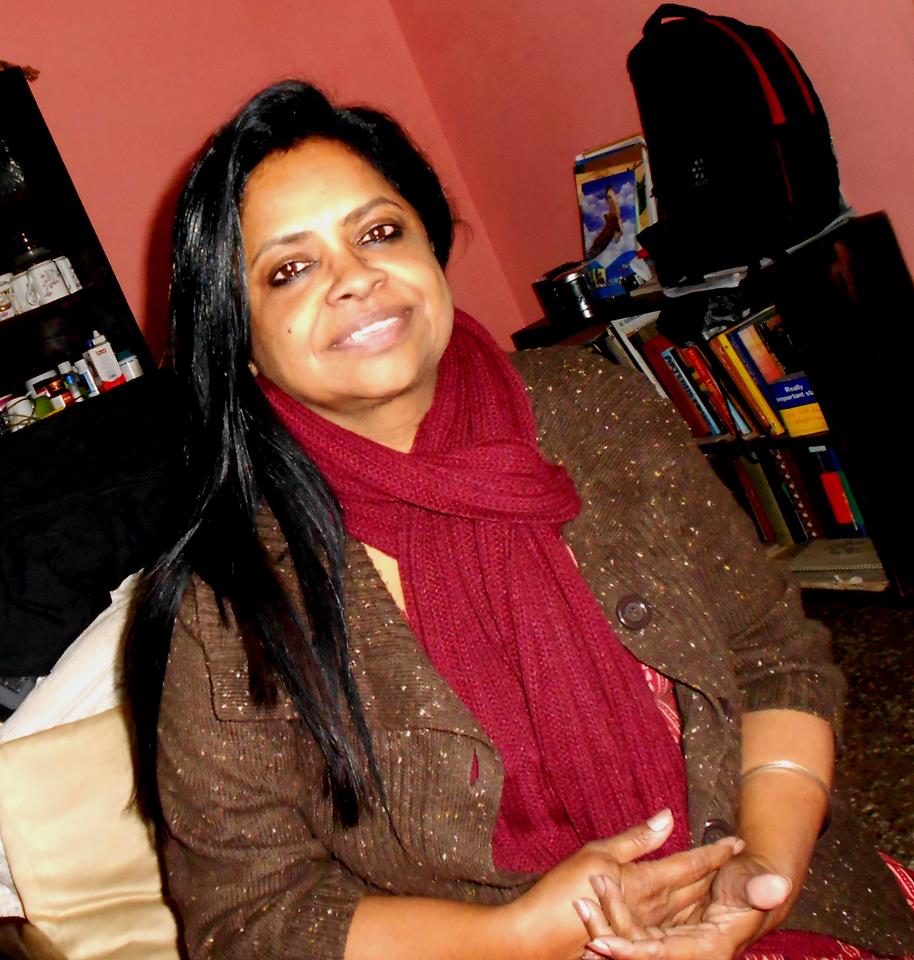
Tejaswi Apte-Rahm spoke about her new book Tatyasaheb: The Story of a Bombay Entrepreneur, a tribute to her illustrious great-grandfather, born in 1875, whose life mirrored the economic and cultural evolution of the city itself. Tatyasaheb rode the booms of three transformative industries – textiles, cinema & sugar – at a time when Bombay was fast becoming India’s commercial capital.
As the sole selling agent of Kohinoor Mills, Tatya built his fortune in textiles, an industry that once formed the backbone of the city. By the early 20th century, Bombay’s mills accounted for nearly 50 per cent of India’s spinning and weaving capacity, making textiles not just a business, but the engine of urban wealth. Tejaswi noted how larger political movements – from the First World War to the Swadeshi Movement – directly shaped entrepreneurial fortunes, turning her research into an origin story of the city itself.
One of the most fascinating episodes in the book is Tatya’s accidental entry into cinema. During a meeting with textile associates, he received a letter recommending financial support for a filmmaker named Dadasaheb Phalke. The endorsement came from Lokmanya Tilak, whose word carried immense moral authority. Despite knowing nothing about films, Tatya and his peers agreed to back Phalke, founding the Hindustan Film Company. Over the next 16 years, Tatya produced nearly 100 silent feature films, around 40 directed by Phalke – quietly shaping the foundations of Indian cinema.
Tejaswi was clear that her intent was not glorification. “I wanted to understand his life with all its ups and downs,” she said, approaching the project as a historian rather than a descendant. If there was pressure, she admitted, it was to match his work ethic and stay true to the purpose. What stood out about Tatya, she explained, was his appetite for risk, his foresight – particularly in sugar production post the 1932 tariff – and his unwavering ethics. Even during the World Wars, when black-marketing cloth was rampant, Tatya refused to participate. Reputation, she emphasized, was his true capital.
If Tejaswi’s story was about entrepreneurship in a formative India, Mayuresh Kore’s narrative was about intrapreneurship under fire. Co-author of Rollercoaster of Hope, Mayuresh recounted Imagicaa’s dramatic turnaround after India’s largest theme park project defaulted in 2018, drowning under debt and facing near bankruptcy. “Overnight, we were labelled defaulters,” he recalled.
What followed felt like a thriller – banks, legal battles, NPA tags, failed auctions & eventually COVID. Yet, as Mayuresh put it simply, “Hope was all we had – and being hopeful was a conscious choice.” Abandoning ship may have been the easiest option, he admitted, but a sense of moral obligation – to the organization, its people, and its vision – kept the leadership team going.
Communication, he stressed, became critical in crisis. Priorities had to be clear, messages broken down, and trust rebuilt daily—often through repeated rounds at banks. When COVID struck, and Imagicaa was written off by many, the team floated new schemes and raised ₹7 crore, “just enough oxygen to keep the ship afloat.”
The turning point came in June 2022, when the Malpani Group (MPG) acquired a majority stake in Imagicaaworld Entertainment Ltd, reviving the dream of a world-class, Disney-style theme park in India. Today, after surviving the brink of shutdown, Imagicaa stands rebuilt as a ₹4,000 crore company – a testament to perseverance and team culture.
As the session concluded, one truth resonated clearly: whether in the cotton mills of the 1890s or the rollercoasters of modern India, Bombay rewards those who take risks with integrity. From Tatya’s honesty to Imagicaa’s never-give-up spirit, Session 6 captured the timeless DNA of a city that refuses to quit.
__________________________________________________________________________________________________________________
The views and opinions published here belong to the author and do not necessarily reflect the views and opinions of the publisher.