
At Business Unusual 2025, Ashok S Ganguly and R Gopalakrishnan reflected on leadership, legacy & why the future is shaped long before we realise it!
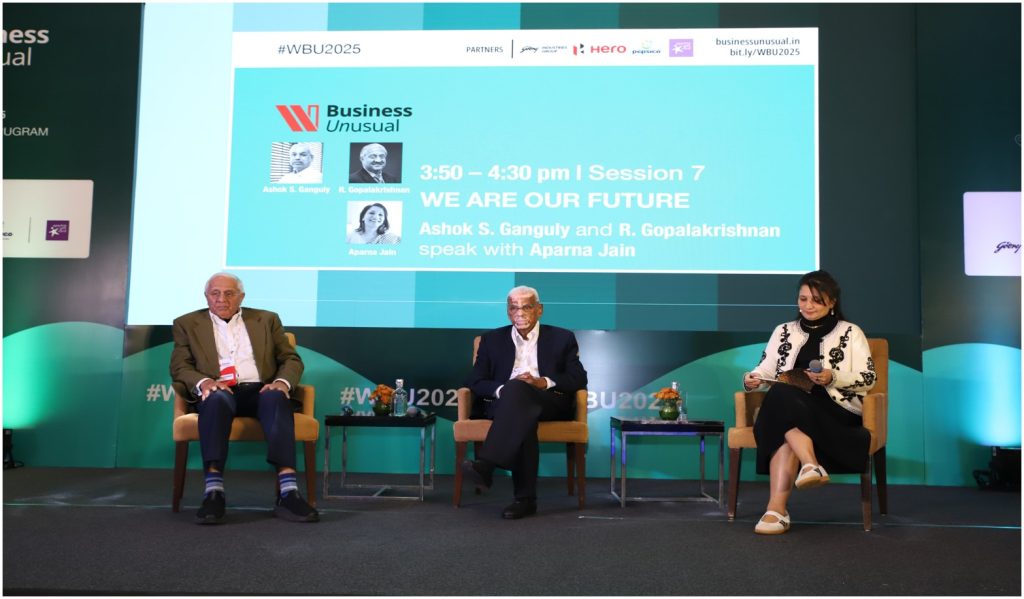
Session 7 of Business Unusual 2025 carried a quiet gravitas. Titled “We Are the Future: Reflections from the Boardroom,” the conversation brought together two stalwarts of Indian industry – Dr Ashok S. Ganguly, former Chairman of Hindustan Lever & former nominated member of the Rajya Sabha, and R. Gopalakrishnan, former Executive Director of Tata Sons and ex–Vice Chairman of Hindustan Lever – in conversation with Aparna Jain. What unfolded was not a forecast of trends or technology, but something far more enduring: a meditation on how lives, leaders, and futures are shaped.
The session opened with a deceptively simple question: How do we imagine the future? Dr Ganguly’s answer was philosophical and personal. Recounting his journey from being an average student to securing the second rank in his university, he challenged the notion of overnight transformation. The shift, he said, came not from a sudden burst of effort but from inherited genes and unconscious learning, especially during the first decade of life. “Nothing changes in retrospect, except you grow older,” he reflected, adding that when one looks back, life often feels “foretold.”
This idea forms the backbone of his memoir Afterness, a sweeping account of his 80-year life. The book weaves together personal milestones, encounters with public figures, and key moments in India’s twentieth-century history. For Dr Ganguly, success is not something we chase blindly; it happens when we align ourselves with love, curiosity, and discovery.
Leadership, the panel agreed, is rarely what popular culture imagines it to be. R. Gopalakrishnan cut through romantic notions with a sharp observation: “Great bosses are not warm, cuddly people.” They are demanding, exacting, and unafraid of tough conversations – yet grounded in strong human relationships. That balance, he asserted, is the true mark of a great leader.
Dr Ganguly illustrated this with a story from his time working with Prakash Tandon, one of India’s pioneering professional managers and the first Indian Chairman of Hindustan Unilever. Tandon, he recalled, was a deep philosophical thinker whose leadership ethos was so understated that he chose not to include the Chairman’s photograph in the Annual Report. The message was clear: institutions matter more than individuals. “We are all products of leaders who inspired us to believe that we too can lead,” Dr Ganguly said.
The conversation repeatedly returned to the idea of learning – not as a phase, but as a lifelong pursuit. Every business, Gopalakrishnan noted, has its own gant or knot. It is neither easy nor difficult; it simply demands that you learn its unique technique. The attractiveness of a career lies not in comfort, but in the continuous effort to untangle that knot.
Sharing personal anecdotes, Gopalakrishnan revealed that while abroad, Dr Ganguly was once offered foreign citizenship. Yet he chose to return to India – to be with his wife, who had been an active partner in his journey and had anchored the home front. Opportunity, they agreed, is fleeting. “You either grab it, or it passes you by.”
Reflecting on his own career, Gopalakrishnan recalled that in the 1960s, few people studied computer science – yet he did. Recruited by Hindustan Lever, he made an unconventional move into sales. “Opportunities fall like gentle drops of rain,” he said. “You can respond – or not. But once you do, you walk down that path.”
Dr Ganguly shared a striking incident from Kolkata, where a union leader demanded that guns be left outside and no bodyguards accompany management. The moment the leader left, his authority evaporated – a lesson in the fragile nature of power. Having advised governments and institutions like the RBI, Dr Ganguly observed pointedly, “You don’t have access to a cash box to keep politicians happy.” For him, the hunger for knowledge was as strong – if not stronger – than the hunger for money.
Any advice for young people? This came not as instruction, but reassurance. Dr Ganguly said, “The sky is the limit. Each of us has a sparkle – everyone is a success, shaped by the genes they are born with.” Gopalakrishnan echoed the sentiment with pragmatism: take pride in what you do. If you can contribute to society, make money honestly, and give back – do it diligently.
At the end, the audience was left with a profound insight: the future is not something waiting ahead. It is something already embedded within us – shaped by values, choices, and the quiet lessons of a life well lived.
___________________________________________________________________________________________________________
The views and opinions published here belong to the author and do not necessarily reflect the views and opinions of the publisher.