

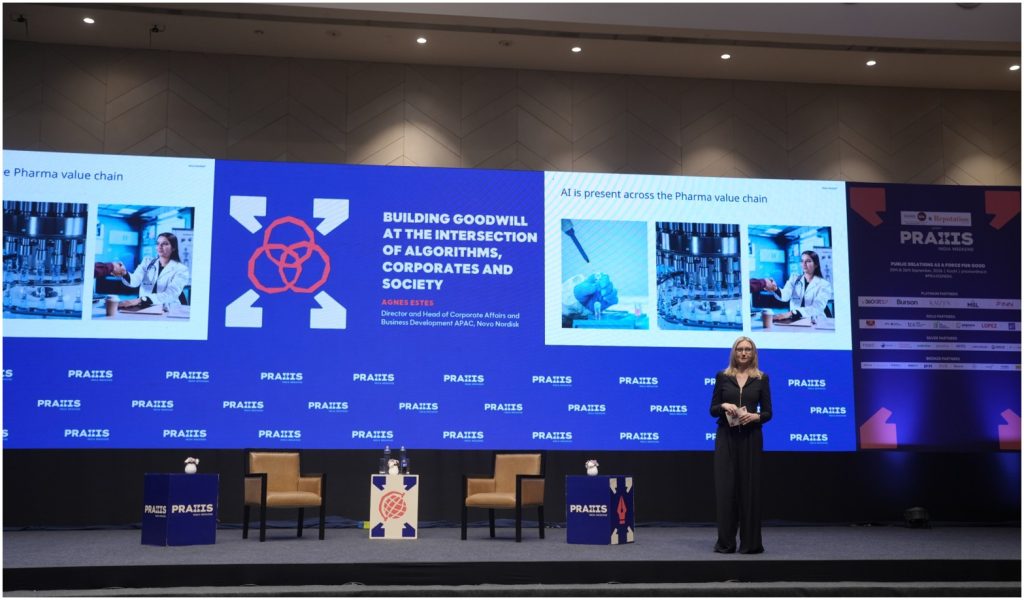
PRAXIS2026 Keynote 11
Agnes Estes, Director & Head of Corporate Affairs & Business Development (APAC) Novo Nordisk
Building Goodwill at the Intersection of Algorithms, Corporates and Society
The pharma business runs on science, but it survives on trust. And here’s a reality check – few sectors are watched as closely by regulators, doctors, patients and media, and few face as many limits on what they can say and how. Medicines are developed over years, marketed under strict rules, and judged eventually by the confidence people place in them. That makes PR in the pharma space different. It involves – explaining complex science clearly, educating patients responsibly, countering misinformation and protecting a company’s licence to operate.
That job is changing fast. Patients now begin their health journeys with a search bar or an AI assistant (rather than a doctor’s clinic). And, the answers they see can shape what they ask, fear and choose. For pharma communicators, the question is no longer only what the media says about the company – but, it’s actually what the algorithm says.
So, trust is the treatment, and we learnt why Pharma PR must win in the Age of AI Search.
It was this intersection that Agnes Estes, Director & Head of Corporate Affairs & Business Development (APAC), Novo Nordisk, took on at #PRAXIS2026 with her session, “PR as a force for good – Building Goodwill at the Intersection of Algorithms, Corporates and Society.” She urged PR professionals at #PRAXIS2026 to see communications as a force for good – one that earns trust where algorithms, corporates and society meet.
A diverse market, a shared challenge
Working for Novo Nordisk which is a healthcare company engaged in research, development, manufacture and marketing of pharmaceutical products worldwide, Estes (who leads APAC), described the region as wildly diverse when it comes to technology understanding and adoption, adding that cultural challenges shift just as much from country to country.
AI across the pharma value chain
AI is now present across the pharma value chain, she disclosed. On the commercial side, medical and field representatives are spending less time on routine tasks, and AI has helped them make better use of the limited time doctors can offer. “AI is really changing the pharma value chain,” she said.
The symptom checker: goodwill in practice
Explaining a symptom checker built with doctors, we noted that the user chooses who the check is for, selects any symptoms, answers dynamic questions and finally sees results. A call to action (CTA) follows, adjusted to the user’s needs – such as custom educational reminders, GP appointment prompts or a link to appointment booking. It is, she pointed out, about building goodwill.
Winning the AI search game
For Novo Nordisk, outreach focuses on high-authority sources. Its AI Search Framework recognizes that partner websites, government websites (for example nih.gov), third-party websites and earned media together make up as much as 90% of the sources cited in AI search responses. This leads to a strong strategy and insights – and underlines why earned media and credible partnerships matter more than ever.
The numbers behind the shift
Estes backed her argument with a series of statistics.
The connected world. In the list of the world’s largest connected populations (countries with the most internet users), India ranked second after China. Then USA was third, followed by Indonesia and Brazil in the long list.
Digital and everyday healthcare choices. Among internet users aged 16+, the share who say online resources are important when choosing treatment for everyday ailments was highest in Indonesia (92.6%), followed by Thailand (89.3%), the Philippines (87.9 %), Taiwan (87.9%), Malaysia (87.7%), Vietnam (87.2%), Hong Kong (85.8%), China and India at 85.5%. followed by other countries.
Estes called this the emerging dilemma of AI-informed healthcare choices, and showed how deep the rabbit hole goes. Further data, all from April 2026, added to the picture:
- Search engine referrals: Google led at 90.01%, followed by Bing (4.98%), Yahoo (1.39%), Yandex (1.34%) and DuckDuckGo (0.76%).
- Checking symptoms online weekly (internet users 16+): Nigeria topped at 54.3%, followed by Chile (37.2%) and Colombia (36.8%). India featured well down the list at 22.2%.
A separate study looked at why people use AI tools. Among AI users aged 16+, the primary reasons in the past month. It was seen that the main reason was finding information – 58.8%; getting advice on problems – 37.8%; learning or improving skills – 37.0%; creating or enhancing images or video – 33.5%; saving time or increasing efficiency – 33.1%; creating or enhancing written content – 30.4%; getting personalized recommendations – 29.6%.
A surprise popped up – for interestingly ‘seeking entertainment’ was 26.5% and managing health and wellbeing – 23.5%.
Why we go online – and how to interpret what we find
Why do we go online? She quoted her guide. AI Ethics, Principles. Drawing on her guide, she asked why people go online in the first place, and how they should interpret the results. It reflects an evolving fear about how people find and understand information. Her framework of AI ethics principles, in this order, covers: empowering humans, accountability, human control, fairness and minimization of bias, privacy, security and safety, and transparency, explainability and ethical use.
For PR leaders in healthcare, the message was clear: as algorithms increasingly mediate what patients read and believe, goodwill will be built by those who show up with credible, accessible and ethical information – in the places where people are actually looking.
So taking a practical route, it was a journey from Symptom Checkers to Search Results, which set the pace for building goodwill in AI-Led healthcare.
In a Dialogue with Shilpashree Muniswamappa, Director, ESG & Communications, Colgate-Palmolive India the question came up – with public trust, constantly fluctuating, what is the one tangible thing for communications to build genuine good will? The story depends on decision mode and good will, she explained. In my career, when you had to do something different, you had to connect with legal colleagues. The decision is with us and we know how communication can build a brand.
How can organizations partner with society to nurture tech-solutions? Technology can only work if it is successful for everybody. Availability of technology can help, which can be traced and then one can figure out how technology can be used.
How does the challenge of creating goodwill differ in Asia-Pacific vis-à-vis Europe? In Asia-Pacific media is more accessible and has a relation-based culture; It’s less common in Europe, was her take.
Today, women in villages are trying to learn tech skills. Technology can be amazing, she declared.
Finally she gave some tips – keep relationships strong. If you want to inform or correct a story, you need journalists. Build a group of intellectuals – to be ‘original’ and it’s most important to learn how to optimize a Press release!
______________________________________________________________________________________________________________________________
The views and opinions published here belong to the author and do not necessarily reflect the views and opinions of the publisher.