

PRAXIS 2026
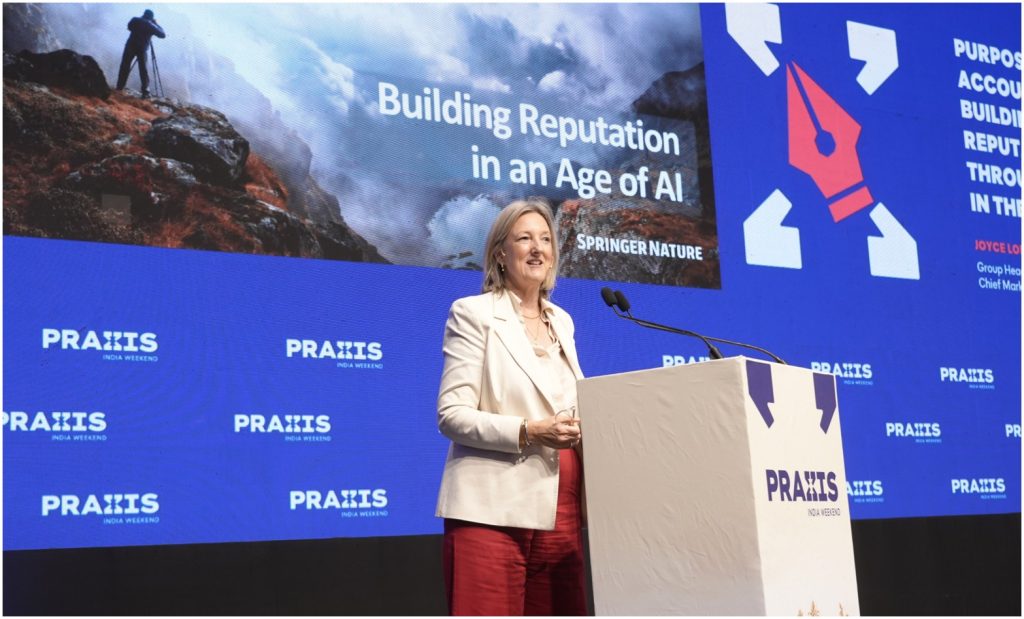
Keynote address 1: Joyce Lorigan, Group Head – Corporate Affairs & Chief Marketing Officer, Springer Nature
Every communicator is a professional. But the more important question today is: where do we add value? At a time when AI is making content faster, easier and more abundant, building trust is becoming increasingly difficult. So, perhaps the question every communicator needs to ask is: “What will I do differently to succeed?”
That was the starting point for Joyce Lorigan, Group Head – Corporate Affairs & Chief Marketing Officer, Springer Nature, as she opened the conference with her session, “Purpose with Accountability: Building Reputation through Impact in the Age of AI”. Her message was both realistic and reassuring: AI may be transforming communication, but it is also giving communicators an opportunity to rethink what truly makes a difference.
At the heart of her presentation was one simple word: trust.
As content becomes more abundant, trust becomes more scarce – and what is scarce becomes more valuable. Trust, she emphasized, is not generated, automated or prompted. It is earned.
That makes authenticity, empathy, human connection and cultural relevance more important than ever. AI can satisfy our need for information, but human storytelling satisfies our need for meaning, especially when that story comes from people and communities we recognize and relate to.
In the Age of AI, Trust Is the Real Currency
She also made a strong case for AI accountability. AI may have become one of the most powerful business tools in history, but technical fluency alone is no longer enough for leadership. AI once represented innovation and the future of efficiency. Today, she suggested, the real requirement is accountability – because every automated decision can carry financial, reputational and moral consequences.
So where does communication fit into this rapidly changing landscape?
“Our job is to translate into what the audience recognizes as critical,” she said, adding that “the audience can become our superpower”.
Her point came alive through the fascinating example of Disneyland Resort Paris, which was described by French film director Ariane Mnouchkine as a “Cultural Chernobyl”. The decisions behind the project may have made perfect sense from the creator’s perspective, but they failed to sufficiently consider the audience and its cultural context.
The lesson was clear: keep the customer central.
“When people don’t recognize themselves in your story, they rarely believe it,” she observed. The issue was not communication. It was ‘culture’.
And that is where she drew an important distinction between AI and human judgement. “AI could have done it, but I am not convinced that it could see the real issue,” she said. Recognizing the deeper cultural disconnect required empathy – something technology could not simply replicate.
As communication becomes more critical, the human connection cannot disappear from the equation. People tend to trust people they know rather than distant institutions. AI can provide information; humans provide meaning.
For communicators, therefore, the challenge is not merely to produce more content. AI has already made content cheaper and faster. The real opportunity is to make communication more authentic, relevant and human.
Organizations that understand this distinction, and consistently earn trust rather than simply attempt to manufacture it – will be better placed to build reputation in an AI-shaped world.
The takeaway from her session was perhaps best summed up this way: technology can accelerate communication, but only people can make it meaningful.
In a conversation with Rachna Panda, VP & Cluster Communications Head, ASEAN, ANZ & South Asia, Bayer the point came up – what is the dumbest thing AI has done for you? Pat came her answer – the dumbest thing was that the numbers were wrong!
You have various roles today, and in the new age of AI, do you think communication is becoming a bit closer to marketing? The answer was quick and clear – “I think there are things marketing can learn from communications!”
During the talk, she stepped up exploring how purpose, impact and accountability can shape reputation in a rapidly changing world.
__________________________________________________________________________________________________________________________
The views and opinions published here belong to the author and do not necessarily reflect the views and opinions of the publisher.