

Despite considerable strides towards gender equality, many societies continue to associate a young woman’s marital status with her sense of responsibility, maturity, and capability. This association persists even when she is financially independent, excelling in her career, and bearing significant family responsibilities with dedication and strength.
One of the primary reasons for this deep-rooted mindset is the traditional gender schema that has shaped social expectations for centuries. In many cultures, especially collectivist ones like India, a woman’s worth has historically been evaluated based on her roles as a wife and mother. These roles were deemed indicators of her maturity, stability, and fulfilment of womanhood. Therefore, even today, regardless of educational achievements or financial independence, many people continue to see marriage and motherhood as a “completion milestone” for women.
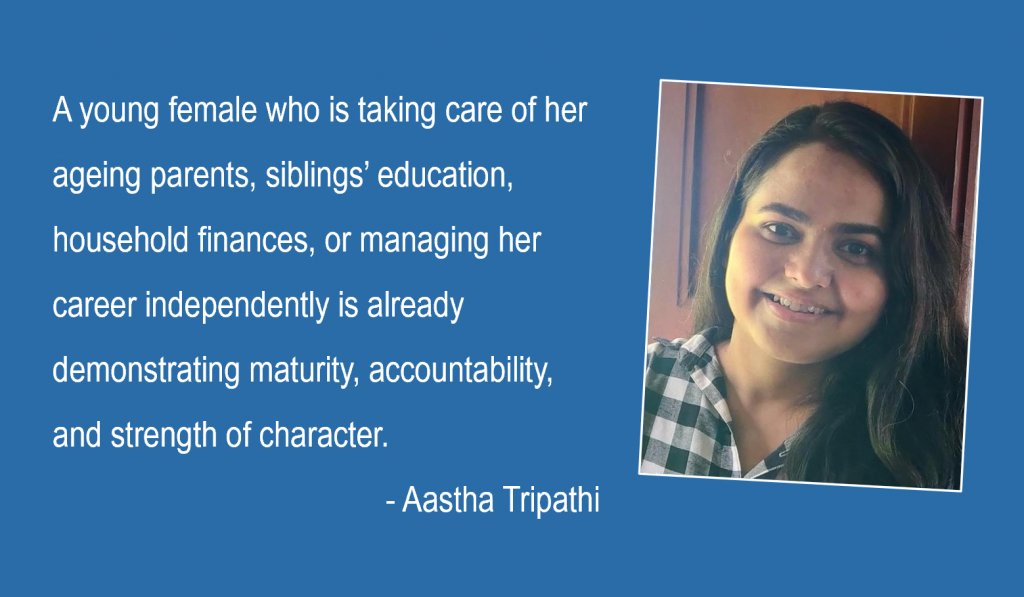
There is a collective unconscious belief that only after managing her own marital household can a woman truly “understand” responsibilities, patience, and sacrifices. This is fundamentally flawed. Responsibility is neither conferred by marriage nor motherhood; it is an individual attribute honed through life experiences, challenges, and personal growth. A young female who is taking care of her ageing parents, siblings’ education, household finances, or managing her career independently is already demonstrating maturity, accountability, and strength of character. However, such realities are often overlooked, as the social gaze remains fixated on prescribed gender roles.
Another dimension to this issue is the intersection of patriarchy and age-based hierarchy. At workplaces, young females are often sidelined under the pretext of “lack of life experience” compared to older colleagues. Yet, this perceived lack is rarely evaluated objectively based on their lived experiences, competencies, or leadership readiness. Instead, assumptions are made that she will only become fully responsible or stable after marriage. Ironically, if she does get married, another bias emerges – assumptions about impending maternity leave or her “reduced commitment” to work due to family obligations. Thus, women remain caught in a no-win situation of contradictory stereotypes.
Further, the belief that marriage is a marker of responsibility reflects society’s discomfort with women exercising agency over their life choices. When a young woman remains unmarried by choice while taking care of her family, investing in her career, and living on her own terms, she disrupts the traditional narrative. For many, this challenges existing power hierarchies and gender norms that dictate what a woman “should be.” Labelling her as “irresponsible” or “immature” becomes a subtle way to delegitimise her autonomy and reinforce conformity.
Psychologically, people also tend to equate shared responsibility (e.g. within marriage) with stability. A married woman is assumed to have “settled down” and hence capable of making mature decisions. In reality, maturity is not a function of marital status; it is reflected in one’s emotional intelligence, accountability, and ability to navigate life’s complexities with resilience and compassion.
At workplaces, young women are frequently denied decision-making opportunities simply due to their age or unmarried status. Older colleagues may believe they “know better” by virtue of years lived, not recognising the dynamism, new perspectives, and problem-solving capabilities that young professionals bring. Ageism intersects with gender bias here, creating compounded marginalisation.
Despite societal advancement, such taboos persist because change in mindset often lags behind visible economic and educational progress. Laws may change, policies may improve, but attitudinal shifts require conscious, sustained efforts across generations. Families, educational institutions, and workplaces need to initiate deeper conversations on why marital status is irrelevant to judging competence, responsibility, or maturity.
Leaders in organisations must introspect whether they are creating truly inclusive environments where young female employees are assessed based on merit, skill, and potential rather than age, marital status, or motherhood assumptions. HR systems must train managers to identify unconscious biases and cultivate an environment that nurtures every individual’s unique journey and contributions.
On a societal level, families must move beyond equating their daughters’ worth with marital status. Parents, relatives, and neighbours need to recognise and appreciate their daughters’ financial independence, emotional maturity, and life choices as valid markers of responsible adulthood. Marriage, if and when it happens, should be celebrated as a personal choice, not a social milestone to measure her worth.
Ultimately, dismantling this taboo requires each of us to question ingrained beliefs. The day we stop defining a woman’s maturity by her marital status and instead value her lived experiences, choices, and contributions, we will take a genuine step towards creating an equitable and progressive society – one that truly practices what it preaches about gender equality.
The views and opinions published here belong to the author and do not necessarily reflect the views and opinions of the publisher.