

Remember the public feud between Ola CEO Bhavish Aggarwal and comedian Kunal Kamra on social media platform X in 2024? What began as a jab about Ola Electric’s customer service spiraled into a weeks-long social media battle, with Aggarwal challenging Kamra to visit service centers and critics questioning the CEO’s approach to the issue. Within days, Ola’s stock dropped 8–9%, wiping out millions in market value. This incident underscores a cautionary tale for leaders: how their online behavior can build or damage brand image.
SEBI has laid down stringent rules for companies on public disclosures. The IPO process involves a mandatory quiet period as part of the Issue of Capital and Disclosure Requirements (ICDR) Regulations. During this time (typically from filing the DRHP until listing), companies are mandated to restrict public announcements to ensure fair access to information for investors and prevent market manipulation. Social media is a powerful platform that provides real-time information, with algorithms constantly pushing specific narratives to the masses. If unregulated, it can significantly impact investor sentiment by creating artificial hype or negative perceptions, potentially influencing stock performance and leading to market volatility. Social platforms can also spread misinformation and rumors, triggering controversy. Hence, a robust social media strategy is critical to prevent reputational crises during the high-stakes IPO phase.
Social Media Checklist for Leaders During IPO
- Social Media Screening
Social media audits should ideally commence 6–12 months before the anticipated DRHP filing. The communications team should establish a framework for social media postings, with strict content reviews by legal and compliance teams to avoid legal or PR complications.
- Avoid personal posts, family images, and online debates during the IPO phase.
- Focus on thought leadership: share company-approved press statements and promote the company’s culture, key milestones, and legacy.
- Implement robust security protocols, including two-factor authentication, password management systems, and restricted access controls.
- Deploy social media archiving tools like Smarsh to manage digital conversations for compliance, legal, and record-keeping purposes.
- Install social listening tools to monitor real-time alerts, sentiment analysis, and fake news.
- Activism and Socio-Political Views
Leaders increasingly use their platforms to advocate for social causes, which can trigger conversations around sensitive issues. While activism can help build trust among stakeholders, if misinterpreted, it can lead to a crisis that harms brand image. Hence, it is advisable to limit personal opinions during the IPO phase.
- Pause commenting on socio-political issues that may trigger polarized reactions.
- Avoid strong opinions, criticism, and feuds with online trolls.
- Maintain a neutral stance and stick to corporate messaging.
- If engagement is necessary, use prepared statements reviewed by legal/PR teams.
- Forward-Looking Statements
SEBI has strict guidelines on what companies can communicate during an IPO to prevent influencing investors. The communications team should maintain a pre-approved message bank for FAQs.
- Avoid disclosing material non-public information (MNPI), such as future expansion plans, mergers and acquisitions, large deals, or new product/service launches that could impact stock prices.
- Stick to approved messaging from corporate communications and legal/compliance teams.
- Financial Communication
Leaders should treat financial discussions with extreme caution. Even seemingly innocuous comments can violate disclosure requirements on social platforms.
- Designate one spokesperson for all financial queries (typically CFO or IRO).
- Avoid discussing valuations, investor interest, pricing expectations, comparable companies, or market timing.
- Keeping financial data handy can be useful for countering misinformation on social platforms.
- Social Media Guidelines for Employees
Employees are authentic brand ambassadors, and many companies leverage employee advocacy to build credibility and trust. However, their posts can create unintentional compliance issues during an IPO. A standard social media handbook can provide general guidelines for employees.
- Conduct mandatory sessions for all employees on social media dos and don’ts.
- Create an approval process for employees wanting to share company news.
- Encourage disclaimers such as “Views are personal” on employees’ social posts.
- Develop pre-approved posts employees can share (about culture, milestones, company values).
- Use social listening tools to track employee posts mentioning the company.
- Establish a rapid response process for problematic posts.
- Rapid Crisis Response
Sometimes, despite putting the best social media frameworks and monitoring tools in place, controversy can erupt and blow out of proportion. Hence, having a response protocol is critical to mitigate reputational risks and regulatory actions.
- Assess severity and potential regulatory implications.
- Decide comms strategy: Ignore, Respond, Debunk, or Remove the content.
- Prepare a response vetted by legal and compliance teams.
- Document the incident with screenshots.
- Determine if SEBI notification is required.
- Draft a holding statement if media inquiries begin.
- Brief all spokespeople on approved messaging.
Post-IPO Transition
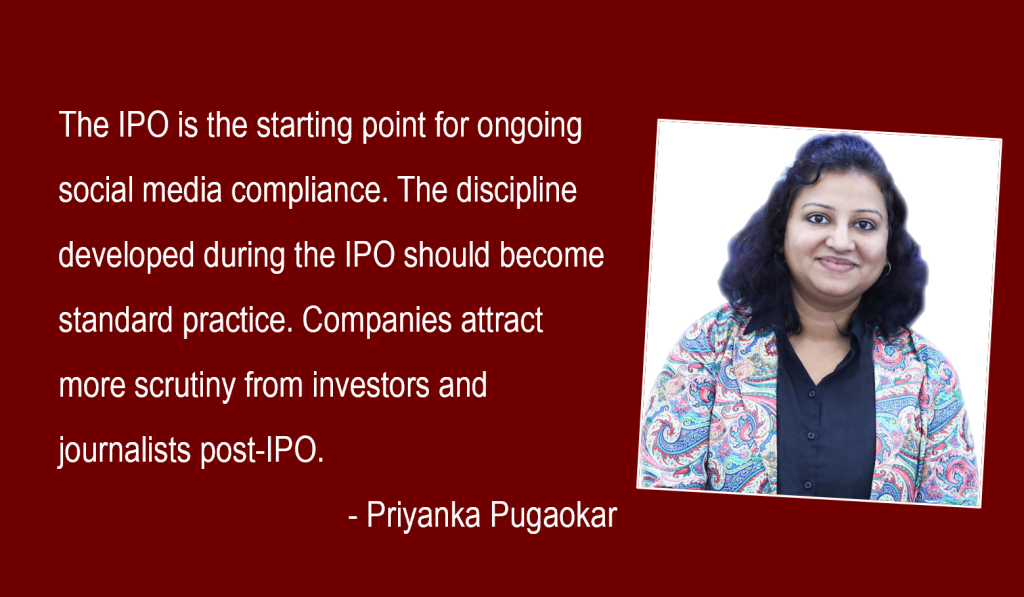
The IPO is the starting point for ongoing social media compliance. The discipline developed during the IPO should become standard practice. Companies attract more scrutiny from investors and journalists post-IPO. Hence, periodically review the social media strategy, train leaders on compliance and disclosures regularly, and deploy the best technologies and tools to safeguard against fake news. In an era where a single tweet can move markets, a robust social media strategy is worth every preventive measure.
__________________________________________________________________________________________________
The views and opinions published here belong to the author and do not necessarily reflect the views and opinions of the publisher.